Showing posts with label city charter. Show all posts

Saturday, July 23, 2022

Queens and the City

 https://bloximages.chicago2.vip.townnews.com/qchron.com/content/tncms/assets/v3/editorial/d/0d/d0d0c63e-090c-11ed-b5bd-eb466e17d36c/62d975fc860a2.image.jpg

 Queens Chronicle

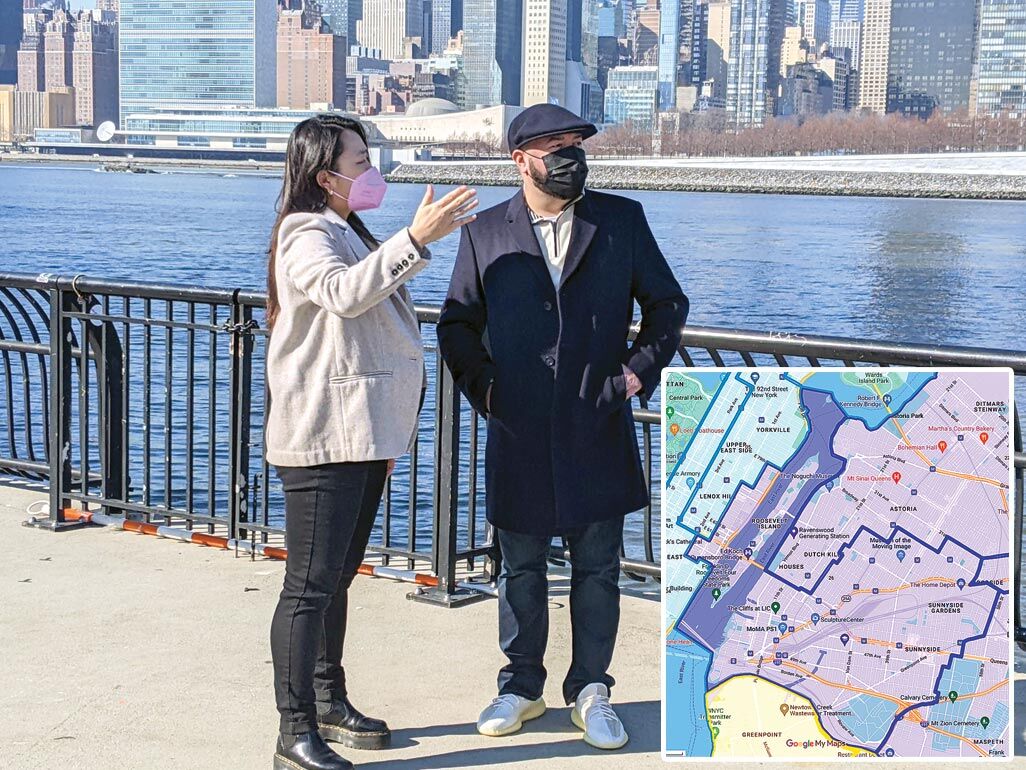
The New York City Districting Commission voted last Friday to make public its preliminary proposal for the city’s reapportioned City Council districts, which poses potential changes for parts of Astoria, South Ozone Park, South Richmond Hill and more.

The proposal comes after weeks of public hearings throughout the city, and accounts for a 7.7 population percent increase citywide and a 7.8 percent increase in Queens since 2010.

Perhaps the most significant change in the borough isn’t even in the borough at all: Should the finished maps resemble the preliminary ones, District 26, which is represented by Councilmember Julie Won (D-Sunnyside) and includes Long Island City, Sunnyside and parts of Woodside, would shift westward to include Roosevelt Island and parts of the Upper East Side of Manhattan.

Won was particularly concerned about the map’s implications for Woodside.

“Looking at the preliminary Council maps, it is painfully clear that no one on the NYC Districting Commission has read the City Charter. The commission chose to separate our communities of color in Long Island City, while also disenfranchising our immigrant communities by splitting Woodside into four council districts,” Won said in a statement.

“While it would be an honor to represent New Yorkers wherever they live, I cannot stay silent while the Districting Commission erases the progress made by immigrants and people of color in my own neighborhood.”

She added that the commission “must be held accountable for violating every single requirement mandated by the City Charter,” and that she would fight it on the proposal.

The councilmember’s office did not comment on her district’s potential inclusion of the Upper East Side, nor did it elaborate on which measures of the City Charter she believes the commission violated. When asked about both, Won’s office said it could not comment further, citing a staff vacancy.

Chapter 2-A, Section 52 of the City Charter says, “District lines shall keep intact neighborhoods and communities with established ties of common interest and association, whether historical, racial, economic, ethnic, religious or other.”


Thursday, February 11, 2021

Team CoJo scrambling to pass his bad development plan

You may recall the post here where Paul Graziano analyzed NYC Council Speaker Corey Johnson's "Planning Together" legislation to change the NYC Charter to favor developers and remove community input. This past Monday, Graziano went head to head with Annie Levers, Assistant Deputy Director, New York City Council Office of Strategic Initiatives, at Community Board 8's Land Use Committee. You can watch the debate yourself. It's worth the time invested so you can clearly see what is going on:

The legislation was then voted on and unanimously rejected. Last night, the full board met and it was again unanimously rejected.

Earlier in the day, a rather long-winded and inappropriate email was sent out to Council Members to refute the information presented, which will no doubt result in a deluge of Community Board rejections. (Click to enlarge each segment)


The final insult came when Council Members - but not Community Boards - received word of an official public hearing on the legislation that was hastily scheduled for February 23rd.


So folks, you better get off your keysters and sign the petition in the sidebar and provide testimony at this "public" hearing (that they don't want you to know about), and make it clear to your City Council representatives that they are to vote no on this bill.

Tuesday, July 24, 2018

Charter changes up for discussion

This is to let you know that the city's Charter Review Commission is having a series of meetings in the boroughs next week, Queens' turn is Thursday evening, July 26 at Queens Borough Hall. The Charter is basically New York City's "constitution" that lays out the broad parameters for administration and operation of the city. Please see the attached flyer for additional information. - Jessica Douglas, Queens Borough Director of the Mayor's Community Affairs office

Community Boards:
1) Whether to place term limits for Community Board members as a method to encourage diversity.
2) How to Standardize and enhance the existing appointment process
3) Provide additional support in resources; particularly as it relates to urban planning
4) Things to adopt methods to ensure Community Boards are representative of the community they serve.

Campaign Finance:
1) The Reduction of spending limits (no amounts provided).
2) Increasing the public match ( no ratio provided).
3) Look into the timeline for implementation given that candidates are raising money under the current system.

Elections
1) Language accessibility ( providing interpreters, translation of ballots and materials, and community advisory groups)
2) Instant Runoff Voting - Look to implement within local primary elections and for citywide elections (where runoffs is provided) or to extend to all offices (Borough Presidents and City Council offices)

A Citywide Civic Engagement Program
1) how such an entity or office could support, supplement, or coordinate the City’s existing efforts in this area, including the recently announced DemocracyNYC initiative.
2) how such an entity or office could facilitate the expansion of participatory budgeting while working within legal and operational constraints
3) where such an entity or office should be situated;.
4) whether such an entity or office should be independent and non-partisan.

Redistricting for City Council Seats
1) In light of the lack of DOJ oversight, solicit testimony from experts and affected communities about the effects of districting process on racial and ethnic minorities and their voting power.
2) Look at altering the Districting Commission to promote independence, including the appointment process.
3) Studying whether there are ways to counteract effects of an undercount in the next census.

Friday, December 15, 2017

December CB7 meeting scheduled

From the Queens Chronicle:

A post from last Tuesday on the blog Queens Crap pointed to how even though December is not listed as an exception to the charter rule, Community Board 7 did not have its regular meeting with a public hearing during that month last year or the one before.

Although the agenda for November’s CB 7 full board meeting said the next one would be in January, the advisory council has set up a meeting for Dec. 18.

Board Chairman Gene Kelty told the Chronicle that though the board did not have a full meeting last December or the one before, the members weren’t ignoring any major issues in the district.

“If we didn’t have a meeting then it meant that we really didn’t have anything on our agenda,” he told the Chronicle.

“All I know is we’re in compliance this year and we’ll be in compliance in the future,” the chairman added.


Now you can put the RKO on your agenda.

Tuesday, December 5, 2017

CB7 takes lengthy holiday vacation

It’s December, and all Queens community boards will hold regular meetings/hearings – all of them, that is, except for Community Board 7. CB7 is skipping the required December meeting & hearing, for at least the third consecutive year.

CB7’s November 2017 meeting agenda states: “The next Community Board Regular Meeting & Public Hearing is scheduled for Monday, Jan. 8, 2018.”

New York City Charter § 2800(h) specifies the regular meetings that all community boards are required to hold:
“Except during the months of July and August, each community board shall meet at least once each month within the community district and conduct at least one public hearing each month. Notwithstanding the foregoing, a community board shall be required to meet for purposes of reviewing the scope or design of a capital project located within such community board's district when such scope or design is presented to the community board. Such review shall be completed within thirty days after receipt of such scope or design. Each board shall give adequate public notice of its meetings and hearings and shall make such meetings and hearings available for broadcasting and cablecasting. At each public meeting, the board shall set aside time to hear from the public. The borough president shall provide each board with a meeting place if requested by the board.”
A monthly meeting/hearing is required each month “except during the months of July and August” – and this requirement holds, even if a particular community board has no rezoning or other application to evaluate during December, because among the purposes of meeting are to “set aside time to hear from the public.”

Online information posted by Queens community boards, and telephone calls to boards that haven’t posted online information, confirm that every Queens community board – other than CB7 – will hold meetings/hearings during December 2017, fulfilling their legal obligations under the City Charter:

CB1: December 20
CB2: December 7
CB3: December 21
CB4: December 19
CB5: December 13
CB6: December 13
CB7: NO DECEMBER MEETING
CB8: December 13
CB9: December 12
CB10: December 7
CB11: December 4
CB12: December 13
CB13: December 11
CB14: December 12

And this has apparently gone on for multiple years, not just this year. Online collections of CB7 meeting agendas and minutes contain none for December 2015 or December 2016, indicating that CB7 held no December meetings/hearings during those years, in addition to 2017. Each community board receives a budget of City taxpayer funds, and in exchange for those funds, each must perform certain services – including meeting during December with time set aside to hear from the public. The City Charter specifies a minimum of 10 regular meetings/hearings annually. By failing to meet each December, CB7 is holding only 9 out of the 10 required meetings/hearings – 90 percent of what the City Charter requires. The City Comptroller should be concerned about a lone community board that accepts its entire share of City taxpayer funds (and even requests more), but purposefully skips December meetings and thus routinely delivers only 90 percent of what the City Charter requires.

How has this been allowed and who authorized it?

Melinda?

Saturday, February 25, 2017

A new approach to big development?

From Crains:

Neighborhood groups would get an earlier jump on city development plans under a proposal being advanced by Councilman Antonio Reynoso, who organized a Friday convening of about 100 planners, housing group leaders, community board members and others.

The Bushwick councilman and Manhattan Borough President Gale Brewer want to build in a community engagement process before the city's formal land-use review process to give the public a stronger hand in determining the details of local real estate projects. Such a change would require a modification of the City Charter, Reynoso said.

This would give neighborhoods a chance to account for new infrastructure needs, according to the borough president.

"The old model, wherein there's no pre-discussion, ends with community stakeholders just chipping away at the impacts of a project or worse, accepting concessions that have little to do with the project's impact. That's why we need to be smart and start early," she said.

Meeting attendees decried what they consider superficial community engagement processes and the city's project-by-project approach to development.

Wednesday, April 6, 2016

What the city charter says about building inspections

§ 649. Inspection. The commissioner, any deputy commissioner, borough superintendents, inspectors, or any officer of the department authorized in writing by the commissioner or a borough superintendent to act in his borough may, in accordance with law, for the purpose of performing their respective official duties, enter and inspect any building, structure, enclosure, premises or any part thereof or anything therein or attached thereto; and any refusal to permit such entry or inspection shall be a misdemeanor triable in criminal court and punishable upon conviction by not more than thirty days imprisonment or by a fine of not more than one hundred dollars, or both.

Full charter

So why does the DOB knock twice and then list a complaint "RESOLVED" if there's no answer and no affidavit or they are refused entry?

Sunday, April 27, 2014

DeBlasio not all that different than Bloomberg...

From the NY Times:

At issue was the Council’s role in approving development projects that require changes in the city’s zoning ordinances — changes that would have to occur frequently if Mr. de Blasio is to reach his ambitious affordable housing goal. The mayor has repeatedly said he is willing to allow developers to build taller, denser buildings in exchange for setting aside units for low- and moderate-income renters.

Under the city’s charter-mandated land use process, known as the Uniform Land Use Review Process, a developer whose project would exceed the size permitted under existing zoning regulations must first get the proposal certified by the city’s Planning Department.

From there, projects go before the local community board, the borough president, the Planning Commission and finally the City Council — with a public hearing at every step. Approvals are required only from the Planning Commission and the Council.

When the mayor’s office negotiates with developers for public benefits — parks, plazas or low-priced apartments — it typically does so where the administration has the most leverage: before certification, or before the Planning Commission’s vote.

As it stands, members of the Council get to negotiate with developers for even more where they hold power: before the Council votes. For a single project, individual council members can hold great sway; traditionally, the full Council defers to the member or members who represent the affected neighborhoods before even bringing it to a vote. Developers say the Council’s ability to take a second bite of the apple leads them to hold back in talks with City Hall, so that they still have something to give when they come before the Council.

In recent days, according to a Council official aware of the talks, aides to Mr. de Blasio proposed that council members raise their concerns at the beginning of the process — before certification — rather than at the end. The administration would then negotiate on the Council’s behalf and reach what the mayor’s aides suggested could be a better deal for the city as a result.

But at a meeting of the Council’s leadership on Thursday morning, a member briefed on it said that David Greenfield, a councilman from Brooklyn and the chairman of the Land Use Committee, had argued forcefully that Mr. de Blasio was trying to undermine the land use process in a way that would erode the Council’s charter-granted powers. The council member said Mr. Greenfield had warned that he expected the mayor to bring up the idea in a meeting later that day and that he would vigorously oppose it.

Friday, November 29, 2013

Leading Speaker contender already has ethics problems

From the Daily News:

A leading candidate for City Council speaker may have violated city ethics rules by accepting unpaid assistance from a prominent lobbying firm working to further her candidacy.

And the lobbying firm, the Advance Group, may have violated the rules by providing the free advice to the councilwoman, Melissa Mark-Viverito (D-East Harlem).

The Advance Group, run by Scott Levenson, helped Mark-Viverito prep for debate forums, set up meetings with county Democratic leaders and network with the Council members whose votes she needs.

The Daily News first reported last week that the assistance was being provided at no cost.

As a public servant, Mark-Viverito is prohibited by the City Charter from accepting a “valuable gift” from a firm that intends to do business with the city.

And lobbyists, in turn, are prohibited from giving those gifts.


The NY Times also points out the Advance Group's excessive spending in the election for mayor:

Bill de Blasio and his Democratic supporters had warned for months this summer that Republican boogeymen — particularly David Koch — would take advantage of a Supreme Court decision and loosen mighty rivers of money and turn our mayoral election inside out. “Don’t let the Koch brothers buy the election,” he said.

David Koch retreated in November to his Park Avenue co-op after spending a relative pittance. But New York City saw a spasm of unregulated campaign money, most of it unleashed by wealthy Democrats and unions. And no one channeled those rivulets of cash more aggressively than Scott Levenson and the Advance Group, the strategic consulting firm he heads.

The United Federation of Teachers dropped millions of dollars and Mr. Levenson took at least a $370,000 cut. A group putatively devoted to carriage horses but focused intently on defeating the speaker of the City Council, Christine C. Quinn, spent a golden lode, and again Mr. Levenson took a cut.

Now the Campaign Finance Board is investigating the Advance Group’s role. Outside groups can spend themselves silly, but they cannot coordinate with individual candidates.

Sunday, April 21, 2013

Claire states why she was needed

Op-Ed from the Queens Courier:

The Power of the Position
BY CLAIRE SHULMAN

Why the borough president, I am asked.

The 1989 Charter has the council voting on both land use and budgets, so what do you do to warrant the existence of the office?

I will tell you.

I can best describe it by telling you what we did before and after the 1989 Charter revision.

My staff and I were determined to make a difference in Queens.

Before 1989 we had to negotiate for money; after 1989 the borough president got five percent of the enhancements in the expense budget and five percent of the capital budget. Queens got 33 percent of the five percent capital money, which enabled us not only to build, but to influence the construction of the following institutions:

Queens Museum of Art
New York Hall of Science
Queens Hospital Center
Flushing Town Hall
Family Court
Civil Court
Queens Theatre
Queens Zoo
Roy Wilkins Park and Recreation Center
Creedmoor Educational Company
Flushing Library
P.S.1
Townsend Harris High School
SE552, $100 million sewer project to relieve flooding in SE Queens
American Museum of the Moving Image
Flushing Meadows swimming pool and ice skating rink
BP and the mayor’s office get Fort Totten from the feds

These are just a few things we accomplished which makes the borough president’s office one of the best bargains in New York City.

We helped to enliven the cultural life of Queens, thereby creating a harmony in a very diverse population. We were involved in so much, none of which was mentioned or prohibited in the Charter.

For example we spent five years saving non-eviction conversion co-ops, thousands of units that helped cooperators, renters and neighborhoods survive.

There are many people currently running for this office because they want to continue the effort.

This is a big city and one cannot know everything, so local government, the planning boards, the council and the BP’s office are our good government.

Together we help deliver services through the Borough Cabinet where it is needed and deal with land use issues and budgets through the Borough Board.

If borough presidents didn’t exist it is my opinion that Manhattan would walk away with all the resources that currently cover major projects in Queens.

I will continue to advocate for the office of borough president and the relative autonomy of our great borough.

Don’t fool yourself — if you are elected by a county of two million people, that’s power and everyone listens!

Thursday, April 18, 2013

Borough presidents: Who needs 'em?

Letter to the editor (Times Ledger):

The old city Board of Estimate included the five borough presidents and, as a result, they possessed to some degree legislative power. The board was declared unconstitutional because the numerical populations in each borough were not the same.

A borough president in a borough with less population than another should not have the same legislative power. The Board of Estimate was disbanded and the legislative authority now rests with the City Council, where it belongs. The mayor, as chief executive, has some power, but the Council runs the show.

Since borough presidents no longer had any legislative authority, there was no basis to retain the office. Politics being what it is, the public foolishly retained the office, not realizing it had no such power. The office was given some limited land use authority subject to being overruled by the Council, which has the last say. The office was given some discretionary authority to disburse some funds in terms of the city’s budget.

The funds are disbursed by the borough president. In the final analysis, the office of borough president, which costs taxpayers tens of millions of dollars annually, has been nothing more than a useless patronage mill.

I take issue with former Borough President Claire Shulman’s claim that without the office, most of the important resources would go to Manhattan. Each borough has Council members who outnumber those in Manhattan, so there is no way they could be disenfranchised by Manhattan members. Shulman’s claim is political nonsense.

Equally nonsensical is the claim she made that the office is a powerful voice for the county. I doubt she can point out a dozen important changes she accomplished in all her years in office that significantly changed the lives of Queens residents for the better. Her reference to a sewer system in southeast Queens ignores the fact that she sat by and watched Willets Point property owners being charged sewer rent despite the fact that there were no sewers and she made no effort to have sewers installed and infrastructure repaired.

Her boasting about Flushing Meadows Corona Park, except for a possible playground, falls flat. She did not oppose a grand prix race track in the park or more than 40 acres of parkland given to the United States Tennis Association and its current application to expand. She never objected when her successor, Helen Marshall, urged the construction of a New York Jets football stadium in the park.

Her claim that she saw cultural institutions rise in the park demonstrates a lack of understanding about what urban parks are about. Parks are for passive use, not huge cement, brick and steel structures. In all the years from Donald Manes through Shulman and Marshall, except for structures that do not belong there to begin with, there has been no significant help for Flushing Meadows, and a walk around the park demonstrates its abysmal condition.

We have a Council. We do not need a borough president. Its budget could be spent more wisely.

Benjamin M. Haber
Flushing

Tuesday, January 3, 2012

Liu appointed dynasty tweeder to pension post

Photo from Facebook

From the NY Post:

Comptroller John Liu has promoted a politically connected Democratic Party official from Queens as one of his top pension bosses — a move that government watchdogs say could be a violation of city rules.

John Dorsa, a state committee representative to New York’s Democratic Party and a co-founder of the Democratic club on Liu’s home turf in Flushing, has been quietly appointed to associate director of pensions in the Comptroller’s Office.

Liu also tapped Dorsa to serve as one of his representatives, or designated trustees, to the city’s largest pension board, the New York City Employees Retirement System.

The powerful board sets pension policy.

Dorsa’s dual roles as a pension boss and a Democratic Party official raise questions about whether he and Liu are complying with the City Charter, which bars city policy-makers from simultaneously holding party leadership positions.

“No elected official, deputy mayor, deputy to a city-wide or boroughwide elected official, head of an agency, or other public servant who is charged with substantial policy discretion...may be a member of the national or state committee of a political party,” Section 15 of the charter states.

Government-watchdog groups said the promotion looks fishy and at the very least violates the spirit of the City Charter.

Shortly after becoming comptroller, Liu visited the Dorsa-founded William J. Clinton Democratic club. He and other members greeted the comptroller, a former local councilman and club member, like a hero, according to press accounts.


Wait, isn't the William J. Clinton Democratic Club the one that meets at Vallone & Vallone? So John Liu = John Dorsa + Paul Vallone + Chuck Apelian. This "John Liu is a saint" testimonial nonsense by brother Peter suddenly makes a whole lot of sense:

Outspoken supporters like City Councilman Peter Vallone Jr. (D-Astoria) are going to stick by Liu to ride out the political mayhem.

“John Liu is a standup guy,” said Vallone, who also serves as the Chairman of the Public Safety Committee, and mentioned John Liu as a man of principal. “I remember when Liu said he wouldn’t run again when term limits were overturned, and he didn’t,” said the Councilman who recalled his election in the same year Liu was elected as Comptroller...“I’m sure he’s going to get through this.”


Liu didn't run for his council seat again because he ran for comptroller with the ultimate goal of running for mayor. It's easy to be in favor of keeping term limits at two when you have no intention of running for the same office a third time. Alas, this is what passes for integrity these days.

Thursday, March 3, 2011

Crap in the yard requires variance

From Bayside Patch:

A plan to build a two-bedroom house on a “side yard” in Bayside Hills could be shaping up as a battle royal between Mayor Bloomberg and the City Council – and there hasn’t been an official meeting about it yet.

The budding brouhaha centers around 50-20 216th Street, at the corner of 51st Ave. A house sits on the wide end of what is basically a triangular lot and the owner has split the property into two tax lots, with the idea of building another house on the land.

But there’s a catch. The planned construction falls short of zoning requirements, so a “variance” is needed from the Board of Standards and Appeals (BSA), with an advisory vote from CB11.

Bonfilio [the owner] said that he feels that BSA will issue the variance anyway, based on “case law.”

So does City Councilmember Dan Halloran, and he has a problem with it. After meeting with residents who were at the meeting, he explained.

The problem as Halloran sees it is that the Mayor appoints the BSA and because of a loophole created by an earlier Charter revision, its decisions can only be challenged in court.

To close the loophole would require either another Charter Revision, or a state law, Halloran said. “The Mayor can knock out the former and exercise considerable influence on the latter,” he conceded.

Monday, November 1, 2010

How should you vote on the charter issues?

Someone asked that we talk about the Charter Revision ballot measures.

Queens Civic Congress advises you to vote yes on question 1 and no on question 2.

But others disagree.

Here's some info on the ballot measure that deals with transparency in campaign finance reporting.

And here's another about the ballot measure meant to bring about environmental justice.

These are on the reverse side of the form, so make sure you fill out both sides before you feed it into the machine. Here are all the questions.

Wednesday, October 6, 2010

A word of advice on ballot questions

From City Pragmatist:

The charter commission says that a “yes” on Question 1 will “set a limit of two consecutive terms” for Mayor, City Council member, Public Advocate, Borough President and Comptroller.” But read the fine print:

The two term limit would take full effect only after all of today’s incumbents can complete three full 4-year terms — 2021 for current Council freshmen.

Question 2 is even less straightforward. It asks you to vote “YES or NO on seven other reforms to the Charter concerning how government elections are conducted and how some parts of city government are organized.”

Sounds good, right? “Reform” means “to put or change into an improved form or condition.” But some of these “reforms” — which we can’t choose among — would increase the power of the mayor, at the expense of the City Council and the public.

So when you enter your polling place on November 2, don’t be fooled. The two charter questions on the flip side of the ballot were placed there by a commission whose members all were appointed by Mike Bloomberg. If you are confident that whoever succeeds Bloomberg as mayor deserves even more power than he has today, vote “yes” on Question 2.

But if you believe as we do, that the mayor already holds too much power, vote “no.”

As for Question 1, Term Limits, we can’t advise you. A lot can happen between now and 2021.

Tuesday, September 7, 2010

Charter commission goes out with a whimper

From The Real Deal:

Six months after being formed, the city Charter Revision Commission issued its final report yesterday, declining to make any recommendations on the three thorniest land use issues before it.

The 15-member panel appointed by Mayor Michael Bloomberg heard from deeply divided interest groups such as the Real Estate Board of New York and Pratt Center for Community Development, but said certain issues were too complex to tackle in the brief period allotted to them.

The commission acknowledged the deep divide on those issues, such as a proposal from community advocates and elected officials to increase the influence of community boards and borough board presidents within the ULURP process. The commission declined to make any changes.

"The commission has considered both the criticisms and the responses to [increasing the role of community boards and borough presidents] and recommends for the future both further empirical study and analysis of how such changes would affect development in the city," the report says.

The panel declined to suggest changes to the city Department of City Planning uniform land use review procedure, known as ULURP. In addition, it decided not to propose regulating controversial community benefits agreements or to revise a locally-driven land-use mechanism called 197-a.

However, the panel in its 219-page report did suggest requiring disclosure of third-party campaign spending from independent groups such as real estate interests, and publishing on city maps the locations of private as well as public waste-treatment facilities, the panel's report issued yesterday says.

The commission, appointed by Mayor Michael Bloomberg in March, was directed to review the city's charter and after holding a series of hearings, to make recommendations on how to revise it. Its major recommendations yesterday were a term-limit proposal, the disclosure of independent campaign expenditures and reducing signature requirements for candidates' petitions.

The report contained no surprises, coming weeks after a draft was released, but the findings do memorialize the arguments of the competing interests for any future attempts to change the charter, which is the city's constitution.

Wednesday, August 25, 2010

Good question!


From NBC:

The Commission has labored long and brought forth a mouse. If the voters say they don’t want the change, then three terms presumably will be enshrined for the future. If they vote for this wishy-washy version of term limits, it won’t happen until years from now. Damned if they do, damned if they don’t.

It’s a compromise, they say, but at whose expense? They want to be fair, the commission members say, to the incumbents. But what about being fair to the people of New York? Somehow, that has escaped them.


From NY Civic:

The bottom line here is that some people wanted to take care of some other people they know. And they were able to convince enough naive colleagues so that they could do it.

The remedy here is relatively simple: another referendum, with an effective date written into it so no Commission can substitute its wishes for the voters' decision by fiddling with implementation and postponing a simple reform for over a decade.

The unanswered question is Rule 17-C. Who will bell the cat? Who will step forward and take the initiative to see that the will of the people is implemented, whatever it may be. Now is the time to begin consideration of that question. It has been attributed to Edmund Burke in 1795. No one, however, really knows who said it first: "The only thing necessary for the triumph of evil is for good [people] to do nothing."

To those of you who think, what difference does this make, two terms or three, you have a point. The issue, however, is not two or three terms. The issue is fairness; first the Mayor and Council circumventing the Charter in 2008 for their own benefit, and now the Commission trying to circumvent the referendum of 2010, whether they know it or not.

Americans, and New Yorkers are Americans, like to play fair, and don't like to be disregarded or manipulated. That is what underlies this controversy. It is the same nagging issue that sharply reduced the majority the competent mayor should have received after two successful terms. Our recommendation: respect the will of the people.


From Room Eight:

The need for a referendum to change the charter, or at least portions of the charter for which the politicians have a conflict of interest, is one thing I thought any decent group of people would propose. But they haven't, and there is no explanation as to why, although the report does mention that having he Council overturn a referendum without another one is something many objected to. Not only could the City Council eliminate term limits, but it could also eliminate initiative and referendum. This stunning omission has gone without comment. BTW, to change the NY state constitution requires the assent of two consecutive state legislative terms AND a referendum. If the City Council can just change the charter, why does it exist, since it is no more difficult to change than any ordinance?

Sunday, August 1, 2010

Bloomberg seeking ways to make development easier

From the NY Observer:

The real estate development world, which is full of complaints about government, rarely throws around the term "efficient" when speaking of the Department of City Planning. One of the biggest complaints is that most every developer embarking on a big project must go through what can be a months-long "pre-certification" process (though it can even be measured in years sometimes) of putting together an application with DCP, adding costs and uncertainty.

Now, the Bloomberg administration is looking for a consultant to streamline bureaucracy at DCP, part of a broader effort to cut down the cost and time that it takes to get things built in New York.

Earlier this month, the city's Economic Development Corporation put out a request for proposals, seeking a consultant to recommend ways to become better, stronger, faster, etc., especially on the subject of pre-certification. From the RFP:

"[T]he Consultant shall recommend a series of initiatives and optimal strategies for DCP that will improve its management of key business processes, in particular the land use review process and environmental review process and reduce costs (both real and perceived) for applicants."

This speaks to the Bloomberg administration's desire to cut the red tape under its own power, and not, notably, by changing the City Charter. On that subject, which is currently up for review by the Charter Revision Commission, the Bloomberg administration has shown no desire to engage in major changes to the land use process.

Sunday, July 18, 2010

Two-timers may not become three-timers

From Gotham Gazette:

When City Council members Sara Gonzalez, Darlene Mealy and Jimmy Vacca voted to extend term limits nearly two years ago, they may not have expected to miss out on the opportunity to serve 12 years at City Hall.

But as the city Charter Revision Commission mulls what type of term limit proposal to put on the ballot this November, members who joined the council after 2002 could end up stripped of their shot at three full terms.

The commission has not decided what type of term limit proposal it will send to voters this fall, let alone whether it will apply to the current council. At a meeting in Lower Manhattan Monday, several members of the 15-member commission voiced support for a return to the two-term limit instead of the current three.

Should voters approve it, the question becomes whether 32 sitting council members will be sent packing after a potential term two. For 13 of them, that means their current term could be their last.

Friday, June 25, 2010

Borough Presidents' power unused

From the Daily News:

The city's five BPs -- borough presidents -- argue what they need is MORE power, not banishment, as many have suggested.

So I looked at the one little-known power they have: The ability to introduce laws.

According to their respective offices, it has been used about a half dozen times in the last decade.

Queens Borough President Helen Marshall has done it twice in nine years. Manhattan Borough President Scott Stringer has done it twice in five years. Bronx Borough President Ruben Diaz, Jr. has done in once (the living wage bill) in two years.

Staten Island Borough President James Molinaro has never done it in nine years. And Brooklyn Borough President Marty Markowitz has done "it once in the past year, and on one or two occasions earlier" during his nine-year tenure.

None of their laws have passed so far.