Showing posts with label St. Johns Hospital. Show all posts

Saturday, September 11, 2021

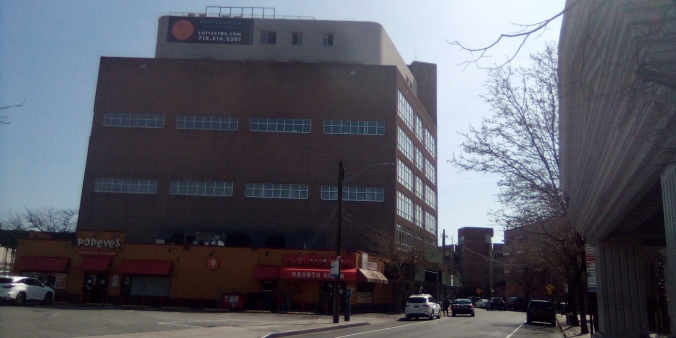
Mysterious fire ignites on top of Far Rockaway hospital


PIX News 

In one of Mario's Son's last attempts to abuse his power to benefit his donors before all those woman exposed what a serial sexual deviant he was, Andy tried to downsize this hospital during a pandemic.

And who knows how many thousands would have survived if he didn't kill Peninsula Hospital 9 years earlier.

Saturday, April 11, 2020

New York's decisions to prioritize upscale real estate development and speculation has led to death and malaise in the epicenter of the COVID-19 pandemic


https://pbs.twimg.com/media/EVP53FBUMAoJFSi?format=jpg&name=small

Association for Neighborhood & Housing and Development


New York City remains the epicenter of the global COVID-19 pandemic, but its effects are being felt differently across neighborhoods. As ANHD's  previous analysis  shows, this virus is hitting low-income communities of color the hardest. The neighborhoods with the highest range of positive COVID-19 cases in the city are home to communities of color whose residents are disproportionately employed in frontline service occupations and face among the highest rates of rent burden and overcrowding. These communities – the epicenters of the epicenter - are home to the largely invisible workforce that is keeping New York City running in this moment of crisis, and they are the ones who are bearing the brunt of its impacts. Recent data released by the City’s Department of Health shows that Black and Latinx New Yorkers are dying at twice the rate of whites - making clear that this pandemic is not only a public health crisis, but a crisis of racial and economic justice as well.   


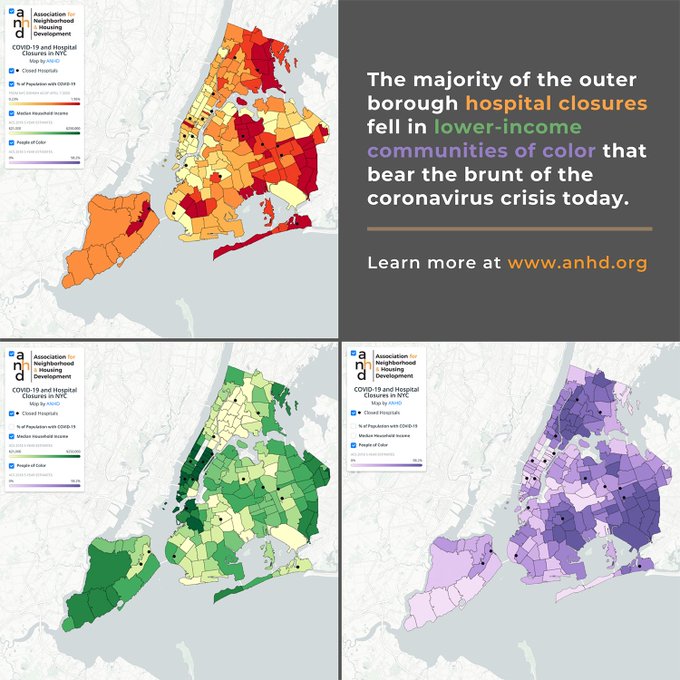
Among the host of historic inequities behind the disparate impact of COVID-19, one is particularly striking: the string of hospital closures that took place in these communities over the past few decades. At least 18 hospitals have closed all of their inpatient services in New York City since 1998 - leading to the loss of thousands of hospital beds - with two-thirds of those closures occurring in the outer boroughs. A look at the data shows that the majority of these outer borough hospital closures fell in lower-income communities of color that bear the brunt of the coronavirus crisis today. These community hospitals catered to neighborhood residents, many of whom lack private insurance; the mass closure and downsizing to outpatient services means less access to necessary health services, especially in a time of crisis. Households without health insurance have few options if they get sick, other than visiting the remaining public hospitals, adding to the likelihood of exposure to coronavirus and the further straining of the healthcare system. 

 While community hospitals were being closed in low-income communities of color, hospitals in wealthier sections of the city were being converted into luxury residential buildings, further depleting the city's overall supply of hospital beds. Of the 18 hospitals that closed in the last two decades, over 40% have been replaced by residential developments, most of them with rents or sales prices that are astronomically out of reach for the average New Yorker. At the site of St. Vincent’s Hospital in Manhattan, where countless poor New Yorkers received care during the AIDS crisis, now stands Greenwich Lane, a luxury condo building. Long Island College Hospital in Brooklyn, a community medical facility known as America’s first teaching hospital, was replaced by 5 River Park where a studio apartment was recently sold for $1.15 million.

In Queens, the epicenter of the COVID-19 crisis, the closures of St. John's Hospital, Parkway 
 Hospital, and Mary Immaculate Hospital have led to massive overburdening of nearby medical facilities. Each of the neighborhoods where these hospitals were once located in have some of the highest rates of COVID cases in the city.

 029


 The former site of St. John’s Hospital is located just blocks from Elmhurst Hospital - the same hospital that has seen among the most COVID-19-related deaths in the country. What stands in its place now is Queens Pointe, a market-rate apartment building. The former site of Mary Immaculate Hospital in Jamaica - another COVID-19 hotspot - was transformed into a residential development in 2009. Nearby Parkway Hospital, which once served low-income Queens residents, was also torn down to make room for a residential building in 2008.

 014

 019

020

 As these hospitals continued to serve poor and uninsured New Yorkers, financial restructuring and an inability to pay their bills contributed to a spate of closures in the late 2000s. The deprioritization of hospital infrastructure and subsequent development of residential - particularly luxury residential buildings - on these former hospital sites is the direct result of the City’s land use decisions. The Bloomberg era saw a pattern of high profile rezonings of both public and private land to facilitate luxury residential development, with few if any public benefits secured in exchange for the enormous value these conversions provided to private real estate developers. The prioritization of profit over community need has left a long-lasting legacy across New York, and communities of color have continued to face the brunt of it through displacement, housing instability, job loss, and health disparities. Communities and advocates have long said that these land use decisions have life and death consequences; we as a city are now forced to reckon with the consequences of those decisions in this moment.

Sunday, March 22, 2020

St. John's is having an outbreak open house sale


028

Impunity City


Recent available testing for COVID-19 has revealed that over 10,000 people were infected with the disease in just the past week. It also brought upon a general moment of clarity and surely an everlasting fury regarding New York City’s stunning low amount of hospitals to house and care for everyone that will test positive for the disease and certainly for the amount of people that are going through the worst of it.


As the NY Post reported last week when Governor Cuomo and Mayor de Blasio were apoplectic about the low amount of beds that will take for the dramatic rise of cases that have just unfolded over the weekend.


Now everyone pretty much knows that the reason why New York City is was grossly, criminally unprepared for this outbreak; because a lot of them went broke and the state and the city not only didn’t adequately fund them but actually enabled their closings with budget cuts and chummy pay to play land deals which led to crucial health care services getting terminated and replaced with high-end condo towers and housing. Even the rats that burrow in the lots during the nascent stages of development even know this.


A grand example of this devastation and deprivation resulting in this harried urgency to save thousands of lives is the notorious closing of St. Vincent’s Hospital in Greenwich Village, Manhattan which was the biggest MASH unit on 9/11/2001- the previous greatest attack on the U.S.A. this century. What remains of St. Vincent’s now is ultra-luxury condominiums, even though it still looks like a hospital.


But what this post is going to focus on is the former St. Johns Hospital on Queens Boulevard, the boulevard of zombie development

 014


Friday, March 20, 2020

Hospital closings in the last two decades from state budget cuts shows utterly stupid foresight


 NY Post

New York has lost a staggering 20,000 hospital beds over the last two decades to budget cuts and insurance overhauls, complicating local and state efforts to battle the coronavirus, according to records and experts.

The Empire State had 73,931 licensed hospital beds in 2000 before years of cuts and closures shrank the number to just 53,000 in 2020, according to records obtained by the New York State Nurses Association from the state Health Department and stats provided by officials.

Gov. Andrew Cuomo said Tuesday the health officials believe they will need anywhere from 55,000 to 110,000 hospital beds to treat the expected wave of coronavirus victims.

“New York has closed too many beds. They went too far,” said Judy Wessler, former head of the NY Commission on the Public’s Health System, about the 28 percent drop in beds.

Those cutbacks mean the state is in a significantly deeper deficit as it searches for ways to expand its capacity to treat COVID-19 victims.

“This is going to crash the health care system,” Cuomo warned, as he again reiterated his request to President Trump that the Army Corps of Engineers be dispatched to help New York state build emergency hospital capacity.