
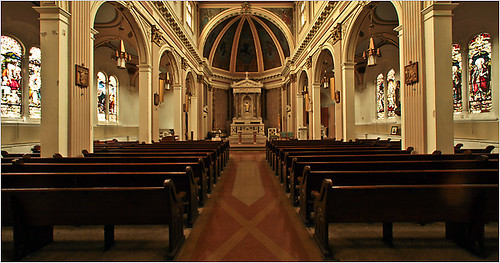
 From the NY Times:
Over the past decade, as Catholic officials in New York have closed underused churches and schools, there have been many battles. About a dozen churches have been demolished, and at least a dozen more are in limbo, draped for demolition while parishioners mount campaigns to reopen them.
Yet this fight is different. Former parishioners do not pretend that the neighborhood can support Our Lady of Loreto, which has been closed for more than a year.
Instead, they have gathered behind a proposal by a loose coalition of Italian-American advocates and African-American leaders, including the developer Jeffrey Dunston, to convert the church into an arts pavilion and community center. The culture center would be the anchor for 90 to 100 units of low-income housing, a few more than in the church’s plan. Mr. Dunston, chief executive of the nonprofit Northeast Brooklyn Housing Development Corporation, has built hundreds of low- and moderate-income housing units in the neighborhood over the past 15 years.
But church officials say their own plan is “shovel ready,” awaiting formal go-aheads from city and state financing agencies. The plan offered by Mr. Dunston and Mr. Piazza lacks financing, they said, and underestimates the cost of converting an aging church into a community center.
Last week, Bishop DiMarzio extended an olive branch, offering to insert some of the church’s outdoor statues into the facade of one of the new apartment buildings.
Flavia Alaya, an architectural historian who has been working to preserve the 1908 church, called the proposal “grotesque.”
Ms. Alaya, who has studied the works of the church’s architect, Adriano Armezzani, and its builders, Antonio and Gaetano Federici, called Our Lady of Loreto one of the finest examples of a Roman Renaissance style embraced by Italian-American artists at the turn of the 20th century in an effort to introduce neoclassical architecture to American cities.
She pleaded with Bishop DiMarzio in a letter last month to cancel the “irreversible demolition of this extraordinary century-old church” while Mr. Piazza and Mr. Dunston arrange their financing. And she wrote to a Vatican commission that oversees historic preservation, which promised to review the case.
A similar battle was recently won by a coalition of Latino parishioners, Irish-American organizations and the serendipity of an anonymous donor who gave $20 million to save St. Brigid’s Church, in the East Village, which was built by Irish immigrants in the 1840s.
“This will be the test of whether Italian-American clout is equal to that,” Ms. Alaya said.


