CBS New York
The city is pumping the brakes on drivers. Mayor Bill de Blasio will lower the speed limit on 45 miles of streets.
The speed limit along a nearly four-mile stretch of Astoria Boulevard will go from 30 to 25 mph.
“These are not small changes in terms of their potential impact on the safety of New Yorkers,” Department of Transportation Commissioner Henry Gutman told reporters, including CBS2’s Kevin Rincon on Monday.
The city is focused on 10 major roadways where the most accidents
happen, places like Woodhaven Boulevard, the Van Wyck service road, and
Pelham Parkway in the Bronx.
In Queens, drivers have mixed reactions.
“It’s for the better, honestly, because elderly people walking by,
you don’t want to hurt them. You don’t want to feel that guilt because
you were rushing to work, or you had road rage,” one person said.
“The traffic has to keep flowing in this area or we’re all going to
be stuck. So it could be good, could be bad. I don’t really know,”
another driver said.
“Thirty is high speed, but 25 is okay, is low, is too low to drive, but I think it’s safer for the pedestrians,” another added.
Making sure cars go slower in congested areas is the mayor’s goal, as
he tries to deal with a growing number of pedestrian deaths.
“It’s clear you have to do something differently when you see that,”
de Blasio said. “In the end, lowering speed limits creates
accountability and saves lives.”
Queens Post.
The city will create a “bike boulevard” along 39th Avenue in
Sunnyside by the end of the year, Mayor Bill de Blasio announced today.
The avenue is one of five streets across the city that will be
transformed into bike boulevards by either November or December this
year. The Department of Transportation (DOT) will be creating one “bike
boulevard” per borough.
De Blasio shared few details during his press briefing this morning as to what the new initiative involves.
According to a press release from City Hall, the DOT aims to slow
down cars and limit traffic volume along bike boulevards “to create
low-stress bike infrastructure in a pedestrian-friendly environment.”
De Blasio didn’t name the cross streets along 39th Avenue where the bike boulevard would be created.
The City has already converted a section of 39th Avenue, from 45th
Street to Woodside Avenue, to an Open Street, which is closed to through
traffic from 8 a.m. to 8 p.m. on most days. Local traffic, however, is
permitted access for parking, deliveries and drop-offs at all hours.
“[Bike boulevards are] going to come with a variety of measures to
make it a safe environment for bicyclists and connect key bike lanes to
each other,” de Blasio said during a morning press conference.
The Department of Transportation will present proposals for each bike
boulevard to local lawmakers and community boards in the coming weeks.
De Blasio also announced that the DOT will be creating a new
protected bike lane along Northern Boulevard to connect the 34th Avenue
Open Street in Jackson Heights to Manhattan via the Queensboro Bridge.
The DOT has already installed “Bike route” signs along Broadway, which connects Northern Boulevard to 34th Avenue.
Update: By the luxury tower enthusiasts at blog Gothamist.
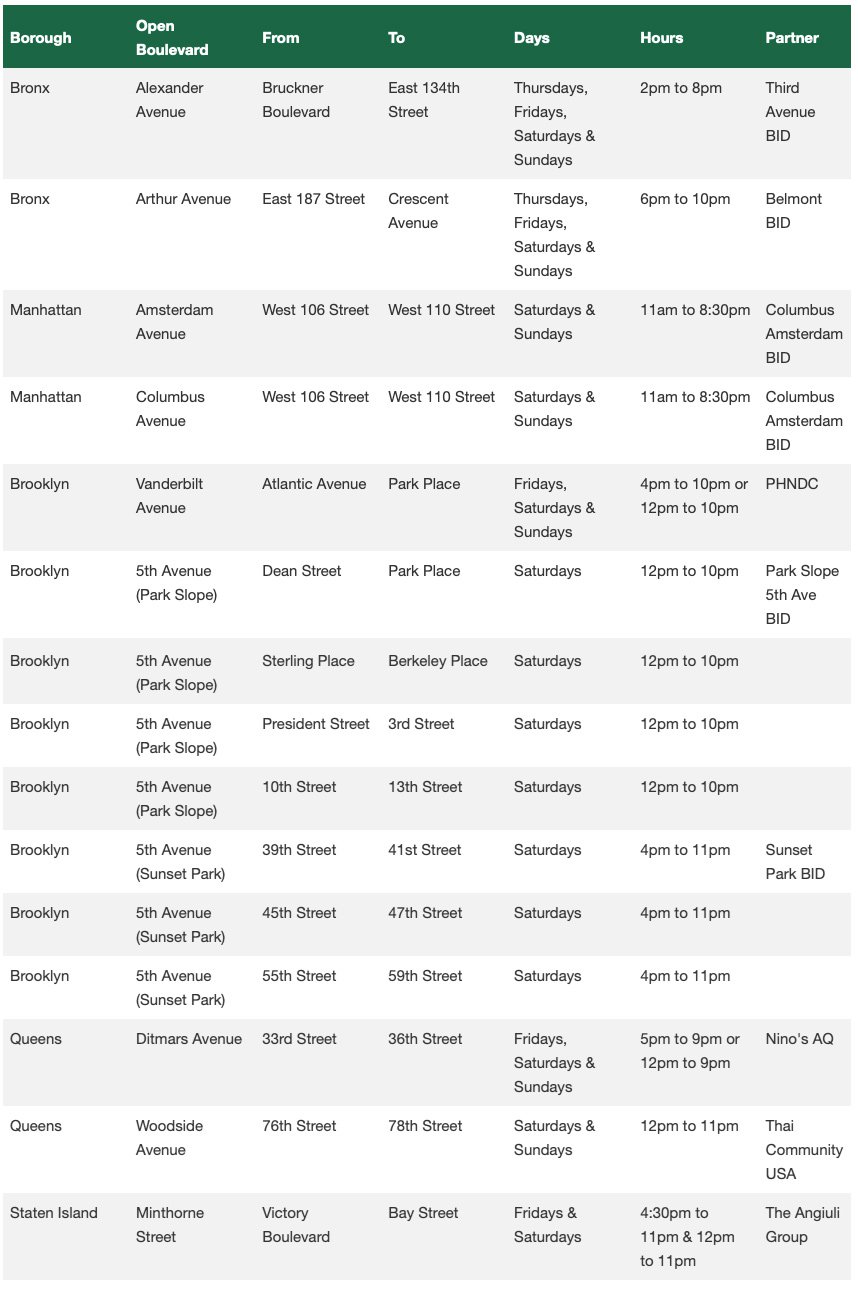
Over the next "few weeks," ten stretches of roadway in New York City
will be transformed into Open Boulevards, Mayor Bill de Blasio said
Wednesday, bringing outdoor dining, picnic tables, community activities,
art, and performances to car-free streets.
The program, which was
designed in partnership with the Department of Transportation and NYC & Compnay, the city's official tourism organization, is meant to
create destinations for both locals and visitors from out of town.
"This
is the kind of thing people are going to love, because all the life and
vitality of New York City, all the diversity, all the energy will be on
display," the mayor said. "This is going to be the summer of New York
City, and Open Boulevards are going to be a great example of a reason
people will flock here."
The announcement came after the City Council voted late last week
to make the Open Streets program permanent, to put it under the
Department of Transportation's control, and to expand the program to
neighborhoods that have been underserved by it thus far.
Andrew
Rigie, the head of the NYC Hospitality Alliance, applauded the Open
Boulevards announcement, adding that the Open Restaurants program thus
far has allowed about 100,000 jobs to return.
"I have no doubt
when we expand this program through the Open Boulevards program and
weave it with beautification and art installations and cultural
initiatives and really get communities involved, we build back a more
resilient, a more livable city that supports everyone in so many
different ways," he said.
Responding to concerns that blocking off
traffic on major commercial roads such as Ditmars Boulevard would
create a mess off traffic on residential side streets, Jee Mee Kim, the
Chief Strategy Officer for the Department of Transportation, said the
Open Boulevards locations were selected based on pre-existing Open
Streets. But she acknowledged the "underlying tension" about how streets
are prioritized.
"The reason why all the Open Boulevards and Open
Streets are temporary is that we're trying them out," said Kim.
"Hopefully it will be a raring success, and folks will get used to
driving around these streets. And I think in the end we're going to see a
net benefit for the community and the businesses."
The reason I highlighted this is because de Blasio just might be using money from the federal emergency stimulus funds President Biden gave New York to make these "Open Boulevards" happen.
de Blasio. Doesn't. Care. About. His. Constituents. Especially those who need (and have an absolute right) to drive.