Friday, November 3, 2023

Caption these fauxgressive elected officials

https://pbs.twimg.com/media/F92vsM-WgAAKIZR?format=jpg&name=small 

AOC could have been a queen bee in politics, but instead is an establishment drone.

Bad Pander's costume is apt, being how he's controlled by non-profit group and real estate donors.

Donnie Richards looks more like a 7/11 breakfast burrito wrapper than an astronaut.

And Shekar Khrisnan wins the costume contest by correctly going as a trash politician.

Thursday, November 2, 2023

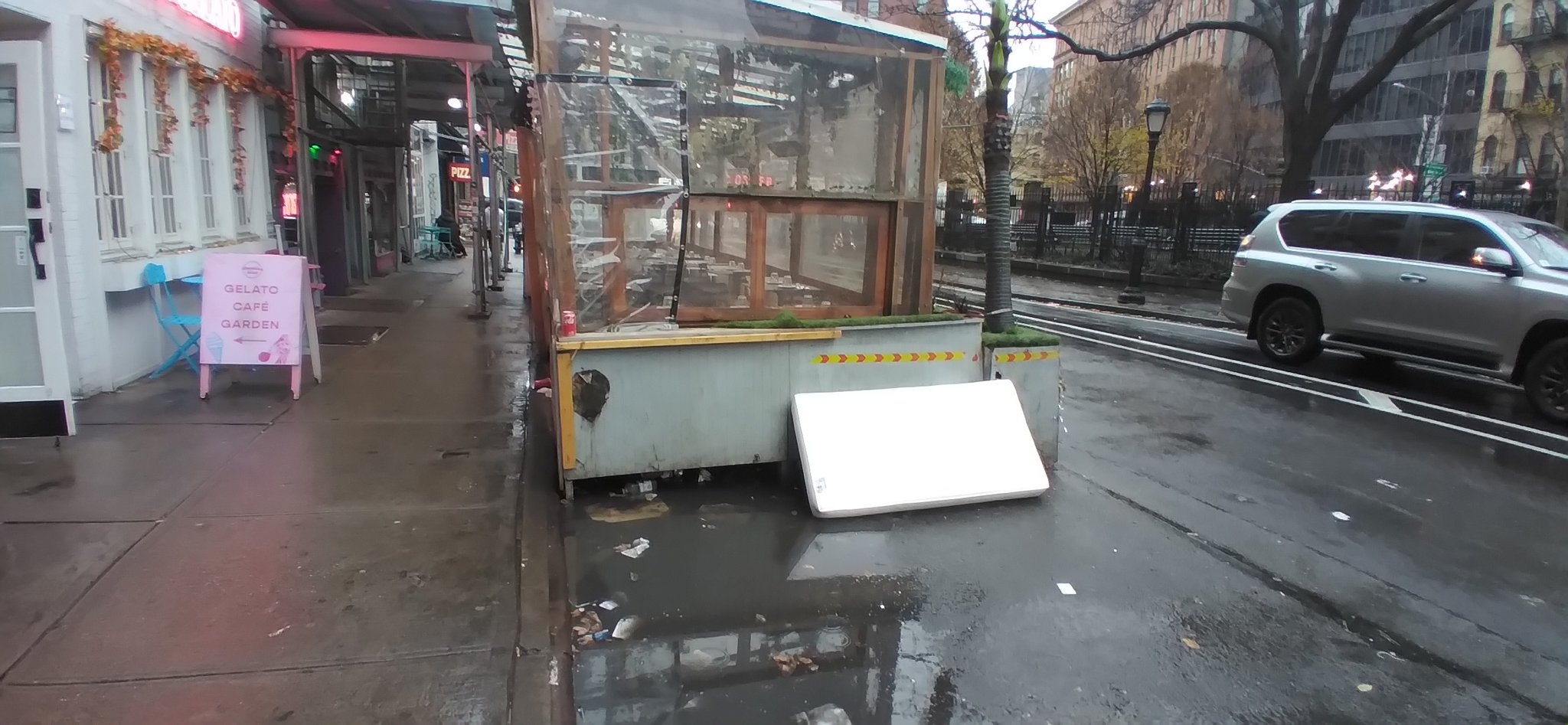
Restaurant shanties hit with lawsuit again

  https://pbs.twimg.com/media/FlGakUrXgAAzkCd?format=jpg&name=large

AMNY

New York City has been hit with a class action lawsuit seeking to overturn its newly permanent outdoor dining program, with petitioners claiming the popular al fresco eateries are an unconstitutional nuisance.

The suit, filed against the city in Manhattan Supreme Court on Monday by 30 New York City residents, claims the recently-enacted permanent outdoor dining program — which replaced the temporary, emergency-authorized program that began during the COVID-19 pandemic — is illegal for not having been subject to a full environmental impact review and public comment.

That allowed the city to enact what the petitioners describe as a “massive change to the cityscape that defines New Yor[k] City” that is “highly destructive to city neighborhoods and the petitioners who reside in them.”

Before the pandemic, outdoor dining was only allowed in a few areas of the city, mostly in Manhattan, and was subject to a long, bureaucratic and expensive approval process. Soon after COVID-19 struck the city and forced restaurants to shut their doors, city officials used emergency powers to significantly liberalize permitting for outdoor dining, allowing thousands of eateries the chance to reopen for customers to dine in and greatly expanding the scope of al fresco eating. Many built elaborate shacks on the sidewalk or roadway for dining.

City officials and restaurant industry reps have claimed the outdoor dining program saved 100,000 restaurant industry jobs and kept innumerable eateries from having to close. Pandemic-era polls showed the program to be broadly popular with New Yorkers; a December 2020 poll by Siena College and Transportation Alternatives found 64% of voters, including 78% of Manhattan voters, found outdoor dining a valuable use of curb space.

Still, others were less than enthused from the beginning. Critics of outdoor dining have contended that dining sheds take away parking spots, attract rats and other vermin, are havens for homeless New Yorkers and crime, and bring noisy crowds to their blocks for all-night revelry.

“This saturation of outdoor seating is not serving me, my family, or my business. It has made this neighborhood pretty much unlivable most of the time,” said Ellen Koenigsberg, a Lower East Side resident who owns a vintage clothing shop and is a petitioner in the class-action suit, in an affidavit. “I feel like I always have uninvited guests in my apartment that just will not leave.”

Others are perturbed by what they contend are “ugly” dining sheds.

“They mostly look like large, dirty garages and disrupt and change the nature of the street,” said fellow Lower East Side resident and petitioner Elizabeth Dworkin. “It feels like a fort has been built on the block to keep the local residents away so paying customers and bars, clubs, and restaurants can occupy all of the public space.”

This claim about how these shanties saved 100,000 jobs is highly dubious, until you consider that probably over half of them were waiters on wheels from all those bike deliveries during the pandemic.


Monday, October 30, 2023

Tuesday, October 24, 2023

The City Of Yes wants SRO's ASAP

 https://newyorkalmanack.com/wp-content/uploads/2014/01/Jacob-Riis-Five-Cents-Lodging-Bayard-Street-c-1889.jpg

 Crain's New York

Ray Ray Soto’s apartment on the Upper West Side has hardwood floors, ceramic counters and city views. At first blush, it’s not so different from many other units in newly built towers.

“This is a beautiful building,” said Soto, 66, who moved there in March after a years-long search. “I love the place I’m living in. I really do.”

Her studio, however, is not inside a conventional rental development. It’s actually located in a single-room occupancy hotel, commonly referred to as an SRO, one of the few remaining examples of a once-common type of dwelling that served as a lifeline to generations of New Yorkers without much money. But their often dark, drecky and dangerous conditions led to a ban on SROs decades ago and prompted officials to allow most of the remaining ones to be razed.

But as homelessness and housing costs hit record levels, Mayor Eric Adams is considering allowing the controversial properties, with their unusually small unit sizes and shared kitchens or bathrooms, to be built for the first time since the Eisenhower era. Soto’s digs could be a glimpse of things to come.

“We have to try something new, and that’s when old ideas become new again,” said Muzzy Rosenblatt, chief executive officer of the Bowery Residents' Committee, a nonprofit housing provider that operates a handful of the city’s few surviving SROs.

But several housing providers who support the mayor’s SRO push said they would tweak a few details this time around, such as getting more buy-in from nonprofits and insisting on regular inspections to make sure living conditions stay up to code. “When SROs were run by private landlords, it was very hard to make them a successful business, because their customers were the poorest of the poor,” Rosenblatt said.

The set of pro-housing zoning changes that Adams proposed in September includes measures that would eliminate rules that have long prevented the construction of new SROs.

Specifically, the mayor would amend zoning laws that set a minimum average size for apartments in new developments to encourage more studios and, the thinking goes, more small-unit apartment buildings.

In the push to get more shared housing in general, City Hall would also loosen rules that prevent developers from adding rooming-house-style units in low-density areas and converting offices into the properties.

Although the City Council would have to approve these zoning changes and likely pass additional legislation for SROs to make a full-fledged return, the need for cheap housing options no longer seems as controversial as it had been for decades. Gale Brewer, a City Council member whose Upper West Side district was the epicenter of the SRO fight in the middle of the last century, told Crain's she “absolutely” supports the mayor’s idea.

So does City Planning Commission Chair Dan Garodnick. “Zoning should not act as a bar to different types of housing that meets the needs of lots of current and future New Yorkers,” he told Crain’s. “We want to allow for a level of creativity within buildings and to explore new ways of living.


SROs may still be a lightning rod. A preview of the possible resistance came in March, when some observers reacted with outrage when Adams hinted at his eventual plan by floating the idea of allowing bedrooms without windows.

But if the City Council were to vote for the reforms, it would represent a remarkable full-circle moment for a type of housing once seen as an island of affordability in a pricey metropolis.

Instead of shelling out for a full-size apartment, tenants—especially single men—with reduced means could fork over much less money for a private bedroom alone and then share a bathroom and kitchen with their neighbors, a model not dissimilar to the increasingly popular co-living communities of the past few years.


No duh

 Image

 LIC Post

According to a study conducted by the nationwide apartment search website RentCafe, the Queens ZIP Code of 11101, which covers Long Island City, ranks third in new apartments completed from 2018-22.

RentCafe hypothesizes that a big contributing factor to the high demand among renters is due to Long Island City’s close proximity and easy access to Manhattan. Additionally, the area’s location along the East River provides residents with a beautiful view of the Manhattan skyline.

In 2017, there were an estimated 9,631 apartments in Long Island City. From 2018-22, there were 7,081 new apartments built there, marking a 73.5% increase to a total of 16,712 by 2022.

In addition to calculating the number of new apartments added during this period of time, RentCafe also determined the median income and age of residents within this zip code. The median income for apartment residents within the 11101 zip code was $87,264, while the median age of residents was 34.

The only two zip codes to rank ahead of 11101 when it came to new apartments were 20002 and 20003 in Washington, D.C. Ivy City, located in northeastern Washington, D.C., represents the 20002 zip code. The area had 7,378 new apartments added from 2018-22. Capitol Hill is the Washington, D.C., neighborhood represented by the 20003 zip code. From 2018-22, there were 7,225 new apartments added in that neighborhood.

 Some of these buildings are in the affordable housing lottery program. Like the one pictured above by the clock tower. The biggest lie in the world is the theory that building more leads to lower rents.