Showing posts with label wasting money. Show all posts

Thursday, October 24, 2024

Driving malfeasance

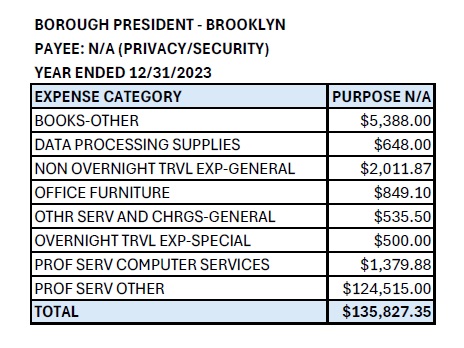
 Brooklyn Borough President Expense Payee NA Privacy Security 2023

 White Collar Fraud

Welcome to New York City’s most impressive disappearing act yet. Following our previous exposés of fiscal acrobatics and car service extravaganzas, we present something remarkable: $4.2 billion of taxpayer money that’s simply vanished from public view.

In what could be called innovative municipal recordkeeping, New York City has classified an astounding $4,201,873,479.51 under the vendor code “N/A (Privacy/Security)” in 2023. Of this impressive sum, $4,131,414,624.59 lists its purpose as “blank” – presumably because even “N/A” felt too specific. The remaining $70,458,854.92 gets the slightly more descriptive purpose of “N/A,” for those times when someone felt compelled to write something.

A sum of $4.2 billion is almost too massive to comprehend, let alone cover in a single post. So, let’s start small – with our borough presidents, whose modest contributions to this trend are particularly telling. After all, if routine expenses like office supplies and travel can be deemed too sensitive for public disclosure, what hope do we have of understanding the billions classified elsewhere? These smaller examples reveal a culture of opacity that has trickled down from the highest levels of city government to the most mundane of expenses.

 Borough President Antonio Reynoso leads with $135,827.35 in classified spending. His office’s signature move? Converting $124,515 into “Professional Services Other” – a category that explains nothing while saying something. They’ve also managed to make $5,388 worth of books disappear from public scrutiny.

 Vanessa Gibson’s office presents $30,680.41 in mysterious expenditures, including $13,618 in travel expenses to undisclosed locations. The destinations remain as mysterious as the purposes.

Under Donovan Richards Jr.’s watch, Queens contributes $13,345.20 in classified spending, featuring $9,100 in “Temporary Services.” The nature of these temporary services remains, appropriately, temporary.

 Mark Levine keeps it modest with $6,358.10 in classified expenses, including an intriguing -$3.50 credit. Even refunds, it seems, can be confidential.

These are the hypocrites who want to abolish parking mandates.


But these borough-level activities are merely a prelude to the city’s larger production. Consider $4.2 billion – enough to fund significant public works – simply marked as confidential. More impressively, they’ve managed to make the purposes disappear as well.

When the purpose of $4.1 billion of spending is classified as “blank,” it raises questions about the very nature of public disclosure. The remaining $70 million marked “N/A” almost seems quaint in comparison.


Sunday, October 20, 2024

The plutocrats of poverty


Gothamist 

Nepotism. Self-dealing. Executive salaries in the high six figures.

These are some of the allegations leveled in a new report on New York City’s multibillion-dollar shelter system released by city investigators on Thursday.

The review, which began in 2021, found a range of potential improprieties at 51 nonprofits that receive taxpayer funds to provide shelter and services for clients of the city Department of Homeless Services, which manages the biggest municipal shelter system in the United States. On an average night, over 87,000 people stay at the more than 500 New York City shelters funded by the department.

The city’s Department of Investigation found multiple instances of apparent conflicts of interest, potential nepotism and failure to comply with competitive bidding requirements on the part of shelter providers, according to the nearly 100-page report.

“City-funded nonprofit service providers pose unique compliance and governance risks, and comprehensive city oversight is the best way to stop corruption, fraud, and waste before it starts,” Department of Investigation Commissioner Jocelyn Strauber said in a statement. “Today’s report provides ample evidence of the risks specific to nonprofits and shortcomings in city oversight and makes 32 recommendations to strengthen controls around this essential network.”

In some cases, insiders were paid outside of their normal compensation through personal business interests involving the shelter where they worked, such as security companies that staffed those shelters — and were owned by the nonprofits they served. In other cases, shelter providers told investigators they did not employ any immediate relatives of senior employees or board members, which would violate their city contracts — but the investigators later found that adult children of shelter executives had been employed by the nonprofits for years.

 Multiple nonprofit executives received more than $500,000 annually, and in some cases more than $700,000 annually, in compensation from the shelter providers and related organizations. Investigators emphasized these salaries were funded largely or in part by taxpayer dollars and said the city lacks sufficient rules to guard against excessive compensation.

Many of the groups have annual revenues in the tens or even hundreds of millions of dollars. More than 90 nonprofit contractors now provide shelter services for the city, up from at least 70 just a few years ago, according to the report. New York City has a decades-old legal right to shelter that generally requires that a bed be provided to anyone who needs one — though this right was curtailed for migrants earlier this year.

The report comes as the city faces a stubborn housing and homelessness crisis exacerbated by the migrant influx since the spring of 2022. The homeless services department’s budget for shelters rose to $4 billion in fiscal year 2024, up from $2.7 billion two years earlier, according to the report. Migrant shelters run by NYC Health and Hospitals — called humanitarian relief centers — were not covered by the review and are being separately monitored by city investigators and a major accounting firm.

A spokesperson for the city’s Department of Social Services, which oversees the shelters, said it has “completely stopped doing business with a number of providers highlighted in the report,” and taken other steps to strengthen accountability for the nonprofit contractors.

“To be clear, this report does not reflect our current contracting and oversight processes given that the review began years ago prior to the current administration, but we look forward to continuing on these improvements to better serve New Yorkers,” the agency said in a statement.

Thursday, July 4, 2024

Home of the free

Image

NY Post 

 New York City officials are dramatically expanding a controversial program that gives debit cards pre-loaded with cash to migrant families staying in taxpayer-funded hotels across the city.

The Adams administration says another round of debit cards is expected to be distributed to more than 7,300 migrants over the next six months, costing the city about $2.6 million. The move represents a major expansion of a pilot program that began earlier this year that doled out cards to about 3,000 migrants. 

New York City Deputy Mayor for Health and Human Services Anne Williams-Isom says the program allows newly arriving families the ability to “make choices for themselves and their children” by using debit cards. 

“They can buy from local shops, support small businesses, and manage their own resources,” she said in a statement. “When we empower people, we help them achieve self-sufficiency and access the American Dream.”

Mayor Eric Adams has defended the program as a “cost savings measure” that “temporarily” replaces New York City’s existing system of providing non-perishable food boxes to migrant families staying in hotels and other city-funded shelters.

The program is a partnership between the Adams administration and the company Mobility Capital Finance, which says the plan will help migrants with food, baby supplies and other necessities as they await authorization to work from the federal government. 

Under the program, a four-person family with children under five can receive up to $350 per week, or about $18,200 a year, according to published news reports.

Critics, including New York Council member Joseph Borelli, have argued that the debit cards are “fundamentally unfair” to the city’s working poor, who don’t receive similar benefits from the city. 

Borelli and other Republicans argue that the city’s right to shelter law, which requires it to provide housing, food and other necessities — coupled with the city’s ‘sanctuary’ policy cooperation with immigration crackdowns — are drawing a record number of migrants to the city. 

 Great, now these families can continue selling candy and deliver food for multiple apps. Ain't that America?

Tuesday, March 5, 2024

Still need congestion pricing?

 Image

NY Post

The MTA could potentially find another $600 million in savings in its bloated plans to extend the Second Avenue Subway, a Post investigation found — as the agency faces pressure to prove it’ll spend its upcoming congestion toll windfall wisely.

New York is potentially just about three months away from launching a controversial $15 daily charge on cars that drive below 60th Street in Manhattan, raising $1 billion a year for the Metropolitan Transportation Authority to spend on projects, such as its expansion of the Q line to East Harlem.

“MTA management is ineffective, and handing more money to unelected bureaucrats will not fix the MTA’s problems,” testified real estate agent Lucas Callejas, 38, of Inwood, during a public hearing about the congestion fee plan Monday.

“I absolutely don’t trust the MTA with my money … They spend like crazy,” added Dana Matarazzo, 40 an oncology nurse at Memorial Sloan Kettering from Staten Island, who spoke to The Post after testifying against the toll.

MTA officials announced last month they shaved $300 million off the $6.9 billion total estimate to extend the Q line from its terminus at 96th Street another 1.5 miles up Second Avenue and then westward along 125th Street to Lexington Avenue.

But The Post’s analysis found another $600 million in savings in the MTA’s station designs, when compared to what it would cost to build a similar project overseas.

While the tunneling costs are in line with those of other major cities, such as London and Rome, the station costs and designs remain in an entirely different league, The Post’s analysis revealed.

Before the recently-announced trims, the MTA’s budget for tunneling, trackwork, stations and power, computer and radio systems was estimated to be $4.1 billion.

The new, “more efficient” station designs have helped lower the figure to $3.8 billion — still more than the $3.2 billion would cost to build a similar project in London, the most expensive of the European cities examined by The Post, in a worst case scenario.

Experts and researchers zeroed in on two major factors that have pushed the MTA’s station costs to levels not seen elsewhere: The amount of area set aside of passengers to circulate on mezzanines before heading down to the platforms; and the amount of “back of house” areas sealed away from public view that provide space for storage closets, mechanical functions and break rooms.

The feds granted permission to rework the 125th Street station design in 2020 in an earlier second round of reviews for the East Harlem leg, but officials not reveal the full scope of the overhaul until stories ran in The Post highlighting the size of the original 2004 design. The first round of tweaks approved by regulators in 2018 allowed the MTA to put the 116th Station in an empty piece of existing tunnel.

The three rounds of reviews have shaved an estimated 17% off of what could have been a $7.6 billion total price tag, records show. Officials have said the third round of reviews remains ongoing.

The overall now-$6.6 billion budget for the East Harlem expansion also includes $245 million for land purchases and eminent domain, $559 million for outside engineering, design and management firms, plus a whopping $943 million for a budget reserve.

The project’s construction costs alone could have been as high as $4.4 billion had the MTA re-used the station designs from the Second Avenue Subway’s Upper East Side extension, a much-delayed project that shattered cost records.

“That’s the hard part, turning this ship around,” said Eric Goldwyn, who lead a team of researchers at New York University that revealed how oversized the MTA’s Upper East Side designs were compared to those used in Stockholm, Rome and Istanbul, dramatically inflating costs.

“When people asked them about our research, they said ‘we were a–holes,’ basically,” Goldwyn added. “I’ve been encouraged by what I’ve seen, but there are absolutely things to keep looking at.”


Tuesday, February 20, 2024

Mayor Adams's migrant debit card debacle


 NY Post

It takes money to make money, as the old saying goes, and, apparently, it also takes money — as much as $53 million — to give money away.

Earlier this month, The Post broke the story that Mayor Adams is giving out pre-paid cash cards to migrants.

Unusually for the mayor, Adams didn’t publicize this story himself, and his administration has for nearly a month failed to correct several public misperceptions about it.

One misperception is that the program allows the city to give out just $50 million to migrants.

No wonder the mayor has been reticent.

This debit-card program — if you read the actual contract — has the potential to become an open-ended, multi-billion-dollar Bermuda Triangle of disappearing, untraceable cash, used for any purpose.

It will give migrants up to $10,000 each in taxpayer money with no ID check, no restrictions and no fraud control.

When The Post exposed the mayor’s debit-card program earlier this month, the mayor’s office spun it as a money-saving program, to solve a problem: migrants staying in hotels don’t eat all their food.

DocGo, the city’s no-bid “emergency” contractor to provide migrants with three meals a day, throws away up to 5,000 meals daily, wasting $7.2 million a year.

Some food is inedible — expired or rotten — and other food doesn’t meet migrants’ dietary needs.

Providing mass-scale meals competently and with options for specific needs — halal, kosher, vegan, non-gluten — isn’t that hard: the school system does it, airlines do it, hospitals and jails do it.

It wouldn’t be that difficult for the city to solve this problem: on-site city auditors could refuse to pay for meals that are objectively inedible, with visible mold, for example, or with expired labeling.

Instead of assuring that it’s existing no-bid “emergency” contractor fulfills its duty to provide edible food, however, the Adams administration has solved its problem by retaining a new no-bid “emergency” contractor — to provide a service with far more scope for waste, fraud, and abuse than stale sandwiches: giving out potentially billions of dollars of hard cash, few questions asked.

Which vendors did the city’s Housing Preservation & Development consider for this contract, as qualified to provide this complex financial service?

New York City is home to hundreds of top-tier financial-services and public-benefits providers, a dream of a competitive bidding pool, to ensure that the city gets a good price, as well as strong protections against fraud and abuse.

But HPD considered only one: Newark-based Mobility Capital Finance, which also has an office in Harlem.

MoCaFi was founded by Wole Coaxum, a former managing director at JPMorgan Chase, who said the death of Michael Brown in Ferguson, Mo., in 2014 inspired him to serve the “underbanked” and “narrow the racial wealth gap.”

How did HPD choose Mobility Capital? The contract makes it quite clear: MoCaFi was “referred to HPD by City Hall.”

What kind of experience did MoCaFi bring to this complex endeavor?

None. As HPD helpfully notes, on a “listing of prior / related emergency large contracts,” MoCaFi is “a new provider of emergency services for HPD.”

MoCaFi’s only city experience, HPD notes, is small-scale support of the city’s participatory-budget program.

The company’s broader nationwide experience is as a “platform” for pre-paid third-party debit cards and bank accounts, marketed to minorities.

The only clue is from a stray off-the-cuff comment Adams made at a reception earlier this month, calling MoCaFi a minority business “that we met on the campaign trail. . . . Little did we know that God is going to say there’s going to be a crisis, you’re going to have to meet them. . . . And it’s going to cost us money” to “put investment . . . in our community.”

 A year ago, the Adams administration was already eager to find something for MoCaFi to do.

Last year, the director of the mayor’s fund to advance New York City — a slush fund powered by anonymous private donors — raised at one of the fund’s board meetings the concept of “an upcoming partnership with the mayor’s office . . . and MoCaFi . . . on a universal basic income project”: that is, giving poorer New Yorkers (not migrants) cash.

 Coaxum seems to have become part of the mayor’s orbit, and even provided a quote to an official City Hall press release praising Adams’ founding of a new “Office of Engagement.”


Saturday, February 17, 2024

Hollywood Boonddoggle

  Image

Crain's New York

New York’s newly expanded tax credit for film productions is a “net negative” that fails to give taxpayers a return on their investment, even as state leaders have continued pushing to expand it, according to a new study commissioned by the state itself.

New York’s Film Production Credit was grown in last year’s state budget to cover as much as $700 million in costs annually for film and television productions that opt to locate in the state, forgiving 30% of eligible costs for each movie and show. Lawmakers, at the urging of Gov. Kathy Hochul, also extended the program through 2034 — despite longstanding complaints from watchdogs that the incentive may not achieve its stated goal of spurring economic activity and attracting more well-paying jobs.

Those claims are bolstered by the new study by the financial advisory firm PFM Group, which was commissioned by the state’s Department of Taxation and Finance to look into each of New York’s economic development tax credits. The study was required by a 2022 state budget provision and was put together over the course of 2023.

All told, New York gets back just 31 cents for every $1 it invests in film productions through tax breaks, the study concludes after considering the program’s pros and cons. The program has cost the state some $5 billion in the last decade, making it the largest of New York’s many tax incentives.

“Based on an objective weighing of the costs and benefits, the film production credit is at best a break-even proposition and more likely a net cost to NYS,” the authors wrote.

As critics have long argued, the study found that much of the filming activity funded by the credit would have happened in New York regardless, given its existing workforce and infrastructure. And although the productions do attract high-paying jobs, the tax credit’s unlimited duration means it functions more as an “ongoing subsidy” rather than a one-time incentive that could wind down after establishing a steady film industry in the state.

Indeed, many of the productions that continue receiving annual tax credits are long-running television series filmed in New York for years — undercutting the program’s stated goal of attracting new investments. And even the job-creation claim is “inconclusive at best,” the study found. After New York launched the credit in 2004, film industry employment remained stagnant for years until increasing in 2010, and its share relative to the nationwide market has since dropped.

A spokesman for Gov. Kathy Hochul said the office is reviewing the report but pushed back on its conclusions, pointing to other studies that found better results. Among them was a study commissioned by the Empire State Development Corp. which found that New York’s state and local governments reaped a combined $1.70 for every dollar spent on the film tax credit in 2021 and 2022 — although the state by itself (omitting local governments like New York City) still lost out overall, the report found.

“New York's tax credits and incentive programs are critical to growing the state's economy, boosting innovation, and creating good jobs, which is why the Legislature approved them in the first place, and Governor Hochul will continue working with members to improve the programs to maximize benefits for New Yorkers,” spokesman Justin Henry said.

Hochul’s office pointed to the high wages available in film and TV jobs, which often employ people without college degrees. New York has also lost productions to other states that boosted their incentives, such as the 2022 film “White Noise,” which filmed in Cleveland after “extensively scouting New York state,” Hochul’s office said.

The PFM study found that other “qualitative” factors cited by boosters of the tax break are similarly murky, like the exposure that New York state and city might enjoy as a result of all the films and shows set here. Many of those productions, like “Law & Order,” hardly portray New York in a fully positive light, the authors note.

The state’s expansions to the program last year also expanded the credit to cover “above-the-line” salaries for actors, directors, producers and writers, in addition to the “below-the-line” jobs, such as hairdressers and set builders, that had been covered before. Hochul, who pushed for the expansions, argued it would lure more productions to the state and boost an industry that serves as a major union employer.

In the end, the study concludes, the strongest argument for the tax credit may be that it works as a “defense mechanism” — deterring productions from choosing rival states like California and Georgia that offer their own incentives.


Tuesday, December 5, 2023

The city will pay you to participate in workshops to control rain

  https://www.wallpaperup.com/uploads/wallpapers/2015/11/19/838999/e1ce6c78dd41c13d66997838591ee1e2.jpg

Dear Community Leader,
Our city has endured tremendous hardships with the onset of more frequent and intense rainfall
events. In the face of this challenge comes an extraordinary opportunity to rethink its physical
and social infrastructure to reduce the risk from heavy rain while creating benefits for New
Yorkers every day.
 

The Mayor's Office of Climate & Environmental Justice and the NYC Department of
Environmental Protection, with Rebuild by Design and One Architecture and Urbanism, are
launching an open call for individuals and organizations who have lived or professional
expertise to recommend strategies and policies to address the increasing rainfall in New
York City. This work builds on an initiative launched by Rebuild by Design and One Architecture
to Rainproof NYC, as well as the City's efforts to improve flood resilience, including strategies
outlined in “PlaNYC: Getting Sustainability Done.”


Apply here by December 11 to express interest in joining a working group.
 

The Rainproof NYC working groups will have 15-20 members, split between NYC agency staff
and community leaders. The working groups will convene regularly from January 2024 to June
2024 and collaboratively propose new, or expand existing, policies, programs, and projects to
increase New York City’s resilience to heavy rainfall.


Each group will focus on the following topic areas. As part of the application, we ask that you
prioritize which group you would like to take part in:


● WORKING GROUP 1: How can we shift NYC’s policies and priorities to create a
comprehensive plan to prepare for increasing rainfall? Address gaps in infrastructure
and risk management to protect from and prepare New Yorkers for more intense
precipitation.


● WORKING GROUP 2: What does an equitable buyout program look like for NYC?
Inform the development of the City's Housing Mobility & Land Acquisition Program
announced in “PlaNYC: Getting Sustainability Done.”


● WORKING GROUP 3: How can we build capacity among communities, the private
sector, and CBO's to share responsibility to address increased heavy rainfall? Every
drop counts. Build out an education and communications campaign to build the
capacities of communities, the private sector, CBO's, local nonprofits, and other
agencies to do their part in managing increasing heavy rainfall.
We strive for diversity in the composition of each group across lived and professional expertise
and across intersectional identities. If you know someone who will bring new and unique
perspectives to these topics, please encourage them to apply too.

If selected, Rebuild will provide non-government members a stipend of $1500 at the end
of the process to support your high-level commitment. For those who cannot commit but
may want to stay involved, there will be various other opportunities to participate in working
towards a Rainproof NYC. We will continue to keep you apprised of those opportunities, even if
you choose not to apply to participate in a working group.


If you believe you have the expertise and availability to participate in a working group,
please APPLY HERE by noon on December 11, 2023. If you are accepted, you will be
invited to an afternoon half-day kickoff meeting that will be held on January 9, 2023 (please
hold your calendar for that date). Selected working group participants will be notified on or
around December 19.

 If you have any questions, email Rifal Imam at rimam@rebuildbydesign.org.
 

Sincerely,
The Rainproof NYC Steering Committee:
Rebuild by Design
The NYC Mayor’s Office of Climate & Environmental Justice
NYC Department of Environmental Protection
The NYC Mayor’s Office of Housing Recovery Operations
One Architecture and Urbanism

Mayor Adams took his 5% austerity machete to cut budgets from schools, libraries and the FDNY for these workshops to pay people to be make believe city planners to "mitigate" water coming from the sky. Workshops are the biggest farces going on in this town.

Saturday, November 11, 2023

We're broke

https://s3-prod.crainsnewyork.com/styles/width_792/s3/eric%20adams%20budget%202024.jpgCrain's New York

 As public and private watchdogs over New York City’s fiscal health, our mandate is to alert the public when the city faces an alarming financial situation. That moment has arrived: major looming budget gaps will have serious consequences for New Yorkers, unless action is taken now.

Many New Yorkers already sense the stress given how the staggering influx of asylum seekers and migrants has strained social services and the budget. The city estimates these costs may grow next year to equal what it spends to run the sanitation and parks departments combined.

But the billions of dollars the city will spend to care for these new arrivals is only one significant contributor to the fiscal shortfall — at most, 42 percent of the Fiscal Year 2025 budget gap. Our organizations project that gap for next year could be $9.9 billion and possibly up to $13.8 billion, even with the lower estimate assuming higher tax revenues and lower migrant costs than the city’s Office of Management and Budget anticipates.

The major underlying cause of the budget gap comes from years of added and expanded city programs that — at best — were supported only for a short time by non-recurring revenue or — at worst — not funded at all. City-funded spending has increased more than 50% over the past decade while recurring revenues have not kept pace. Despite the urging of our offices, few efforts have focused on increasing efficiency or shrinking lower impact programs, which could have allowed ongoing revenue to be sufficient to avoid future cuts.

The city and its unions agreed to reasonable raises for city workers, but did not identify how the $16 billion they added to the budget will be funded. The city also used federal Covid aid and a temporary tax revenue surge from record Wall Street bonuses to fund and grow over $2.5 billion of programs, from housing vouchers to education for 3-year-olds. Spending on overtime, special education and other services also regularly exceeds the budget. We are now facing what we call a “fiscal cliff,” because when funds dry up, the budget gap expands or programs must be cut.

What to do now? Knowing a reckoning is approaching, Mayor Eric Adams has rightly called for immediate action to stabilize the budget, directing city agencies to propose one round of 5% savings and be prepared for another two, amounting to nearly 15% in total. This is not easy, and must be done right to minimize impact on critical services. And it would be a futile task if city leaders continue to add spending: Adams’ four previous savings plans were helpful, but new spending that was simultaneously added amounted to more than double the planned savings.

Monday, March 6, 2023

Poverty pimping sister act

 https://nypost.com/wp-content/uploads/sites/2/2023/03/Valerie-C-Smith-square-web-1.jpg?resize=1024,1024&quality=75&strip=all 

NY Post

Providing shelter is a family affair at the city Department of Homeless Services.

The firm of Homeless Service Administrator Joslyn Carter’s sister has been awarded 17 contracts with the agency valued at a staggering $1.7 billion, according to data compiled by city Comptroller Brad Lander’s office.

Carter’s sister, Valerie Smith, is vice president of New York City Housing programs for Yonkers-based Westhab Inc., which runs homeless shelters in the city.

She has been a top administrator there since 2017.

Seventeen of the social services contracts were awarded by DHS, many in recent years with Smith working at the agency as the city grapples with a record homeless population fueled by a massive influx of migrants from the southern border.

Three others were awarded by the Department of Youth and Community Development and two by the Department of Education, totaling $4.7 million.

Councilman Robert Holden (D-Queens) demanded an investigation by the Department of Investigation and Conflicts of Interest Board after hearing of the unusual sibling relationship involving the city homeless services honcho and a top contractor awarded business with the agency.

Holden griped numerous times about problems at a shelter for 180 single men run by Westhab on Cooper Avenue in Glendale in his district — including complaints of drug use, violence, masturbating in public and menacing neighbors — some of which were exposed in a CBS report last September.

He suspected something was amiss when he said he failed to get an adequate response from Westhab or the city homeless officials.

“The whole thing stinks to high heaven. Why is Westhab getting all this money?,” Holden said Sunday. “It looks like they have someone on the inside. They’re protected.”

“They’re not doing a good job at the shelter on Cooper Avenue. It’s a mess over there.”

In a Feb. 8 letter to DOI and COIB, Holden said, “I recently learned from a credible source that the Department of Homeless Services Administrator Joslyn Carter is the sister of Westhab’s Vice President of New York City Shelter Programs, Valerie Smith. I am concerned that immediate family members can work on the same contract despite a potential conflict of interest.”

He told the investigative and ethics agencies that there have been 1,500 calls to 911 for the shelter and 156 resident arrests.

“As you know, corruption and criminal acts often occur in the social service industry.

Tuesday, February 21, 2023

Governor Kathy Clown's security's stupid corruption

https://nypost.com/wp-content/uploads/sites/2/2023/02/NYPICHPDPICT000006995677.jpg?resize=2048,1489&quality=75&strip=all

NY Post 

State Police investigators are probing whether troopers in Gov. Kathy Hochul’s security detail have been cheating taxpayers by claiming they’re on the clock when they’re actually blowing off their shifts, The Post has learned.

The probe is focused on members of the governor’s detail stationed in New York City — and those troopers under scrutiny have already been removed from their post and could face disciplinary action if the allegations are confirmed, officials and law-enforcement sources told The Post on Monday.

The governor’s detail includes a rotating group of more than 40 troopers and supervisors, sources said.

The New York State Troopers’ Internal Affairs Bureau is probing claims that at least some of them had their records falsified so that they could still get paid even when they weren’t working, sources said.

Some of the troopers are specifically accused of having colleagues sign them in on timesheets and then simply not showing up for their shifts, sources said.

IAB investigators grilled several troopers in Hochul’s detail last week about the allegations, with more officers expected to be questioned later this week, according to sources.

The probers also are reviewing everyone’s timesheet, sources said.

In a statement Monday, state police spokesman William Duffy confirmed that the agency “has launched an administrative investigation into time and attendance issues involving members of the Protective Services Unit.

“Integrity is one of our core values and we thoroughly investigate any claims of wrongdoing,” Duffy said. “If our investigation determines that our policies were violated, the state police will take appropriate disciplinary action.”

Hochul, who was elected last year after taking office in 2021 to replace disgraced former Gov. Andrew Cuomo, is assigned three different security details to protect her: in Albany, New York City and when she is at her home in Buffalo. 

The sources said each of the Albany and New York City details consists of four troopers and one supervisor when they’re on duty, with the details drawn from the larger group.

Saturday, February 18, 2023

Mayor Adams neglects hiring rat czar to make up a czar for open streets and restaurant shanties instead

https://www.amny.com/wp-content/uploads/2023/02/side-by-side-mayor-and-ya-ting-liu-1200x675.jpg

AMNY

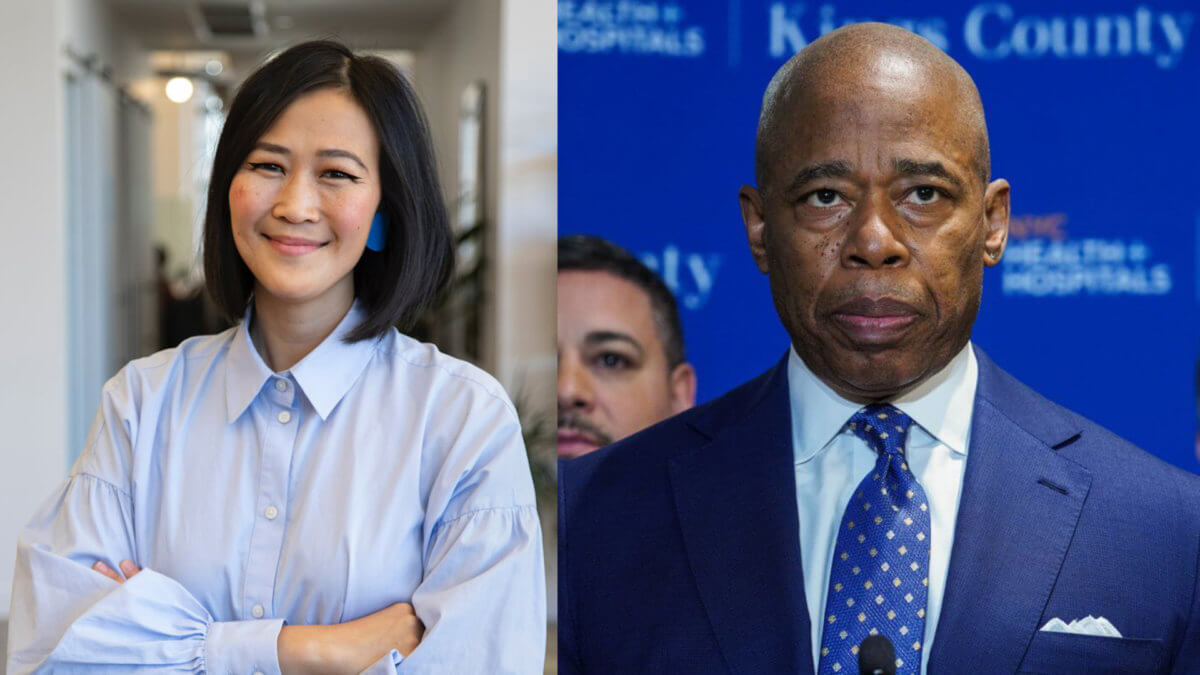
Mayor Eric Adams has tapped Ya-Ting Liu to be the city’s new chief officer of the public realm, as he signed an executive order officially creating the new cabinet position that will oversee the creation of more “extraordinary public spaces” across the five boroughs to “drive” the city’s economic rebound from COVID, according to his office.

Adams first announced he would add the new role to the top ranks of City Hall during his State of the City address late last month, based on a recommendation from the New New York Panel convened last year, which issued a December report mapping out plans for the city to reinvent its economy post-pandemic.

“Our city’s public spaces are too important to fall through the cracks of bureaucracy, and now they won’t,” Adams said, in a statement. “New Yorkers need to know there is one person at City Hall whose number one goal is to improve their quality of life by creating incredible, new public spaces and ensuring the ones we have are clean, equitable, and safe. As someone who knows how to think big and ‘Get Stuff Done’ for New Yorkers, Ya-Ting Liu is the right person to serve as the city’s first-ever chief public realm officer.”

In her new role, Liu will work to implement the mayor’s $375 million plan to improve and create several public spaces across the city, according to City Hall. Those projects include: the “Broadway Vision Plan” to reimagine Broadway in Manhattan, a “full reconstruction” of Jamaica Avenue in Queens (!!!) and making certain open streets permanent in the Bronx and Staten Island.

She’ll also oversee the implementation of a permanent outdoor dining program in conjunction with the City Council.

“In New York City, the public realm is everyone’s living room. It’s where we eat, play, and gather. Having beautiful public spaces accessible to all people is one of our greatest assets — it is what makes New York City so special,” Liu said, in a statement.

“I am thrilled and honored to be the first-ever chief public realm officer for the City of New York, and I look forward to working with our businesses, community partners, and city agencies to build vibrant, attractive, and inclusive public spaces in all five boroughs,” she added.

Tuesday, November 29, 2022

This would be 17 million cheaper to fix than building a fake park in Jackson Heights

https://bloximages.chicago2.vip.townnews.com/qchron.com/content/tncms/assets/v3/editorial/7/65/7651918b-6c63-520f-ac7f-376f04b2e212/637e476f9825a.image.jpg?resize=750%2C503

Queens Chronicle

Nearly three years after the Flushing Meadows Corona Aquatic Center’s Olympic-caliber pool closed for what was supposed to be “at least six weeks” for an emergency roof repair, it remains off limits to the public as the Department of Parks and Recreation struggles to repair its unique movable floor.

Parks said in a City Council oversight hearing last December that the pool at the 14-year-old, $67 million facility — built as part of New York City’s unsuccessful bid to host the 2012 Olympics — would reopen by January or February 2022. But while the emergency roof repair was completed in July 2021, the pool remains closed with the department’s site now reporting that the closure is “due to needed repairs to the movable floor” that’s designed to move up and down to accommodate diving as well as swimming.

Whirling machine sounds reverberated from the direction of the pool when THE CITY visited the center on Tuesday as a father rushed in looking for a swim meet for his two children waiting in the car — only to be told he was at the wrong location.

“This part of the building is closed, that’s why we have this thing here,” Ashley Bernal, the facility’s deputy director, told THE CITY as she pointed to a black belt cordoning off a section of the chlorine-scented lobby.

Construction work on the floor began this September. Yet the Parks Department capital project tracker shows the $500,000 fix marked as “0% complete.”

Parks spokesperson Dan Kastanis told THE CITY the department plans to reopen the pool around January 2023, before closing it again for 12 to 18 months starting in the summer of 2024 for a complete reconstruction of its roof along with its HVAC and dehumidification systems. In the meantime, safety netting installed onto the ceiling in early 2020 would remain in place to catch concrete shedding from the roof.

Progress on repairing the movable floor has been slow, one source familiar with the project said, because it’s a custom item that does not exist in any other Parks-run aquatic facility and requires specialized materials that are not widely available. The parts are expected to arrive in December and be installed shortly after, the source said.

Queens Chronicle 

More than two years after its transformation began, the 26-block stretch of 34th Avenue between 69th Street and Junction Boulevard in Jackson Heights remains a source of joy to many and angst to others.

The 1.3-mile section of roadway has been part of the city’s Open Streets initiative since May 2020. The longest open street in the Big Apple, it’s considered the “gold standard” of the program. On Oct. 24, the New York City Department of Transportation’s major redesign of the corridor, a project called “Paseo Park,” was officially completed.

The new design includes more “shared streets,” where cars can travel at slow speeds and are directed by diverters and other road treatments, as well as eight traffic-restricted, fully pedestrian plazas. The stretch of the avenue serves as an open street between 7 a.m. and 8 p.m. seven days a week.

“We are very happy with this space and design,” says Jim Burke, co-founder of the 34th Avenue Open Streets Coalition, which had helped bring Open Streets to Jackson Heights and push for subsequent improvements. “And I think it’s a pretty fair compromise.”

Not everyone agrees. Cassandra Langer, a resident of Jackson Heights for the past 35 years, believes both the open street and new design have blighted 34th Avenue and the neighborhood in general. She wants the route returned to a standard, functioning street.

“This new design ignores the needs of the retired elderly population, handicapped people and others,” laments Langer, a community activist who works closely with the Jackson Heights Coops Alliance — which holds an anti-Paseo Park stance. “The changes might have made sense at the beginning of the pandemic, but not anymore.” 

Langer stresses that the Paseo Park design negatively impacts parking and the ability to get deliveries, and is “not pragmatic” for older citizens who cannot solely rely on biking or walking to get around. She also points out that barriers aren’t always removed when open-street hours have ended.

“The politicians are not listening to our side or even looking for a compromise,” Langer complains. “They just want a top-down approach. We’re the grassroots taking on the powers that be.”

She said more community meetings about the situation will be held and a lawsuit is possible. And she believes the upcoming winter months “will show how unworkable the Paseo Park design is.”

Jim Burke, unlike Langer, is satisfied with the open-streets format, which he had helped fight to establish. He notes the various family-friendly activities held on 34th Avenue: everything from gardening to arts and crafts to dance classes.

The longtime safe-streets activist also emphasizes that Paseo Park “is a way to get to other thoroughfares without a car,” which is important to many in Jackson Heights. Burke believes the new level of accessibility, along with the chairs and tables peppered throughout the 34th Avenue corridor, is partly responsible for the economic resurgence of some “mom-and-pop stores and vendors” in the area.

In response to those who criticize Paseo Park for being ill-suited to the needs of older citizens, Burke cites his mother: “She has been using Access-A-Ride without an issue.” (Jim Burke's mom lives in Rockaway Beach)

Councilman Shekar Krishnan (D-Jackson Heights), who was instrumental in bringing Paseo Park to the community, is proud to have such a space in his district.

"The 34th Avenue Open Street was designed by DOT, FDNY and NYPD to improve safety and accessibility for our community," Krishnan told the Chronicle. “It is a family-focused oasis on what was once a car-centric corridor, bringing together neighbors of all backgrounds and ages. ” He declined to speculate about future plans.

Really would like to hear what the NYPD and FDNY have to say about their role in the open streets that has impeded accessibility of ambulances, fire engines and patrol cars. And who actually from those departments approved this? This one mile of new fake park land is going to cost us 84 million dollars too, so this dumb experiment is going to leave that Flushing pool high and dry.

Wednesday, November 9, 2022

Economic Development Corporation gets funding to destroy Hunters Point park space for new NYC Ferry dock

https://queenspost.com/wp-content/uploads/2022/11/ferry-5.jpg 

Queens Post 

The New York City Economic Development Corporation plans to demolish the existing ferry terminal at Hunter Points South Park and build a new dock about 300 feet away in front of the main boardwalk by the Oval.

The EDC, which oversees the city’s ferry routes, filed permits on Oct. 18 to build a floating dock in front of the boardwalk that runs parallel to the outdoor dining area near the Oval. If all goes to plan, the new dock would be completed by 2023.

The new ferry terminal would allow for an expansion of ferry operations at the site with the landing being able to accommodate two ferries simultaneously, according to the permit application. The current terminal can only handle one boat at a time.

The plans would see the construction of a large floating barge about 100 feet out from the boardwalk. Two boats would be able to dock at the barge.

A concrete platform would be built directly adjacent to the boardwalk and a long footbridge, known as a gangway, would then connect the platform to the floating barge.

The new ferry terminal would replace the current landing structure that is located in front of the beach volleyball court. The current terminal, which includes a 20-foot-wide floating barge, would be torn down should the project be approved.

The city has authorized $12.2 million in funding for the project, according to the EDC.

The plans, which were filed with the US Army Corps of Engineers, would bring about significant change to the waterfront. They have already drawn criticism.

For instance, the Hunters Point Parks Conservancy, a volunteer group that helps with the upkeep of the waterfront parks, is opposed to the project arguing it would spoil the view of the Manhattan skyline and fill the boardwalk with hundreds of passengers.

The group was also critical of the EDC, saying that it did not consult them about the plans when they were filed last month.

Meanwhile, Councilmember Julie Won, who has been briefed on the plans, said she has not yet taken a position on the matter and is waiting to hear community feedback.

Saturday, September 17, 2022

The Queensway has just been approved


NY1

Mayor Eric Adams on Friday unveiled an investment of $35 million to begin phase one of QueensWay, a new linear park planned for Queens.

The funding includes $2.5 million from the City Council, a press release said. 

“We are moving from a city of no to a city of yes and QueensWay is the way we are going to go throughout this entire city,” Adams said at news conference in Forest Hills. “And ensure that open space, green ways, good clean environments for children and families will continue to grow in this city.”   

The first phase of the project will help transform a section of an abandoned Long Island Rail Road line in Forest Hills, known as the Met Hub, into a five-acre park.

Once complete, the 47-acre QueensWay will provide the 2.4 million residents living in the borough with a new open space that will give them access to recreational amenities, outdoor educational programs and an alternative transportation to schools, businesses, and 10 bus lines, the release said. 

“QueensWay improves quality of life, improves the air quality and it promotes both physical and mental well-being and it gives more visibility to businesses along the route,” Adams said. “And so this is an economic stimulus as well.” 

But some residents were hoping get more transit options.

Last month, state, local and federal officials signed onto a letter calling for Adams and Gov. Hochul environmental impact study on the prospect of a subway line being extended into the area.

“QueensWay improves quality of life, improves the air quality and it promotes both physical and mental well-being and it gives more visibility to businesses along the route,” Adams said. “And so this is an economic stimulus as well.” 

 The gaslighting by every elected official at this announcement about the lack of park space and how it's a transit desert is mind blowing. Forest Park is by there and spans 4 neighborhoods. Numerous bus lines go around there. This also throws any plan to restore the rail transit line in the garbage.

And here's another thing. Why are two members from Transportation Alternatives there? That's Peter Beadle on the left who was at that hilarious parody protest against Jenifer Rajkumar by the rail line last year and fellow bike zealot and shameless anti-car fascist Juan Restrepo. Does that "non"-profit "public streets advocacy" organization have a government office we are not aware of? Their presence is also heinous because their Queens chairman Jim Burke recently defamed a community group led by a gay man as homophobes and racists with absolutely no evidence with the help of one of their fellow elected officials in City Council!


It's astounding how this plan just materialized from thin air after Adams made budget cuts to every municipality only a few days ago and city council found money to fund this fantastical project. This isn't the city of yes like Swagger Adams says, this is the twilight zone.

Thursday, September 8, 2022

NYC Ferry has a sinking feeling


 THE CITY

New York City is again looking for a company to run its ferry service — and wants the winner of the next contract to contribute more revenue rather than receive millions of dollars in subsidies to keep the service afloat. 

The city’s Economic Development Corporation, which oversees NYC Ferry, posted a request for proposals on Wednesday looking for a potential replacement for current operator Hornblower Group, whose contract is up next September.

Applicants will have to include a “revenue generation plan” focused on offsetting costs and EDC is inviting “creative thinking from private sector respondents” on how to make it sustainable, according to the request posted in the City Record.

EDC will favor the proposals with revenue plans that funnel the most money back to the city, the agency wrote. 

The expiring contract includes revenue sharing on the boat’s concessions and interior media ads, as well as the fares based on total ridership and revenue numbers, noted a spokesperson for Hornblower, which plans to put in a new bid. 

“Today, no other operator is better prepared to build upon the system’s early success and implement the vision to create a more equitable and accessible NYC Ferry,” Kevin Rabbitt, the CEO of Hornblower Group, said in a statement to THE CITY on Wednesday.


Tuesday, July 26, 2022

MTA coming up short on funding the subway from low ridership, but will devote 10 years to make cellphone service accessible in the tunnels.


 NY Daily News

 The MTA needs billions in new funding by 2025 to avoid dire cuts to mass transit service in and around New York City, agency officials said Monday.

Before the pandemic, rider fares and driver tolls covered about 40% of the agency’s roughly $18 billion in annual operating expenses. But new ridership projections show that model is no longer sustainable.

New projections now show that the MTA faces a $2.5 billion funding shortfall come 2025, giving lawmakers precious little time to find new funding sources to prevent service cuts and layoffs that would hamper New Yorkers’ ability to move in and around the city.

“The new dedicated funding is necessary to avoid what we’re all trying to avoid,” said Metropolitan Transportation Authority Chief Financial Officer Kevin Willens. “Large fare increases, service cuts and layoffs.”

The MTA previously estimated ridership on the the agency’s subways, buses and railroads would reach 77% of prepandemic levels in 2022, bumping up to 86% in 2023. But the spread of the omicron variant over the winter halted many companies’ plans to return to in-person work, tanking those estimates.

The MTA now projects just 61% of those riders will be back on trains and buses this year — with just 69% of them returning in 2023.

 Transit officials on Monday did not lay out what new funding sources they seek, but said planned fare hikes for 2023 and 2025 wouldn’t be enough to cover the shortfall.

CBS New York 

Cell service is coming to New York City's subway tunnels. 

On Monday, MTA CEO Janno Lieber told CBS2 the agency is rolling out a 10-year plan to install equipment that will let riders use cellphones in all underground tunnels. 

Lieber said the $1 billion investment also includes installing Wi-Fi service at all above-ground stations. 

Transit Wireless CEO Melinda White said in a statement, "Expansion of the riders' connectivity through the tunnels and across the above ground stations shows the MTA's ongoing commitment to the rider experience."

The upgrade comes as the MTA is strapped for cash. The agency is moving what it calls its "fiscal cliff" up one year sooner, since outside projections of ridership returns fell short. 

The MTA is turning to the federal government for more money, saying the pandemic relief funding will now run out in 2024. 

The agency says a full return to ridership may not come until 2035 or later. No doubt, officials hope advancements, like adding Wi-Fi, get more people underground sooner.

Friday, July 8, 2022

The Blaz's expensive lies


THE CITY 

Last fall the city Department of Investigation released a damning report declaring that then-Mayor Bill de Blasio needed to reimburse the taxpayers $320,000 for the cost of bringing his NYPD detail along during his quixotic and ultimately failed quest for the White House.

At the time, the mayor questioned DOI’s findings, claimed there were “inaccuracies” in the report, and insisted he was simply following the advice of the NYPD. He also maintained he had “never received any contradictory guidance” on the use of the detail.

But a day before he announced his bid for the White House, he did receive explicit advice from the Conflicts of Interest Board (COIB) informing him in no uncertain terms that he must pay back the city for the use of the detail on the campaign trail.

The clarity of this instruction is revealed in a May 15, 2019 letter obtained by THE CITY via the Freedom of Information Law, signed by then-COIB Chairperson Richard Briffault to de Blasio’s City Hall counsel, Kapil Longani.

Briffault’s advice on how to avoid violating city conflict rules is unambiguous:

“The City may pay for only the salary and/or overtime of the NYPD personnel on such a campaign trip,” Briffault wrote. “All other costs associated with such personal campaign travel — including but not limited to airfare, rental cars, overnight accommodations, meals and other reasonable incidental expenses — must not be borne by the City. Rather these costs must be paid for or reimbursed by the Mayor’s campaign committee.”

In explaining his decision to de Blasio, Briffault noted federal campaign finance rules would require a federal candidate to repay a government for the use of governmental resources as part of a campaign. De Blasio is currently one of more than a dozen candidates running for Congress in the 10th Congressional District.

Three years after receiving COIB’s letter, the former mayor has yet to pay a dime.

De Blasio did not respond to a voice message left by THE CITY early Thursday asking about the straightforward declaration from COIB and his decision to disregard it. Neal Kwatra, a spokesperson for his congressional campaign, followed up later in an email to say he’d need more time to research the issue before answering.

THE CITY

Former Mayor Bill de Blasio’s signature NYC Ferry took taxpayers for a pricey ride when city economic development officials underreported its costs by nearly a quarter of a billion dollars, City Comptroller Brad Lander said Wednesday.

Lander accused the city of “playing hide the ball” on ferry finances and criticized the economics and oversight of the watery transportation network, which launched under de Blasio in 2017 and promised heavily subsidized $2.75-per-ride trips from piers in all five boroughs.

The comptroller’s report says the Economic Development Corporation rang up $758 million in ferry-related costs from July 2015 through the end of last year — but only reported $534 million in expenses in its audited financial statements and other records.

“This is a very substantial financial underreporting and mismanagement,” Lander said while standing near Pier 11 in Lower Manhattan. “$250 million of underreporting raises a lot of questions and those questions should be asked.”

Auditors found that the city’s actual subsidy on each ferry trip rose to nearly double the $6.60-per-trip subsidy that the de Blasio administration originally projected. The city subsidy amounted to $12.88 for Fiscal Year 2021, according to the report, not the $8.59 that was originally reported.

“It is a premium service, like express buses and it is also a tourist commodity,” Andrew Rein, president of the Citizens Budget Commission, told THE CITY. “We should be pricing the ferries accordingly and that should be able to reduce that subsidy.”

The comptroller’s report follows a series of stories in THE CITY about NYC Ferry, including one in January that revealed how de Blasio’s budget office supplied a $23.2 million infusion for the service before he left City Hall at the end of 2021 — after the service had previously been funded by the EDC.

“The ferry system was eating the EDC budget,” said Rein, whose nonprofit organization detailed in a 2019 report how subsidies for NYC Ferry are among the highest in the country for comparable ferry networks.

Lander’s report calls into question the purchase of new boats — something THE CITY flagged in April 2019 — as well as the $2.75 fare that de Blasio insisted on for the privately operated ferry trips. The price of an NYC Ferry trip is considerably lower than one on similar services in San Francisco and Boston.

On the San Francisco Bay Ferry, for example, fares are determined by three different zones, with the priciest zoned trip set at $11.25 for a paper ticket or $9.00 for rides paid for through mobile devices or the Clipper fare-payment system. 

De Blasio, in a statement through a spokesperson for his campaign for Congress, said he could not comment on Lander’s report because he had yet to fully review it.

Wednesday, May 4, 2022

99 and a half will do and more

Collins’ gown, a loaned sample, is from Oscar de la Renta's Spring-Summer 2022 collection.

NY Post 

It’s good to be the Mayor!

Eric Adams’ office made out the best among the Big Apple’s more than two dozen major city agencies, scoring a 25 percent bump in his recently unveiled $99.7 billion city budget proposal, a Post analysis found.

Adams has requested $204 million for his 1,400-strong executive operation, up from the $163 million de Blasio allotted to his office during his final year running the city.

“One of the easy criticisms of the de Blasio administration was growing the Mayor’s Office budget,” said Council Minority Leader Joe Borelli (R-Staten Island). “Everyone can see litter in the street and understand the need for more sanitation workers, so what’s the plainly obvious reason for this?”

Most of the $41 million boost is dedicated to a major expansion of the division of the Mayor’s Office of Contract Services, which reviews spending agreements and tracks vendor performance.

Adams’ budget would increase MOCS’s budget from $26.5 million to $59 million and add another 47 employees, expanding its headcount from 197 to 244 employees.

Monday, April 25, 2022

Mayor Adams throwing more city budget money gas on the homeless shelter fire


AMNY 

Mayor Eric Adams announced Sunday the largest investment made by any city administration to combat homelessness.

Adams declared that his administration will add more than $170 million in the Fiscal Year 2023 executive budget to provide what he says will be high-quality services and resources for homeless New Yorkers. 

The announcement comes as his administration works to dismantle homeless encampments throughout the city and get unhoused individuals out of the subway system. Both efforts received criticism among advocates and homeless people themselves, many of whom said they don’t want to be forced to return to city-run homeless shelters that have proven unsafe in the past.

But Adams said the funding will be used for “Safe Haven” and supportive housing beds that offer residents a peaceful and stable environment by which to rebuild their lives. It’s an effort to build confidence among homeless residents to accept the help the city’s offering them.

“This is not a one and done. This is a baseline that every year this is going to have the funding will include expanded outreach efforts to connect those in need to specialized resources,” Mayor Adams said. “This funding will help expand these efforts including safe havens, stabilization beds, and drop off centers. These are the things people have stated constantly, these are the things you need to do, so now here’s the partnership: Every elected official, every advocate, the state, we want these types of beds we’re saying to them, join us, you know, join us we’re not going to oversaturate one community with the beds that we’re looking for because we have done that historically. We’re not going to do that. This is New York City’s problem, so New York City must ensure that this is happening correctly.”

Sunday, April 24, 2022

Mayor Adams is going to spend 900 million dollars to make life difficult for drivers


NY Daily News

Mayor Adams on Saturday said he aims to give New York City’s streets a $904 million makeover over the next five years — adding hundreds of miles of bike and bus lanes as well as revamped pedestrian spaces.

The budget target makes good on legislation passed by the City Council in 2019 that mandated a “streets master plan” for the five boroughs. The plan requires the city Department of Transportation build 250 new miles of protected bike lanes and 150 miles of new bus lanes by the end of 2026.

“This is a historic investment,” Adams said during a news conference on his proposal. “We must do our part, and that is to ensure that the pathways are safe where people can feel comfortable and utilize the bike infrastructure we have. We are so far behind international leaders. If you go to other cities and countries across the globe, they are so far ahead of us.”

Adams — who rode a bike from City Hall to the press conference in downtown Brooklyn —didn’t lay out specific plans for the bus and bike lanes’ makeover, or new pedestrian this year.

The proposed $904 million investment over five years must be worked out with the City Council as part of the city’s budget that’s due at the end of June. The amount is roughly in line with the $1.7 billion the Council in 2019 estimated the street redesigns would cost over a 10-year period, officials said.

But the proposal is well short about $2.2 billion short of the $3.1 billion Council members proposed earlier this year for the city’s streets plan. The Council’s plan goes much further than the benchmarks laid out by the 2019 law, and would add some 500 miles of bike lanes and turn dozens of city streets into pedestrian plazas.

The Daily News, and surely every other news outlet, forgot to mention that this plan was concocted mostly by "public space" and bike zealot lobby groups Transportation Alternatives and Bike New York. Showing once again that the agents of the city are shaping the city for the worse.