Showing posts with label transportation. Show all posts

Friday, March 11, 2022

City Council cronies form civic concern for "transportation equity" and are coming to your town

https://impunitycity.files.wordpress.com/2022/01/049.jpg

For Immediate Release: Friday, March 11, 2022

Contact: Vanessa Caesar | vcaesar@council.nyc.gov | (646) 941-3331


Majority Whip Selvena N. Brooks-Powers Continues

Citywide Transportation Tours in Partnership with

Council Members Alexis Avilés and Lincoln Restler


(Queens, NY) - New York City Council Majority Whip Selvena N. Brooks-Powers, Chair of the Committee on Transportation and Infrastructure, will tour New York City Council Districts 33 and 38. Majority Whip Brooks-Powers will embark on the fifth stop on a citywide transportation listening tour as a part of her First 100 Day Tour, meeting with elected officials and citywide stakeholders to better understand both infrastructure and transportation needs in communities across the city.


Majority Whip Brooks-Powers will first join Council Member Alexa Aviles will tour the Brooklyn-Queens Expressway intersection, plaguing trucking routes, and pedestrian crosswalks, ending at a last-mile facility in Red Hook, Brooklyn. During the tour in Council Member Lincoln Restler’s district, the Majority Whip will tour the district viewing dangerous pedestrian sites, local subway stations and will conduct tour partially via Citi Bike. 


Following tours in all 50 City Council districts, Majority Whip Brooks-Powers will conclude with listening sessions with each Borough Delegation. Listening sessions will be open to the public and take place virtually to discuss borough-wide issues regarding accessible transportation options, bus routes, train and commuter line rail issues, for-hire-vehicle rights and availability, as well as a myriad of issues affecting residents of the five boroughs.


WHO:           NYC Majority Whip Selvena N. Brooks-Powers and

NYC City Council Members Alexis Avilés and Lincoln Restler


WHEN & LOCATIONS:     Friday, March 11, 2022

·         Stop #1 @ 8:15am: 4417 4th Avenue (Ground Floor), Brooklyn, NY 11220

·         Stop #2 @ 10:00am: Intersection of York Street and Jay Street, Brooklyn, NY 11201


Press is invited to attend

###


Vanessa Caesar | Director, Scheduling/Events

Office of NYC Council Majority Whip Selvena N. Brooks-Powers

31st District, Queens

City Hall: (212) 788-7216

Far Rockaway: (718) 471-7014

Laurelton: (718) 527-4356

Website: https://council.nyc.gov/district-31/

Follow Us At:

Facebook/Instagram: @CMSelvenaBrooksPowers

Facebook: @CMBrooksPowers

Do I have to remind everyone that one of these council cronies, the notorious Linky Restler is wholly influenced and agency captured by the Transportation Alternatives non-profit lobby organization that are trying to usurp the streets from commuting by car? This guy is such a pawn for them that he's reduced himself to making ludicrous videos feigning to be scared of crossing a street.


Well except if you happen to work for app-hail car corporation that happens to be one of Transportation Alternatives biggest contributors. Because Council Member Brooks Powers is holding a massive job fair event "powered by Lyft" in Rockaway Beach to recruit new gig livery drivers, which will also be attended by other elected officials including the meddling shitlib self-promoting comptroller Brad Lander. '''
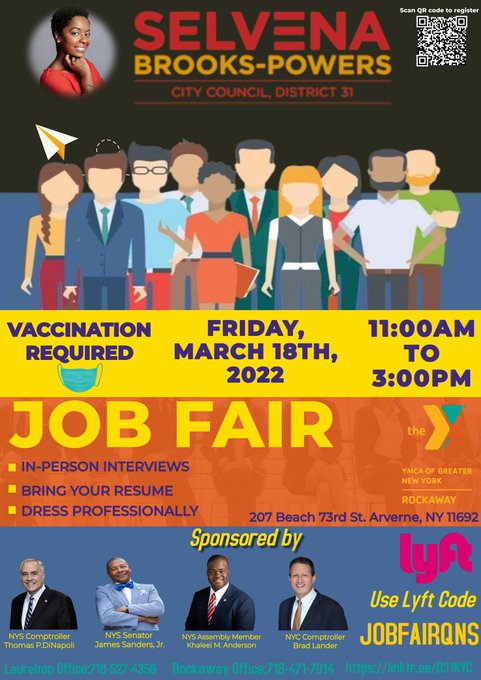
 

 https://pbs.twimg.com/media/FNf6a5WVgAQuROS?format=jpg&name=small


Oh, don't forget your fucking vax pass.


Monday, November 5, 2018

City: "Now that LIC is overdeveloped, let's worry about infrastructure"

From LIC Post:

The city has committed to investing millions in Long Island City under a new plan released today aimed at supporting sustainable growth in the neighborhood.

The Long Island City Investment Strategy, as the longterm plan is called, outlines the ways the city is and will be addressing practically all infrastructure in the neighborhood, ranging from parks, schools, transportation, and sewage systems.

To fund the improvements, the city is funneling $180 million into the neighborhood on top of $2.2 billion it says it has invested into the area over the years.

The city admits the impetus for its strategy comes from rapid residential development that has strained neighborhood resources and the quality of life of people living in the neighborhood since the 2001 rezoning.

The plan, additionally, stems from coordinating with multiple city agencies and engaging with the community since 2015, where the city heard concerns from distressed locals on infrastructure keeping pace with development.

Monday, September 3, 2018

Transportation between Brooklyn and Queens is pretty bad

From CityLab:

One might think that getting from Brooklyn to Queens—or vice versa—would be easy.

For one, they’re physically connected to each other; they share the same landmass—the start of Long Island, but not technically Long Island. Secondly, they’re New York’s two biggest population centers. And finally, of the five boroughs, they’re both major drivers of population and job growth in the city right now.

But unless you own a car—which most New Yorkers do not—it’s strangely hard to get from one borough to the other. By subway, residents must seek out train lines at the ends of each borough, before backtracking. Bus routes are notoriously circuitous and slow. Both systems are a result of the spoke-hub model, designed at a time when Queens was comparatively pastoral and Brooklynites largely headed into Manhattan for work. So much so that even in 2018, it’s a common refrain in New York City mass transit that if you’re going between the two boroughs, you’re either going through Manhattan, or not going at all.

That’s what made The Great Cross-Borough Mobility Mode Challenge (that was my name for it, at least) on this steamy Tuesday morning during rush hour a bit more interesting.

Just after 8:30 a.m, seven participants simultaneously left a starting point in Bushwick, Brooklyn, and hopped onto their assigned means of transportation: subway, bus, Citi Bike, Uber, UberPool, taxi, or electric moped. Their goal? Pass this goofy made-up finish line—which had a sign, green tape, and all—outside of the Court Square Diner in Long Island City, Queens, where myself and a handful of other transit-beat reporters were waiting beneath the shadows of rapidly rising condos and subway tracks.

The race was put on by Revel, a shared electric moped company that recently premiered in north Brooklyn. The point of the stunt, beyond snagging some media attention, was to highlight the fact that traveling during rush hour between Brooklyn and Queens sucks. And it only stands to get worse once the L train goes offline for 15 months in April of 2019, dispersing hundreds of thousands of riders onto overburdened stations and roads. The big question: Which of these shared-mobility services, old and new, performs best under pressure?


And they wonder why we own cars here...

Friday, May 25, 2018

MTA to provide more Queens bus service later this year

From the Queens Tribune:

The Metropolitan Transportation Authority announced this week that it will soon offer additional rush hour train service and weekend bus service due to high demand.

Last week the Queens Tribune published a feature titled “Surviving The Summer Of Hell In Western Queens” that informed borough commuters regarding delays and closures that are expected in the upcoming months.

The president of New York City Transit has since announced that additional A, D, E and F subway trains will operate during weekday rush hours beginning in November. There will also be additional Q6, Q8, Q29, Q47, Q49, Q101 and Q65 buses on the weekends beginning in July.

Saturday, December 30, 2017

Why we can't get any major MTA projects done

Great expose in the NY Times:

An accountant discovered the discrepancy while reviewing the budget for new train platforms under Grand Central Terminal in Manhattan.

The budget showed that 900 workers were being paid to dig caverns for the platforms as part of a 3.5-mile tunnel connecting the historic station to the Long Island Rail Road. But the accountant could only identify about 700 jobs that needed to be done, according to three project supervisors. Officials could not find any reason for the other 200 people to be there.

“Nobody knew what those people were doing, if they were doing anything,” said Michael Horodniceanu, who was then the head of construction at the Metropolitan Transportation Authority, which runs transit in New York. The workers were laid off, Mr. Horodniceanu said, but no one figured out how long they had been employed. “All we knew is they were each being paid about $1,000 every day.”

The discovery, which occurred in 2010 and was not disclosed to the public, illustrates one of the main issues that has helped lead to the increasing delays now tormenting millions of subway riders every day: The leaders entrusted to expand New York’s regional transit network have paid the highest construction costs in the world, spending billions of dollars that could have been used to fix existing subway tunnels, tracks, trains and signals.

Thursday, November 30, 2017

Advocates come up with development & transit plan to make NYC less affordable

From the Daily News:

Imagine New York without its 24/7 subway system?

The experts at the Regional Plan Association did, and they believe it's key to building a reliable transit system for a growing metropolitan area.

The radical idea to snuff the pride of New York is one of dozens of recommendations in the research group's latest regional plan — the association's fourth region-wide blueprint since 1929 — being released Thursday.

“We think that the days of the 24/7 subway system in New York are coming to an end,” RPA president Tom Wright told reporters of the “controversial” idea.

Raise money through new taxes, like charging drivers to enter Manhattan’s business center, tolling major roads and highways, adopting a cap-and-trade program for emissions, and a tax based on vehicle-miles traveled. Build dense housing near transit stops throughout the region.

Extend subway lines around the city and build out overcrowded stations.

Create a regional rail network that allows trains to flow unimpeded through the tristate area, such as building a new facility south of Penn Station that could allow rail to bring travelers between Long Island and New Jersey without switching trains.

RPA is unveiling its full plan Thursday at The New School, with elected and government officials from around the region.

Thursday, September 14, 2017

A more fiscally prudent transportation plan

From Crains:

Rather than spend several hundred million dollars to build a light-rail system which could take a decade or more, why not ask the LIRR to resume service on this corridor? It could run a two-car scoot service reconnecting Long Island City, Glendale and Middle Village with other communities including Richmond Hill and other intermediate stops to Jamaica. The LIRR could use existing equipment, which would afford far earlier implementation of service than light rail. This would provide connections east bound to the J/Z and E subway lines, Kennedy Airport via AirTrain and the LIRR's Jamaica Station. Queens residents traveling to jobs and colleges in Nassau and Suffolk counties would have access to all LIRR branches except the Port Washington line. Ditto for those traveling to the Barclay Center and downtown Brooklyn via the LIRR Atlantic Avenue branch. There would also be connections westbound at either the Hunters Point or Long Island City LIRR stations to the 7 subway line.

Thursday, January 5, 2017

Cuomo unveils plan for JFK overhaul

From AM-NY:

Governor Andrew Cuomo Wednesday unveiled a multi-billion dollar plan to rehabilitate Kennedy Airport as well as travel connections to the facility.

The three-pronged plan, completely reimagines the airport while also attempting to address access on roads and through mass transit.

The overhaul would come at the tune of about $10 billion, with around $7 billion coming from private investment.

It was put forth by Cuomo’s Airport Master Plan Advisory Panel, which is also overseeing the redevelopment of LaGuardia Airport, as a way to accommodate projected passenger increases.

The proposal would expand the newer terminals to meet growing passenger demands. Older terminals would be redeveloped and relocated to increase connectivity. The roads in the airport facility itself would be reworked create a less-complex circular route.

By car, Cuomo’s administration wants to widen connector ramps of the Van Wyck Expressway and Grand Central Parkway at the Kew Gardens Interchange to reduce bottlenecking. It would also add an additional lane in each direction to the Van Wyck. This would cost anywhere between $1.5 billion to $2 billion.

Cuomo said his administration was still deciding between two options to address mass transit access to the airport. One would focus solely on improving JFK AirTrain service and its links to the rest of the area’s transit network. This option would increase service frequency while also doubling the number of cars per train, from two to four. It would also bring a complete overhaul to the Jamaica transit hub to improve transferring to the AirTrain from the subway and LIRR.

Friday, November 18, 2016

Brooklyn doesn't want streetcar

From DNA Info:

Downtown Brooklyn residents “don’t need” the mayor’s proposed streetcar running through their neighborhood, locals told city officials at a Tuesday meeting, citing the high cost to taxpayers and the disruption to traffic.

Officials from the Department of Transportation and the Economic Development Corporation presented proposed routes for the Brooklyn-Queens Connector, dubbed the BQX, through Downtown Brooklyn and the surrounding neighborhoods at a Community Board 2 Transportation Committee Meeting.

Proposed routes such as Flushing Avenue and Cadman Plaza East would take riders past the transit-starved Brooklyn Navy Yard and make connections to transit hubs including Borough Hall.

“You cannot maintain all the lanes of traffic, maintain all the sidewalk width, all the bike lanes and all parking lanes — that’s not possible,” BQX Director Adam Giambrone said. “There will be tradeoffs that need to be made.”

Residents and community board members raised opposition to the streetcar — which will cost $2.5 billion to build and $30 million annually to operate — calling the costs unnecessary and instead suggested the city spend the money on additional buses in the area.

Tuesday, August 30, 2016

Jamaica transportation hub getting an upgrade


From the Daily News:

A major transit hub in Jamaica, Queens, is getting nearly $8 million in state money for upgrades that’ll make it easier to catch a ride, State Sen. James Sanders will announce Tuesday.

The money for the Jamaica Transportation Center Station Plaza — one of the city’s busiest transit stations where commuters can catch a Long Island Rail Road, the E, J and Z trains and a host of bus routes — is intended to give more space to pedestrians at the bustling transit and retail center, said Sanders, who got money for the station improvements as part of a transportation funding plan hashed out with his fellow state lawmakers.

Tuesday, May 10, 2016

Streetcar a developer's fantasy

From Patch:

City officials held a public “visioning session” on the proposed Brooklyn Queens Connector (BQX) streetcar in Astoria Monday night — the first of what they promised would be many outreach efforts to gather feedback on the $2.5 billion proposal.

Bus lanes might be cheaper to implement, the head of the EDC said, but a streetcar could carry twice as many passengers — a critical perk for a system that would transport an estimated 50,000 riders on weekdays.

Torres-Spring also argued a rail system would increase property values along its route. This, she said, would allow the city to fund the BQX using a cut of rising property values along the rail line.


[AHA! I think we're on to something here.]

Also present at the meeting was Ya-Ting Liu, recently named executive director of Friends of the Brooklyn Queens Connector. Liu's organization was behind the project’s first feasibility study, and is currently advocating for its construction.

While developers like Two Trees are well-represented in the Friends group, Liu noted that many non-developers are also members — including Paul Steely White, executive director of Transportation Alternatives, and Thomas Wright, president of the Regional Plan Association think tank.


[Oh, you mean reps of groups funded by developers?]

Saturday, July 11, 2015

Crowley pushes for light rail, housing in manufacturing areas

From the Queens Courier:

Commuters in Glendale and Middle Village deal with limited public transportation options. Most residents in both communities live a mile or farther away from the nearest subway station, and local bus lines through the area have a reputation for being slow and overcrowded.

City Councilwoman Elizabeth Crowley hopes to change this situation with a plan to introduce light rail service between Glendale and Long Island City on the Long Island Rail Road’s Montauk branch, which currently offers only freight service west of Jamaica. She hopes to pitch the idea to the Department of City Planning in the coming weeks.

In an exclusive interview with the Ridgewood Times on Monday at her district office, Crowley said a new diesel-powered light rail line would address the transportation needs in Glendale and surrounding communities. ***The light rail line could also encourage redevelopment of underutilized industrially zoned areas adjacent to the line for business or residential purposes.***

Crowley doesn’t suggest rebuilding the former Glendale station, but rather creating a new stop at The Shops at Atlas Park, noting that the shopping center—where her district office is also located—could serve as an active park-and-ride option for local residents.

“If we were able to get a rail here, people could potentially use this spot as park-and-ride, or the community around us could take a bus to the train or walk to the train,” Crowley said. “It provides options for public transportation that would effectively get more cars off our streets.”

She also pointed to an area near Flushing Avenue in Maspeth as another potential station site, noting that it’s close to the connecting LIRR Bushwick branch, another freight rail line that Crowley suggested could potentially also accommodate light rail service.


We all know Atlas Park isn't doing well and that Liz's friends, the Argentos, recently opened a soundstage next to Atlas Park. So it's interesting that she admits that she wants to boost their real estate value by building a light rail station there. But I guess she forgot that there are 2 at grade crossings west of Flushing Avenue, which a light rail to LIC would be forced to pass through, including one which just experienced a serious collision this past week due to a malfunctioning signal. And where are all the freight trains on the line going to go? Freight traffic is increasing, not decreasing.

Tuesday, April 7, 2015

Residents identify Jamaica's problems

From Karen Clements:

Poor transportation, too many fast food options and crime are some of the barriers residents told Downtown Jamaica’s three Business Improvement Districts, which prevent them from visiting the area. This feedback was part of a forum hosted by the BIDs to gather resident input and participation on improving Downtown Jamaica.

Despite persistently low crime rates, Downtown Jamaica continues to suffer from the perception of being a crime ridden district. Part of that perception has to do with the large number of teens that congregate on Jamaica Avenue at the end of the school day. In addition, residents cite recent high profile police events, including the attack on a police officer by a machete wielding assailant.

Transportation was also an area of concern. Although the Jamaica Center Transit hub is located in the Downtown Jamaica District, residents mentioned how poor service curtails opportunities to shop and dine to just passing through

“I still wait thirty minutes for the Q6 bus,” said Vanessa Sparks a resident who participated in the forum.

“It would be great to get off work, pick up a meal, put it in a bag and then take it home,” said Maria Starks, a resident who participated in the forum and summed up the insights of her group.

In addition to an over abundance of similar stores and too many fast food chains, residents felt that Downtown retail is geared towards a younger market. Sneakers and trendy clothing are heavily marketed, however goods that would be of interest to mature adults and seniors are not readily available and that audience is not coveted. The quality of merchandise and poor service were also in question with residents suggesting the addition of higher end retail.

Residents didn’t only look at external forces as the cause for their for their lack of interest in the area, but took ownership for their part as well for their lack of participation.

Thursday, March 26, 2015

Big long bus route proposed

From the Daily News:

The city’s most ambitious plan to speed bus travel to date — an approximately $200 million, 14-mile super route through the heart of Queens — was unveiled by the de Blasio administration Tuesday.

The design features bus-only lanes, curbside fare payment and wireless technology that activates green lights for approaching buses between Woodside in the north all the way down to the Rockaways on the southern coast.

A six-mile segment in the center of the route along Woodhaven and Cross Bay Blvds. will be the most dramatically altered, with separate lanes for local and through traffic, turning restrictions and wide, landscaped pedestrian islands for riders getting on and off buses, officials said.

Construction is expected to start in 2017 and take about one year, Transportation Commissioner Polly Trottenberg said. The entire project is estimated to cost $200 million, officials said.

When finished, the seven Select Bus Routes created by the city since 2008 will pale in comparison, Trottenberg said.

Thursday, March 19, 2015

We spend way too much time commuting

From the Daily News:

New Yorkers aren’t just workaholics - they spend more time working and commuting than residents of any other big city.

The city’s work week and commute together average 49.1 hours - beating the 29 other largest cities in the country, according to an analysis by City Controller Scott Stringer.

“Our transportation network is grinding us down,” Stringer said. “It’s a one-two punch for lower wage workers, who get paid less and travel longer to get to work.”

New Yorkers work only slightly longer hours - with an average work week of 42.4 hours, compared to 42.5 in the other cities - and rank 12th of the 30 spots surveyed.

But with commute factored in, the city’s combined work week of 49.08 outstripped other cities’ average of 46.48 by two and a half hours.

Workers in the finance industry log the longest work weeks, at 47 hours on average. But security guards have the longest commutes, at eight hours a week, Stringer found. Low wage workers tend to have the longest travel times because they can’t afford to live close to work.


This is why it makes me laugh when commenters say that people should live near subways to reduce carbon footprint, not own a car, blah, blah, blah.

Thursday, February 5, 2015

Transit advocates don't want more ferries

From Capital New York:

By de Blasio's estimation, New York City is a water-bound metropolis whose rivers and harbors are underutilized resources. It's a view shared by politicians representing water-proximate neighborhoods from the Rockaways to Red Hook to Brooklyn Heights.

Transit advocates, however, greeted his pronouncements tepidly.

"In the transit community that I am a member of, ferries are looked on as being as helpful as rowboats," said Gene Russianoff, staff attorney at the Straphangers Campaign.

Jeffrey Zupan, a senior fellow for transportation at the Regional Plan Association who's a bit more ferry-positive than Russianoff, said that while it was a good thing to explore how best to further deploy ferries, caution is also in order.

"The idea of running ferry service has always been attractive ever since ferries stopped running, when we built all those bridges and tunnels," Zupan said.

But by his count, since 1986, ferry operators have tried roughly 70 different ferry routes to Manhattan, and only about 20 are still in place.

That's because most ferries move relatively few people and generally require more per-rider government subsidy than subway and bus operations.

In fact, the de Blasio administration made that very argument last year, when it decided to cancel ferry service to the Rockaways because it cost too much per rider.

Wednesday, January 7, 2015

Ambulette service ripped off Medicaid

From the Daily News:

A QUEENS-BASED transportation company will pay the state back $300,000 in a settlement related to Medicaid overcharges, Attorney General Eric Schneiderman said Monday.

Apple Transportation of New York, Inc. “frequently” billed Medicaid for ambulette services to transport mental health patients instead of for livery services, which has a lower reimbursement rate, Schneiderman’s office said.

The pricier ambulette services provide personal assistance to the patient, whereas livery service does not.

The improper billings took place between 2004 and 2008, officials said.

Thursday, December 4, 2014

Doctoroff has really pissed Van Bramer off

From LIC Post:

The drum beat to develop the Sunnyside Yards continues with the latest call to build on it coming from the former Deputy Mayor Dan Doctoroff.

Doctoroff, in a New York Times op-ed piece that ran Sunday, said that the city needs to build a 3.1 million square foot convention center and that Sunnyside Yards would be the ideal place for it. The center could also be accompanied, he wrote, by nearly 14,000 residential units of which 50 percent would be affordable.

The op-ed stated that Long Island City is a great location for this development since it is “one of the most convenient, transit-friendly areas in the city, served by eight subway lines.” The idea is that the new convention center would replace the Javits Center, which he deemed too small.

However, residents and local officials argue that the concept just doesn’t make sense and that the neighborhood’s infrastructure in terms of schools, parks and subways are already stretched. Many are unsure how the neighborhood will absorb all the new residents coming to the area, with 5,000-10,000 units coming online in the next few years.

“I found some of [Doctoroff’s op-ed] patronizing,” said Councilman Jimmy Van Bramer who opposes decking over the yards. “It revealed to me somewhat of a Manhattan elitist view of Queens.”

Van Bramer said that Doctoroff might find the neighborhood transit friendly when he looks at the area on a map. However, he said, people who live here know that the No. 7 train is not reliable and there are a lot of delays. During morning rush hour, people often struggle to get on at the Jackson Ave/Vernon Blvd. Station, he said.

At the October Community Board 2 meeting, when the idea of studying the yards was raised, several board members wanted to know how the area will cope with all the Court Square/Queens Plaza development coming online—let alone the yards.

Meanwhile, a petition has just been formed, calling on the city not to allow the site to be developed.

Saturday, October 11, 2014

Katz not yet sold on Aqueduct soccer stadium

From the Queens Chronicle:

Aqueduct soccer stadium bandwagon — at least not yet.

At Community Board 10 last Thursday in South Ozone Park, Katz said she “likes the idea” of a Major League Soccer stadium in Queens, but had “deep reservations” about siting it at Aqueduct, which she said is not easily accessible from other parts of the city.

“We have a 90 percent increase in subway ridership right there,” she said. “It takes a long time to get there, and during rush hour it’s worse. There’s infrastructure and access issues.”

Katz’s concerns echo those of many in the community who feel Aqueduct Race Track is not easily accessible by car or public transportation.

“I think it’s good for us, it’ll bring tourism in. I think there’s a response from folks here with a deep interest for that,” Katz said of a stadium in Queens, but noted that even from her own house in Forest Hills, getting to Aqueduct would be rough.

She did not offer any other potential sites. The stadium plan, which would be home to MLS expansion franchise New York City Football Club, was originally proposed for Flushing Meadows Corona Park, before being moved to the Bronx when the New York Yankees took a 20 percent share of the team. NYCFC begins playing at Yankee Stadium next year.

But a Bronx deal was not worked out, and Aqueduct was the next idea to be floated.

Thursday, October 9, 2014

Plan to change transportation in western Queens

From the Daily News:

The blossoming areas of Long Island City and Astoria need better connections to tech hubs in Brooklyn, as well as Roosevelt Island and LaGuardia Airport.

So say city planners, who are suggesting a slew of changes to better connect rapidly developing areas of Western Queens to job centers across the city.

Among the possibilities included in a city study, issued this week, are the creation of a new transit corridor — potentially serviced by an express bus — that would extend from LaGuardia to Downtown Brooklyn.

The city also proposed the expansion of bus and ferry service to service Astoria’s rapidly developing waterfront neighborhoods.

Among other possibilities:

  • Extending service to Roosevelt Island on the Q19 (Astoria Blvd. to Main St.) and Q39 (Queensboro Plaza to Ridgewood) bus routes.
  • Eliminating the Q102, which runs between Manhattan, Roosevelt Island and Astoria.
  • Adding express service on the N and Q subway lines at the Ditmars Blvd., Astoria Blvd. and Queensboro Plaza stops.
  • Calming traffic along Vernon Blvd., 21st St. and Crescent St. including the addition of crosswalks and curb bumpouts.
  • Converting metered lots at Vernon Blvd. and Jackson Ave. into so-called green medians.
  • Improving bike travel to Roosevelt Island by upgrading a path along 36th Ave.

Some objected to elements of the proposals — such as the new ferry service — that seemed geared to accommodate Astoria Cove, which is still under public review.

Yup, that's the only reason this is happening. Love the war on Vernon/Jackson metered parking. Will do wonders for the restaurants there, especially when the 7 stops running again. There's also a guy petitioning for a Metro North stop in western Queens.