Showing posts with label taxpayers. Show all posts

Sunday, August 14, 2016

Dissecting the numbers: DHS' phony homeless crisis

The story from the DHS has changed from "243 residents of Maspeth" are in shelters, to "243 residents of Community Board 5" are in shelters. Why the city feels the need to require shelter placement based on made-up political boundaries is a good question. Regardless, the DHS' numbers still don't add up. They say that CB5 doesn't have a shelter and needs to do its fair share, however, another 110-room shelter in CB5 is not necessary at all. Why?

Most of the homeless from CB5 are members of families with children. Each family needs one room. CB5 produced 54 homeless families in 2014. Crunching the numbers it appears that 1 existing location could just about house every homeless family produced by not one, but FOUR community boards in western Queens.

CB1:
Astoria: 41 families

CB2:
Long Island City: 29 families
Sunnyside: 1 family
Woodside: 22 families

CB4:
Corona: 38 families
Elmhurst: 15 families

CB5:
Maspeth: 7 families
Middle Village: 3 families
Ridgewood/Glendale: 44 families

Total: 201 families
The Pan Am shelter alone holds 200 families

So if all of the homeless families of western Queens could fit in the Pan Am, why do we also need the Metro Motel, the Westway, the Quality Inn, etc? It seems we have too many beds for the homeless families we are told we need to be responsible for.

Moving on to couples:

Once again, the 1 couple from Maspeth and 3 couples from Ridgewood could fit into a 4-family house. The city owns one on Flushing Avenue that it wishes to keep in dilapidated condition instead of putting to productive use.  Using the criteria above, the homeless couples without children produced by CB1, CB2, CB4 & CB5 amounts to 30.  The city is proposing a 110-room shelter for couples at the Maspeth Holiday Inn which is way more rooms than western Queens needs to house the homeless couples we crank out.

And finally, singles:

34 singles from CB5 doubled up in rooms means that in actuality, only 17 rooms are required in the district. Spread them out across the neighborhoods and that doesn't seem to be a big deal. I suggest using AirBnB to accomplish this (tee hee).

Please do not believe the DHS' dazzling lines of bullshit. They want hardworking taxpayers of Queens to pay for freeloaders from out of town. Let them do what every other municipality seems to be doing - put them on a bus to somewhere else, preferably where they came from in the first place. The burden of sheltering the entire country should not fall on NYC taxpayers because fauxgressives want to perpetuate the dependency culture that keeps them elected for life.

Tuesday, May 21, 2013

Lots more where they came from

From the NY Post:

Shady politicians and their backroom deals cost taxpayers at least $49,710,630.64 — enough cash to build two schools, bankroll the New York Islanders or pay for 100 new fire trucks — according to a Post analysis of documents relating to 15 city and state officials who’ve been jailed, indicted, censured or lost re-election bids under a cloud of suspicion since 2006.

The rogues gallery is led by former state Comptroller Alan Hevesi, who cost the state $36 million in pension-fund management fees after taking nearly $1 million in illegal gifts; ex-state Sen. Pedro Espada, who funneled $7 million to himself and family members through a Medicare-funded nonprofit; and Assemblyman Vito Lopez, who cost taxpayers $103,000 in secret settlements after staffers accused him of sexual harassment.

The nearly $50 million tally doesn’t include bribes accepted or money embezzled from private entities, such as the $440,000 that state Sen. John Sampson allegedly raided from foreclosure escrow accounts he was appointed to oversee. It also doesn’t count taxpayer money that was promised but never doled out, such as the $80,000 in discretionary funds City Councilman Dan Halloran allegedly said he’d allocate to a dummy company in exchange for a bribe.

Thursday, January 19, 2012

Using taxpayer dollars to promote themselves

From the Daily News:

The state's budget crisis hasn't stopped lawmakers from spending big bucks to promote themselves.

Members of the Senate and Assembly have spent nearly $9 million in taxpayer money this year on constituent mailings, the Daily News has learned.

The spending comes as the state faces a $9 billion budget deficit and is preparing to lay off hundreds of government workers on Dec. 31.

"It's an extraordinary amount of money when the state is broke," said Dick Dadey, executive director of the good government group Citizens Union.

"And the timing of the newsletters is geared to inform voters just before an election, which is doubly inappropriate."

Senators spent $5.3 million on postage, while Assembly members spent $3.6 million. The Senate and Assembly spent a combined $12 million last year, records show.

Tuesday, November 22, 2011

Court rules against taxpayers in pork lawsuit

From Capital Tonight:

The state’s highest court has dismissed a lawsuit brought by a group of 50 taxpayers who challenged state government’s constitutional authority of doling out economic development grants and tax breaks to private companies.

In a 4-2 ruling handed down today by the state Court of Appeals, Judge Theodore Jones wrote there were no grounds for suit despite the questioning “the wisdom of policy choices.”

Judges Eugene Pigott and Robert Smith wrote separate dissents, taking a more word-for-word interpretation of the constitutional argument in the suit.

Wrote Pigott:

“Unconstitutional acts do not become constitutional by virtue of repetition, custom or passage of time. But that is what the majority opinion holds today. The arguments made by these defendants are precisely the kind of claims that sully taxpayers’ view of our State government. It is unfortunate that the majority gives credence to those arguments and, as a result, deprives these plaintiffs – 50 New York State taxpayers who are attempting to exercise their right to air their grievances – of an opportunity to conduct the most basic discovery to support their claims.”

Thursday, September 1, 2011

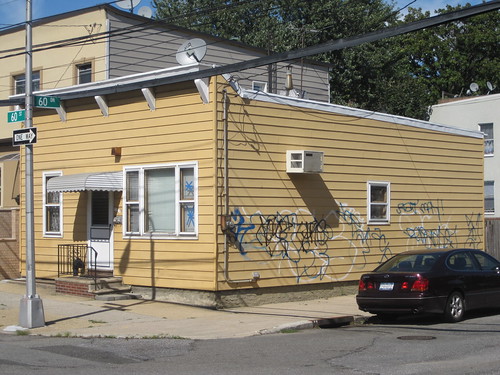
City fails to clean graffiti for 4 months


"I called 311 to report graffiti at 60-45 60th Street in Maspeth on Tuesday, 8/30/11. I was told by the 311 operator that graffiti on this house was already reported via 311 on 4/25/11 (complaint #G71340), and that it was put in the City's cleaning queue. When I inquired as to when the site was scheduled to be cleaned by the City, the operator said he did not have that information.

The City is supposed to remove graffiti within 35 days of it being reported. In addition to "Graffiti Free NYC", there is also the "Mayor's Paint Program" which provides free supplies to volunteer groups that wish to organize cleanups. Yet every time our precinct or GCOP organizes a cleanup, they ask local civic groups to donate money or paint supplies. Why is this, if the City is supposed to be providing it free of charge?

On top of this, council members' discretionary funding is often dedicated to graffiti removal!

If the City is already funding all the paint, labor and supplies through the Mayor's & EDC's program, then why all the redundancy and wasteful spending?

And why, if there is a 35-day deadline, hasn't this location been cleaned after 4 months? There are supposedly 23 graffiti cleaning vans roaming the City. When will one make it over here?" - Christina Wilkinson

Wednesday, June 29, 2011

Who needs community input?

From the NY Times:

It has never been easy for a mayor to get things done in New York City, where every government proposal must navigate a thicket of community groups, policy boards, and empowered neighborhood gadflies who can blackball a project in a blink.

So the Bloomberg administration has taken a tack that could be called “do it first, answer questions later.” And the key to the strategy is to start small, and to use the word “pilot.”

Dozens of marquee administration projects, as broad as transforming the city streetscape with pedestrian plazas and bright green bike lanes or using new ways to train principals and encourage school attendance, have started as so-called pilot programs, ostensible experiments that are often exempt from the usual forms of city review.

The pilot has emerged as the mayor’s signature policy weapon. Admirers see an innovative way around red tape. Critics see a blunt tool that undermines democracy by minimizing the public’s role in scrutinizing the ideas of government.

Once a pilot is in place, there generally is no requirement for review in, say, a public hearing or a City Council committee, even if the pilot is expanded. Indeed, some pilots are expanded but never pronounced permanent, suggesting that they are still in the experimental stages.