New York
In mid-September, shortly after the New York City police chief resigned amid a federal criminal investigation and Mayor Eric Adams’s
chief counsel quit, apparently because her client wasn’t heeding legal
advice, and a couple of retired Fire Department officials were arrested
on bribery charges, Ingrid Lewis-Martin
disappeared from City Hall. Lewis-Martin had long been the most loyal
and indispensable of Adams’s advisers — he brings the swagger; she
swings the stick — so her sudden absence was noted in the building.
“She’s not in this country,” one Adams critic told me. “I hear she is on
a beach.” Questions kept bubbling up. Was she fighting with Adams? Was
she cutting a deal with the Feds? Was she gone from City Hall for good?
In
fact, Lewis-Martin was in Japan on what her attorney later described as
a personally financed “friend trip,” sightseeing with a group that
included the city official and former state senator from Brooklyn Jesse Hamilton,
real-estate executive Diana Boutross, and former state assemblyman Adam
Clayton Powell IV. “It was pure vacation,” says Powell, who chronicled
his highlights — resort hotels, bullet trains, a night out in Roppongi, a
geisha show — on Instagram. The whole time, though, Lewis-Martin’s
phone was buzzing. One day, the FBI was searching the interim police
commissioner’s house, reportedly looking for classified documents. The
health commissioner announced he was on the way out the door and was
soon followed by the schools chancellor, whose phone had been seized.
City Hall reporters were pestering Lewis-Martin for comment. Rumors were
rampant that the mayor was about to go down. On September 26, at around
10 a.m. Tokyo time, the news leaked that Adams had been indicted on
corruption charges — a long-anticipated but nonetheless shocking moment
in the city’s history.
The
next day, Lewis-Martin flew home to a city on the brink of a municipal
civil war. Some prominent officeholders, like Representative Alexandria
Ocasio-Cortez, had already called for Adams to resign. Others wanted
Governor Kathy Hochul to exercise a seldom-used power to remove him from
office, which would trigger a snap special election. A half-dozen
potential replacements were jostling for position — including Hochul’s
predecessor, Andrew Cuomo,
who was looking for a comeback express lane. It appeared certain that
more arrests, more scandal, and more pressure would be coming. “We
continue to dig,” Damian Williams,
the U.S. Attorney for the Southern District of New York, said at a
press conference unveiling the Adams indictment. Investigators had
conducted yet another search, this time at Gracie Mansion, earlier that
morning. When Lewis-Martin and her travel companions arrived at JFK the
next day, Powell heard a loud voice call out at Customs and saw
Lewis-Martin pulled to the right. Two separate groups of investigators
were waiting. The Feds served her a subpoena for documents, and the
Manhattan district attorney’s office had a warrant for her phone. (The Daily News would subsequently report that Hamilton’s was taken too.)
Outraged
and device free, Lewis-Martin went to see her criminal-defense
attorney, Arthur Aidala, at his office on 45th Street. The
investigators, meanwhile, had hit her Brooklyn rowhouse. “They’re using
very heavy-handed tactics all around,” Aidala told me. The federal
subpoena involved fundraising, he said, and the DA’s warrant was related
to an investigation of potential bribery. Lewis-Martin assured her
lawyer she had done nothing wrong. He moonlights as an AM-radio host,
and she appeared on that evening’s edition of his show, “The Arthur
Aidala Power Hour.”
“We
are imperfect, but we are not thieves,” she said on the air. “And I do
believe that in the end, that the New York City public will see that we
have not done anything illegal to the magnitude or the scale that
requires the federal government and the DA’s office to investigate us.”
The defense was set: Maybe we’re just a little
criminal. The indictment alleged that, for years, starting during his
tenure as Brooklyn borough president, Adams had cultivated a
relationship with a representative of the Turkish government who
arranged for him to receive some $123,000 worth of illegal gifts, such
as discounted business-class tickets on Turkish Airlines and a stay in
the Bentley Suite at the St. Regis in Istanbul. When Adams ran for
mayor, his Turkish supporters allegedly channeled illegal donations to
his campaign through straw donors with the connivance of Adams himself.
In return, prosecutors say, Adams performed a number of favors as a
public official, most notably pressuring FDNY inspectors to certify that
the new Turkish Consulate near the U.N. was safe without conducting the
necessary inspections.
The mayor’s defenders described all this as a whole lot of nothing. His defense attorney, Alex Spiro,
ridiculed the indictment, calling it the “airline-upgrade corruption
case,” and filed an immediate motion to dismiss the bribery charge,
citing a recent Supreme Court decision that enlarged the bounds of
acceptable gift taking. (He had less to say about the foreign
donations.) Over the following week, Adams went on the offensive,
speaking to Black audiences and looking to clothe his plight in the
language of redemption.
“I’m
not going to resign,” Adams said at Emmanuel Presbyterian Reformed
Church in the Bronx the Sunday after his indictment. “I’m going to reign.”
The
city’s political class seemed to take a deep, steadying breath.
Influential voices in the Black community called for due process. Hochul
went quiet. Everyone would wait to see how deep the rot went. Spiro has
said he wants a quick trial, which could occur before next year’s
Democratic primary. But investigators appear to be taking their time.
They are reportedly looking into the mayor’s dealings with other foreign
governments in addition to Turkey and scrutinizing contracts for the
school system and migrant shelters. More revelations and indictments are
sure to be coming.
Not
since the dying days of the Koch administration had the city appeared
to be so much for sale, and never in the 126 years since the five
boroughs consolidated had any mayor been personally charged with crimes
of corruption. Adams and his supporters, determined to brazen it out,
were convinced that the old rules of political accountability no longer
applied. “We look at what happened with President Trump,” said Bishop
Gerald Seabrooks, a minister who prayed with Adams at Gracie Mansion the
morning the indictment was unsealed. “Thirty-four counts, and nobody is
asking him not to run.” (During a press conference, Trump wished Adams
luck in his legal fight.) Adams loyalists signaled that if Cuomo, or
anyone else, wanted the mayoralty, they would have to take it. “We don’t
worry about what’s in the shadows,” said attorney Frank Carone, the mayor’s still-influential former chief of staff. “The mayor is not resigning — full stop.”
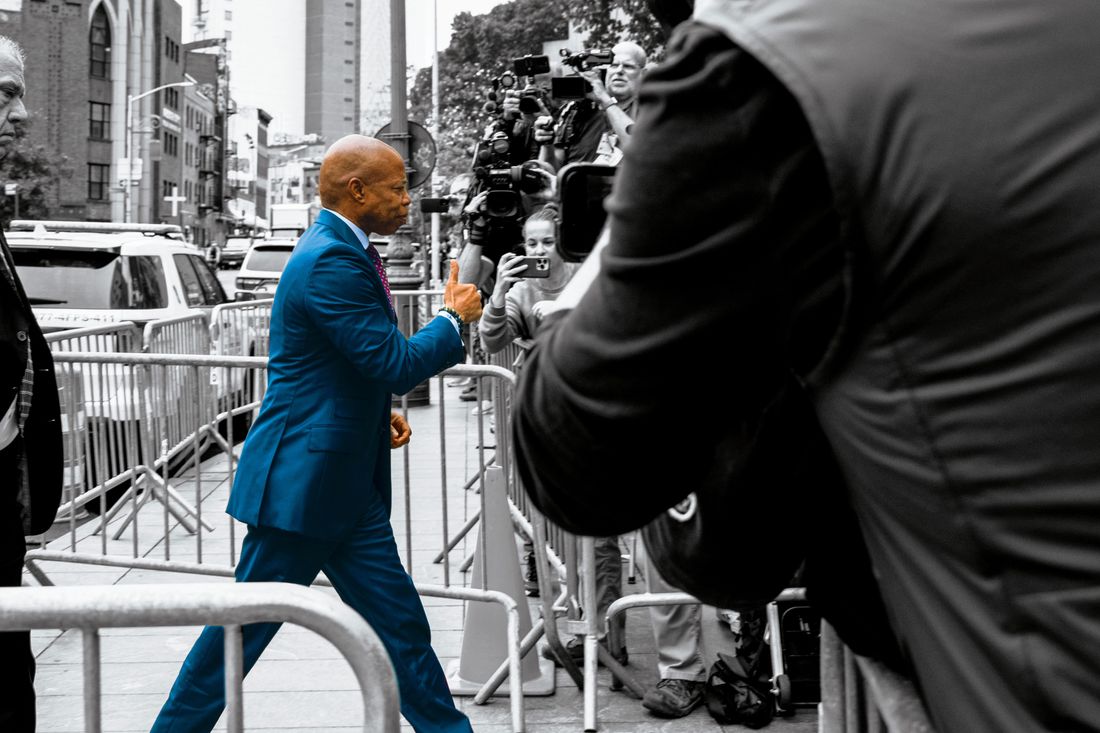
With Ingrid Lewis-Martin at a rally of clergy and community leaders outside City Hall on October 1.
Photo: Mark Peterson/Redux
Eric
Adams had the talent to be a great mayor. He is as lively as his city
and loves its nightlife, even if it brings him into contact with some
unsavory characters. He is funny, and there’s a lightness to his
egotistical flourishes, like his prodigious use of the possessive case
(“my city,” “my cops”) and his practice of walking out to “Empire State
of Mind” when performing even the smallest mayoral function, like
wheeling the Sanitation Department’s new trash can up to a press
conference.
Until
recently, Adams’s habits of evasion, of creating a fog of mystery
around even the most basic questions — where does he live? What does he
eat? — had mostly made him seem like a scamp, not a criminal. Even after
his indictment, some of those who had worked for him found it hard to
believe he is personally crooked. “I’m certain that Eric is not
corrupt,” says a former Adams aide. “On the other hand, Eric can have
terrible judgment in people and is incredibly stubborn.” Adams has often
called himself “perfectly imperfect,” a phrase that now seems likely to
serve as his epitaph, however the end comes. The positive side of his
record includes his hiring of a number of highly competent — and mostly
female — deputies and empowering them to run much of the city with
minimal interference. The imperfections start with some of the other
individuals on his payroll, who represent the very worst that city
politics has to offer.
“How did we get here? He brought with him a set of people whose track record of corrupt activity was already well known,” says Brad Lander,
the city comptroller and a declared candidate for mayor in the next
election. “I think that sent a broad signal to people that this was an
administration with a very high tolerance for corruption. And
unfortunately, a lot of people seem to have gotten that message and then
people who did really genuinely try to do things with integrity paid
for it.”
Reports
of corruption have dogged Adams’s administration since its earliest
days; now, they’re just more detailed. Straw donations. A
nightclub-shakedown racket. Nepotism hires. A buildings commissioner who
took alleged bribes from alleged mobsters. A mayoral crony who
supposedly cried out, “Where are my crumbs?” And it was all so crummy,
so careless, so old-school, so Tammany Hall.
“It’s
a surprise to me how stupid they seem to be,” says one veteran of
Brooklyn politics who has seen a few bosses come and go. “In the sense
that if you’re going to milk your positions for private gain, that they
weren’t more thoughtful about how they went about doing it.”