Showing posts with label negligence. Show all posts

Saturday, September 30, 2023

Mayor Party Hardy Means Tardy

  https://lede-admin.hellgatenyc.com/wp-content/uploads/sites/43/2023/09/Adams929.jpg?w=1200&q=75

Hellgate NYC

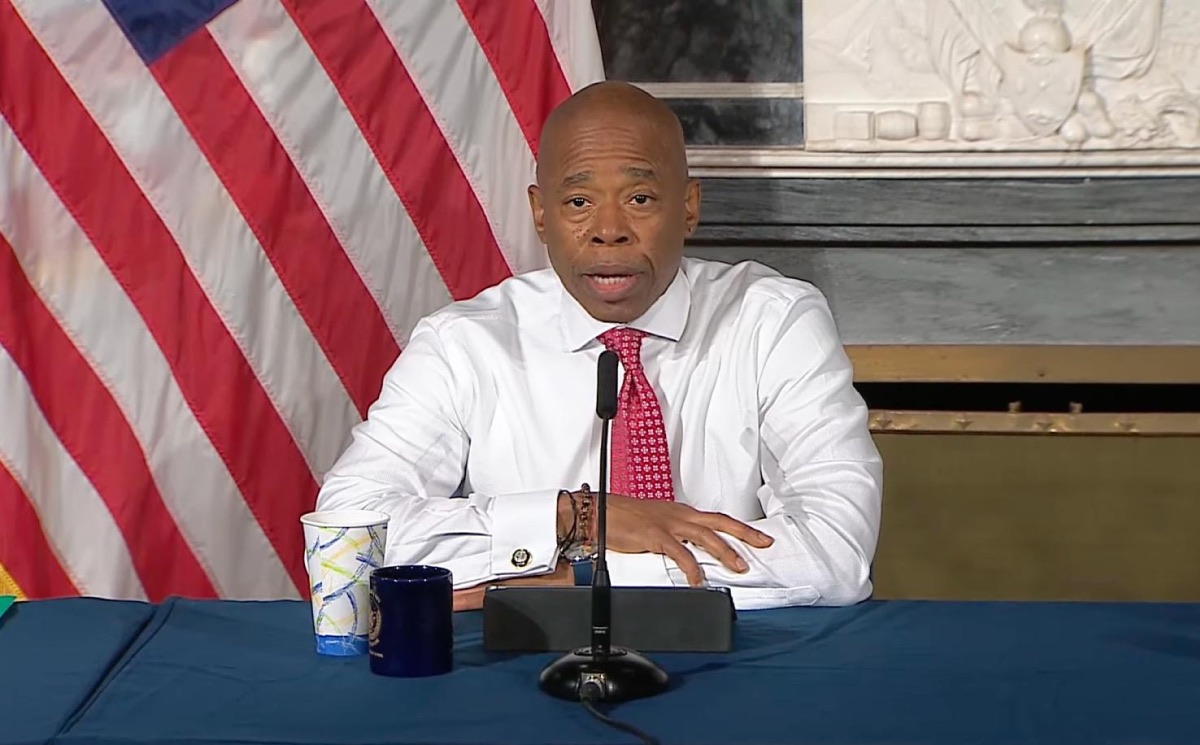
Ten hours after the National Weather Service issued a flash flood warning, five hours after the heavy rain began to fall across New York City, three hours after social media platforms began to be deluged with photos and videos of floodwaters stranding vehicles and commuters, 90 minutes after the MTA essentially told riders the trains were all too broken to be of any use, and 40 minutes after the press conference was supposed to start, Mayor Eric Adams spoke to New Yorkers for the first time about the flooding that continues to pummel the city that is under his control.

"We're ready, and you should be as well, to be prepared for this moment," Adams said.

What took him so long?

The mayor—flanked by a coffee mug and a tall paper cup, his voice sounding markedly more craggy and halting than usual (Adams had a "birthday fundraiser" in Inwood on Thursday night)—told reporters that he didn't need to be the first official to address New Yorkers about the flooding, because his deputies had already done so, in the form of sending out some Notify NYC alerts, appearing on 1010 WINS and Fox Weather on Thursday, and forwarding a press release to reporters at 11:08 p.m. on Thursday night. (Some of those deputies, including Deputy Mayor for Communications Fabien Levy, who earns an annual salary of $250,000, went even further, and snippily alerted reporters to all the alerting that had previously occurred.)

"Leadership is not only the mayor," Adams said. "It is all of those that are placed in those positions, and that is what you saw."

At the start of the presser, Adams said that he "got a firsthand look at the impact of the rainfall and what it is doing moving around the city," but later revealed that this was a little bit of serendipitous multitasking. On Friday morning, he had actually gone to a wake for a retired NYPD officer, and had driven back home through East New York, Canarsie, and Sheepshead Bay. 

Just six families had been successfully evacuated from flooded basement homes so far, according to Levy, but with two to four more inches of rain on the way, where could New Yorkers who live in basements go if their homes flooded? Where was the "higher ground" that NotifyNYC told basement apartment-dwellers to seek? The mayor didn't say, though he assured everyone that was being taken care of.

"We will have sites for those who can't go with family and friends, we will always provide shelter for those in need and we will navigate that," Adams said.

Zach Iscol, head of the mayor's Emergency Management division, assured New Yorkers they were "monitoring continuously," and "in very active response mode right now," but the evidence provided for that was simply more assurances.

"We're taking this extremely, extremely seriously," Iscol said.

For an event featuring the mayor, Governor Kathy Hochul, the head of the MTA Janno Lieber, and many leaders of City agencies, not a whole lot was revealed at this press conference. Despite the chaos on the street, everyone had convened to convince New Yorkers they were doing their jobs, and that the system is working, more or less. After the mayor thanked the governor, the governor thanked the mayor. "Mayor, you've been fantastic," Hochul said.

What about migrants staying in tent structures? No major leaks or flooding have been reported, Levy said.


Saturday, March 19, 2022

The DOT's street infrastructure negligence and useless bike lane chronicles

All pictures and posts were provided by Northwest Queens resident Dorothy Moorhead. Great job exposing the Transportation Alternatives influenced kakistrocacy that has taken over the D.O.T. - JQ LLC


This is where the westbound Queens Boulevard bike lane ends. How is this safe? If it weren’t for the fact that very few bikers use the bike lane—in a full week I saw a total of 11—there would be many accidents. (Admin note: This part of the road has always been damaged, and it's funny how TA never brought up this hazardous lane merge with vehicular traffic and also how the bike lane ends in Sunnyside. Utter proof of the lack of interest from the bike scientology cult and of actual bike commuting seen on Queens Blvd. Which I have seen myself for nearly 3 decades)

It would be nice—not to mention safer—if DOT paid more attention to faded street signs and potholed streets than it does to bike lanes. Since Transportation Alternatives started running the DOT, it seems like every issue other than expanding bike lanes has taken a low priority.


Here’s another DOT fail. Years ago alternate side parking restrictions were changed. Instead of two days a week, they are now one day in most parts of the city. In Astoria the DOT has yet to change the signs. I guess they need the money for the bike lanes that seem to have unlimited resources. (The second day on the signs are the street cleaning days.) If the DOT can’t afford new signs, they could at least cover the incorrect information.


DOT: Do as I say, not as I do.


Last post today on the DOT and its short-sighted effects on NYC streets. This shows an oil delivery truck in the bike lane where Skillman Avenue has been reduced to a single through lane. The driver had no option other than pull up between the row of parked cars and the bike lane. Had he parked in the through lane for the fifteen or twenty minutes it takes to deliver the oil, he would have backed traffic up past PS11, with horns beeping. At 8:00 am.


Friday, March 11, 2022

Bill de Blasio diverted FDNY building inspectors to montior vaccine mandate enforcement at restaurants with deadly results

  https://www.nydailynews.com/resizer/0NQ4H79Ej6nI4qadc5tENJXYzs8=/800x533/top/cloudfront-us-east-1.images.arcpublishing.com/tronc/3YDXWTBP4RGMPCNUPE37F4EI7M.JPG

NY Daily News

 A Bronx building that became a towering inferno in January, leaving 17 dead, was scheduled to be examined by an FDNY fire inspector several months beforehand — but it didn’t happen because the inspector was reassigned to conduct COVID restaurant inspections.

 The troubling account came from Oren Barzilay, president of the union that represents paramedics and fire inspectors who testified Wednesday at a hearing held by the City Council’s Fire and Emergency Management Committee.

“That building was scheduled to be inspected, but because they were sent to a task force, that building was not inspected,” he testified.

“It’s terrible,” he told the Daily News after his testimony. “I’m not blaming Eric Adams. I’m blaming the previous administration for not thinking it through.”

The Jan. 9 blaze at Twin Parks North West in the Bronx killed 17 people and left dozens more injured. The fire was caused by a faulty space heater that burst into flames and made worse by malfunctioning doors that were designed to close on their own. Because the doors failed to shut, the toxic smoke spread quickly through the 19-story building.

The blaze was the deadliest in the city since the Happy Land night club fire killed 87 people in 1990.

Barzilay told the Daily News an inspector was assigned to Twin Parks about a year before the fire took place to examine the building’s stand pipe system, which would supply it with water in the event of a fire. Barzilay noted that while inspectors wouldn’t have focused on inspecting doors, any problems they saw would have been flagged and addressed.

“If they had noticed anything else, they would have addressed the issue,” he said.

Barzilay also noted a Brooklyn building that was the site of an explosion recently was also slated to be inspected before the incident, but was not because inspectors were diverted to enforce vaccine mandates at city restaurants. Mayor Adams rolled back those requirements, known as the Key2NYC, on Monday.

Monday, February 7, 2022

Judge calls NYCHA a criminal landlord...then he vanished


NY Daily News

That was the message from a Queens Housing Court judge outraged by the agency’s failure to provide hot water to as many as 300 tenants in a Rockaway apartment building since November, the Daily News has learned.

“If this was a private small landlord he [the landlord] would be in jail by now,” Judge Kimon Thermos said during a Jan. 20 hearing. “He would have been in jail by now and the fines would have been $500 per day, per apartment. So he would have been in jail and he would have been losing his building too.”

As a city-run agency, the New York City Housing Authority is not eligible for the same penalties as a private landlord who neglects its properties and tenants.

“Why is your crime shielded this way?” Thermos asked a NYCHA lawyer. “NYCHA is dropping the ball big time here.”

Tenants in Carleton Manor say NYCHA did little for months to fix the water problem that makes taking a shower a major undertaking. Dozens of tenants have filed a petition in Housing Court seeking to force NYCHA to make repairs at the 174-unit building on Beach Channel Dr. and Beach 74th St. in Arverne.

“This is the dead of winter,” said Alisha Robinson, 42. “We need this corrected. We need some attention on fixing this.”

“It doesn’t make any sense to me,” she said. “I have to go to a hotel to take a decent shower.”


The legal fight began Nov. 29, when one tenant, Shaniya Callender, filed a petition to get the water problem fixed. That yielded no progress, so on Dec. 28, 45 tenants signed a petition threatening housing court action if no repairs were made by Jan. 10.

That deadline came and went, so the tenants took NYCHA to court. At the Jan. 20 hearing, Judge Thermos was outraged that NYCHA’s work on the building was being overseen by an unlicensed plumber.

The judge said he was considering issuing a subpoena demanding NYCHA Chairman Gregory Russ appear in court. But before he could, Thermos was replaced on the case by a different judge, for unclear reasons.


Tuesday, November 9, 2021

Chokshi screwed up

https://www.nydailynews.com/resizer/o0btsOccppNwZYnruuQIgooTejk=/800x533/top/cloudfront-us-east-1.images.arcpublishing.com/tronc/DDB7ZTZU4NHYXC5B6RKCCWIAA4.jpg 

NY Daily News

A city effort to vaccinate newly eligible kids ages 5 to 11 against coronavirus kicked off Monday morning at school clinics — but ran into some early hiccups.

Anxious parents spent hours waiting outside some schools in the hopes of securing a vaccine dose for their elementary-age kids, only to be told the clinic didn’t have enough supply.

Parents at Public School 8 in Brooklyn Heights began lining up at 6 am for the city-run school vaccine distribution, with the line swelling to more than 100 people, one parent said. But city workers running the clinic said they could only give out 50 shots because they needed to conserve doses for other schools they were visiting Monday, according to parents at the school.

“I just don’t understand why they would have taken this approach,” said Michele Walsh, the parent of a first-grader and a fifth-grader, who was turned away after waiting for more than an hour.

Walsh said she refrained from looking for other appointments for her kids because she was counting on getting them vaccinated at the school.

She added that PS 8 administrators even gave city officials a heads-up in advance that there was going to be a huge demand for the shots Monday morning.

Walsh was even more frustrated that her kids had to miss the start of school while waiting outside in vain for a COVID-19 vaccine. “If they had just given us numbers and told us how many they had, the kids could’ve been in school instead of waiting outside,” she said.

A parent at PS 40 in Manhattan reported a similar supply problem, and said the shipment of shots still hadn’t shown up by 10:45 am — nearly four hours after the distribution was supposed to start.

100,000

https://cdn.vox-cdn.com/thumbor/f2X5wDdyyDcz0DYqdTN45S_R8mc=/0x0:3000x2000/920x613/filters:focal(1260x760:1740x1240):format(webp)/cdn.vox-cdn.com/uploads/chorus_image/image/70112227/110221_jackie_robinson_school.0.jpg

THE CITY

Nearly 1 in 10 New York City public school students were homeless last school year, a staggering rate that has barely budged for several years.

About 101,000 students lived in unstable, or temporary, housing in the 2020-2021 school year, according to an analysis of state data released Monday by Advocates for Children. That’s a larger number of children than the entire school district of Denver.

Homeless students face a host of barriers to education in any given year, especially in terms of attendance. In a year when the COVID pandemic continued to disrupt in-person schooling and place extraordinary challenges on families and students across the five boroughs, homeless students faced even more hardships.

Accessing classwork and instruction — which was difficult for many children last school year — was sometimes impossible for homeless students and their families. Family shelters did not have Wi-Fi and are only getting it now, following a lawsuit from Legal Aid. Even students equipped with city-issued internet-enabled iPads struggled to log on for classes because shelters had spotty connections to the cell service that those devices depend on.

Now, advocates are looking ahead to Mayor-elect Eric Adams in hopes that he’ll take aggressive steps to curb student homelessness and address their dire educational outcomes.

Just 29% of homeless students passed their grades 3-8 reading exams, while just 27% passed math — both about 20 percentage points lower than their peers living in stable housing, according to 2019 data. Sixty-one percent of homeless students graduated on time in the school year before the pandemic, compared to 84% of their peers with stable housing.

“We are hopeful that given the incredibly poor outcomes we’re seeing, particularly for students in shelter, that Mayor-elect Adams’ administration will recognize the crisis for what it is,” said Jennifer Pringle, director of Project Learning In Temporary Housing at Advocates for Children.

More than 3,800 students had no shelter and lived in cars, parks or abandoned buildings, while another 200 students lived in hotels or motels, according to the Advocates for Children report.

Another 28,000 lived in city shelters, while about 65,000 students lived “doubled-up” with friends or family. (Information was not available for roughly 3,900 students, the organization said.)

Though the rate was similar to prior years, the overall number of homeless students — 94% of them Black or Hispanic — appeared to have fallen by 9.5% year-over-year. That decrease could be due in part to a drop in student enrollment across the system, which lost more than 3% of its students last school year. Additionally, schools may have faced more challenges in identifying where students lived because the majority of children chose to learn remotely — an issue that advocates also flagged last year.

Homeless students were far less likely to show up for remote or in-person school last year. Between January and June 2021, attendance rates for students living in shelters were roughly 10 to 14 percentage points less than students in stable housing, according to city data analyzed by Advocates for Children.

The struggles have continued this year. The first couple weeks of this school year, the attendance rate was about 73% for those in temporary housing, rising to 78% more recently, compared to the citywide rate hovering around the “high 80s and low 90s,” according to what education department officials have shared with Advocates for Children.

Saturday, October 23, 2021

Rikers Gulag

https://nypost.com/wp-content/uploads/sites/2/2021/10/rikers-overcrowding-01.jpg?quality=90&strip=all

NY Post 

Dozens of men crammed together for days in temporary holding cells amid a pandemic. Filthy floors sullied with rotten food, maggots, urine, feces and blood. Plastic sheets for blankets, cardboard boxes for beds and bags that substituted for toilets. 

This is what the epicenter of the crisis on Rikers Island — which has a whopping $1.2 billion budget for fiscal year 2022 — looked like for months.

The Post obtained exclusive photos showing the intake cells at the Otis Bantum Correctional Center on Rikers Island between July and late September where hundreds of inmates languished for days or weeks on end in violation of city regulations, which require they be assigned a housing area within 24 hours.

The images show as many as 26 men stuffed body to body in single cells where they were forced to relieve themselves inside plastic bags and take turns sleeping on the fetid floors.

 In one image, an inmate is seen curled up on the floor — outside of the holding cell — because there was nowhere else to put him and when the facility was ready to burst, or when elected officials came to visit, detainees were stashed in a gym, Department of Correction sources said.  

“It was inhumane … They’re not supposed to be there that long, the intake is just a place to process the inmates,” a jailhouse source told The Post of the conditions at OBCC, which housed most new admissions to the jail before intake was moved to another, larger facility in late September with double the clinic space. 

“And the sad thing about it is … you couldn’t do anything about it, it was all management,” the source said. “They knew what was going on and they did nothing.” 

Internal records obtained by The Post offer a glimpse of the problem’s scope and indicate at least 256 inmates festered inside the OBCC intake beyond the 24-hour limit between June and late September because of “medical delay” and “shortage of DOC staff.”

One of those detainees — 42-year-old Isaabdul Karim — died three weeks after he spent 10 days “mired in intake,” where he contracted COVID-19, his lawyers have said. His cause of death is still being determined by the city’s medical examiner. 

During a five-day period in mid-September, shortly before most intake processes were moved to the Eric M. Taylor Center, at least 105 inmates were inside the crowded cells long after they should have been moved, records show. 

In response, a spokesperson for the DOC said the “conditions in these photos do not exist at Rikers Island today.” 

“We’ve closed OBCC’s intake and reopened the Eric M. Taylor Center for intake purposes, ended overcrowding and long waits in intake, and thoroughly cleaned this and many other facilities,” the spokesperson said.

 So the D.O.C. had to reopen a jail to ease intake. Which confirms that City Council's legislating and Mayor de blasio's decision to close Rikers exacerbated the humanitarian crisis in the prisons.


Wednesday, October 20, 2021

Dave Chokshi's health department offices are COVID traps

 https://s3-prod.crainsnewyork.com/0622p1_Chokshi%20Dr.%20Dave_Buck%20Ennis.jpg

NY Post 

 About 1,000 New York City Health Department employees have signed a letter blasting the agency’s return-to-office guidelines, accusing it of failing to communicate internal COVID-19 cases and not following a “science-informed” approach, including masking and social distancing.

“It’s a huge contradiction because we’re the Health Department,” one agency worker told The Post.

“We, of all agencies, are falling short of implementing an evidence-based and science-informed return-to-office process.”

“We’re not just whiny people who want to sit at home in sweatpants on our laptops,” a second DOH employee said.

“We are all so committed and dedicated to public health, and so hardworking. But we want scientific evidence explaining why it’s safe to go back to the office.”

Their eight-page Oct. 1 letter to DOH Commissioner Dave Chokshi says the agency’s Queens headquarters lacks onsite COVID-19 testing and sufficient supplies of hand soap and sanitizer.

“We’ve continuously found hand sanitizing stations empty on the 11th floor and a lack of hand soap available at 11th-floor kitchen sinks, despite having placed several service requests,” the fed-up public health workers wrote in the letter, which was obtained by The Post.

 In addition, not all employees are adhering to mask rules — and instead of having supervisors enforce them, workers are asked to “police each other,” which creates uncomfortable situations, according to the letter.

The open cubicle setting at Long Island City headquarters also doesn’t allow for social distancing because desks are closer than six feet apart, a third DOH worker told The Post.

The letter requests agency officials “regularly provide information about our actual risks at the worksite, based on available evidence,” including the number of staff infected with COVID-19 and the “date of diagnosis at different DOHMH worksites.”

“Be transparent with actual details on airflow, expected transmission rate in our workplace settings, the rationale for removing the physical distancing requirement, and why it is considered safe to have us eat at our desks,” it says.

The exasperated agency workers also want to know why the commissioner didn’t question the mayor’s decision to force all 300,000 city workers back to their desks full-time starting Sept. 13 if it isn’t safe.

They note that Chokshi told them during an internal town hall meeting in August that productivity hadn’t suffered from remote work during the pandemic — despite the mayor saying that municipal workers don’t get as much done at home.

The Health Department has led the city’s response to the pandemic that’s sickened over 1 million New Yorkers and killed nearly 35,000 residents.

This exchange during a very overlooked zoom briefing about the Key to NYC revealed DOH officials flouting these guidelines.


Monday, October 4, 2021

Homeless services provider CEO that almost got the contract to run Trump's golf course makes a million a year profiting from the housing insecure

Jack A. Brown III, the chief executive of CORE Services Group. 

NY Times 

Some executives at nonprofit groups that operate New York City homeless shelters are benefiting from the plight of the people they serve.

Soon after Jack A. Brown III quit his job at a private prison company, his former employer accused him of fraud. A few years later, after Mr. Brown started a nonprofit to run halfway houses, a federal audit found that it had failed to deliver key services. The New York State comptroller concluded in another review that Mr. Brown had shown “a disturbing pattern of ethical violations.”

None of that history seemed to bother officials in New York City.

Since 2017, as homelessness has risen to record levels, the city has awarded more than $352 million to a nonprofit run by Mr. Brown to operate shelters. The money is meant to help homeless people regain their footing in life, but it has benefited Mr. Brown, too.

The nonprofit has channeled contracts worth at least $32 million into for-profit companies tied to Mr. Brown, allowing him to earn more than $1 million a year, The New York Times found. Millions more have gone to real estate companies in which he has an ownership interest. He has also hired his family members and given employees perks such as gym memberships and cars.

 When Mayor Bill de Blasio came into office, he criticized a small group of landlords for charging the city exorbitant rates to house people in squalid rooms while doing little to curb homelessness. In 2017, the mayor pledged to open dozens of new shelters that would be managed by nonprofit groups. Their mission, he said, would be altruistic rather than driven by financial gain.

But four years after that change and an extraordinary infusion of city spending, homeless people still crowd shelters and set up camps on the street, while a new group of operators has figured out how to make money off their plight.

An investigation by The Times, based on hundreds of pages of legal filings, business records and tax documents, as well as interviews with homeless people, city officials and shelter employees, found that under the cloak of charity, executives at nonprofits have collected large salaries, spent their budgets on companies that they or their families controlled and installed relatives in high-paying jobs.

One landlord started a nonprofit that handed out millions of dollars to real estate and maintenance companies that he and his family owned. A Bronx shelter operator was charged earlier this year with laundering kickbacks through a consulting company run by his family. A former board member of another homelessness organization is under criminal investigation after the city said the group paid millions of dollars to a web of for-profit entities he secretly oversaw.

For years, Mr. Brown has personally prospered by running an organization to help the homeless.

In addition to serving as the chief executive of the nonprofit he founded, CORE Services Group, Mr. Brown started a security guard company that polices his shelters, a maintenance company that makes repairs in them and a catering company that feeds the residents, records showed. Mr. Brown heads each of them, collecting total compensation that tops $1 million. He is the highest-paid shelter operator in New York, according to a review of available records.

(This guy is the Jeff Bezos of homeless shelters-JQ LLC)

In one year alone, the for-profit companies that Mr. Brown ran spent more than $460,000 on gym memberships for employees, records showed.

Mr. Brown, 53, has profited in other ways: Along with partners, he owns two companies that have rented buildings to CORE, and his mother, sister, aunt and niece have all worked at the nonprofit, in addition to his brother, who has collected a six-figure salary.

At the same time, residents at one of the largest shelters in Mr. Brown’s operation, Beach House in Queens, said they lived with vermin infestations, creeping mold and violent fights in the hallways.

“A lot of money is going into this place,” said Annabelle Alexander, who lived in the Beach House shelter for more than a year before moving out last week. “But it’s not going to us.”

State and federal laws prohibit nonprofit organizations from engaging in many types of self-dealing, the practice of executives benefiting personally from their organizations without proper disclosure. But the line between permissible transactions and illegal behavior can be hazy, and nonprofit executives are rarely prosecuted for financial abuses.

In fact, executives at the groups that run shelters in New York are permitted to run profitable side businesses — all fueled by city money — as long as they reveal the information to the city and follow contracting rules.

This year, the city has directed $2.6 billion to nonprofits to operate homeless shelters, and officials already know they have a problem with some of them. Nine of the 62 groups that run shelters are on an internal city watch list for issues that include conflicts of interest and financial problems, according to records reviewed by The Times. All of them continue to receive city funding.

THE CITY 

A leading homeless shelter operator has pulled out from a deal to take over a Bronx public golf course after the Trump Organization exits the links at Mayor Bill de Blasio’s demand.

“CORE Services Group, Inc. has decided to withdraw from consideration,” an attorney for the Brooklyn-based nonprofit wrote in an email to executives with the city Department of Parks and Recreation and the golf course operator Bobby Jones Links on Wednesday.

THE CITY exposed CORE’s unlikely involvement Monday, after public records revealed Parks’ proposed 13-year deal to put a company registered by CORE CEO Jack A. Brown in charge of the deluxe Jack Nicklaus-designed 18-hole course near the Whitestone Bridge.

“We are disappointed that we are unable to move forward with this project at this time and help bring workforce training and jobs to communities in New York City that are underrepresented in the sport of golf,” a spokesperson for CORE, which has $544 million in current contracts for family and single adult shelters, said in a statement.

“We will continue our work breaking barriers and creating new opportunities for all New Yorkers.”

Asked Tuesday morning about THE CITY’s report on the future of the Trump Golf Links at Ferry Point, de Blasio said that CORE would be “only working on some of the staffing. It is not the organization that’s operating the whole golf course.”

That organization, Parks officials said, will be Bobby Jones Links. Yet the Atlanta-based golf course operator has not responded to multiple inquiries from THE CITY and is not listed in any public records related to Brown’s company, Ferry Point Links LLC.


Ozone Park sidewalks still a shambles after a hurricane from two years ago

 Isaias damage persists on Ozone Park streets 1

 Queens Chronicle

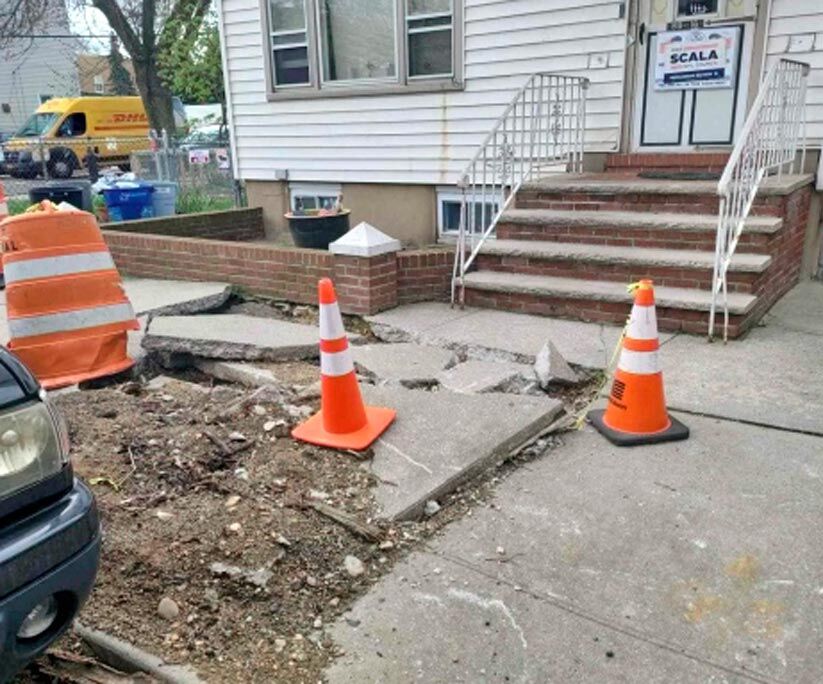
Shards of cement are scattered in a pile in front of 88-16 102 Road in Ozone Park. The stretch of sidewalk looks like it was attacked by a demolition crew.

Only it’s no temporary construction site. It’s been like that for a year since a downed tree was uprooted and disposed of in the wake of Tropical Storm Isaias.

Two years ago the city announced that it would no longer charge homeowners for sidewalk damage caused by city trees and promised to ramp up sidewalk repairs in problem areas.

A year after Tropical Storm Isaias pummeled the borough, collapsing trees and power lines, and hitting especially hard in South Queens, Ozone Park still bears the evidence that the city has not been living up to Mayor de Blasio’s promise about sidewalk maintenance or repair.

In the wake of that storm, the Chronicle documented the widespread instances of poor arboreal health in Ozone Park that led to a large number of downed trees. Now over a year later, the Ozone Park Residents Block Association has begun calling out the city’s failure to replace the sidewalk in the areas where uprooted trees disrupted the neighborhood’s pedestrian fabric.

“In what can only be described as reckless, careless, a dereliction of duty, lack of concern, failing to protect our residents, amongst the many adjectives I can use, the City of NY has dropped the ball on our residents,” wrote Sam Esposito, the civic group’s president, in a press release calling attention to the problem.

The group listed seven sites in the neighborhood where it says trees overturned by Tropical Storm Isaias turned the surrounding sidewalk into a pile of rubble that has yet to be repaired by the city. In five of the sites, Esposito said that he had coordinated with the homeowners, but he ensured that a 311 complaint was filed in each case.

Unfortunately, a long wait time for sidewalk repair is not uncommon, despite recent efforts from the city to correct the issue.


Friday, September 24, 2021

Cojo the derelict

https://nypost.com/wp-content/uploads/sites/2/2021/09/CoreyJohnson.jpg?quality=90&strip=all&w=744

NY Post 

New York City Council Speaker Corey Johnson wouldn’t say how much time he spent on Cape Cod over the summer as he defended his job performance amid findings that lawmakers posted their least productive summer in two decades.

“I was spending some time with my family this summer and I hadn’t seen my mother since before the pandemic,” Johnson said in his first public remarks about The Post’s story since it published Tuesday. “I’m not ashamed of me taking some personal time, while at the same time the Council was continuing the hard work.”

The Post revealed this summer has been the Council’s least productive in two decades — with committees and its other bodies meeting or scheduled to meet just 61 times between July 1 and September 30.

That’s the lowest number over the three-month period since 2003, an analysis of Council records shows.

It’s also a dramatic drop in the meetings and hearings when compared to the numbers posted in the summers of 2017, 2018 and 2019 — and even a decline from the number during the pandemic-ravaged summer of 2020.

The decline was especially notable this summer as the Council failed to hold an oversight hearing on the reopening of schools until Sept. 1, days before students returned to classrooms; and didn’t hold an oversight hearing on the crisis at the Rikers Island lockup until Sept. 15.

A half-dozen Council insiders and observers pinned the plummet in productivity on Johnson’s trips to Provincetown, Massachusetts, a summer hot spot renowned for its art galleries and beaches.

Wednesday, September 22, 2021

Across 118th Street


 Impunity City

 This scene takes place in South Richmond Hill on 118th Street and 103 Ave.

In the middle of the road yeah. 


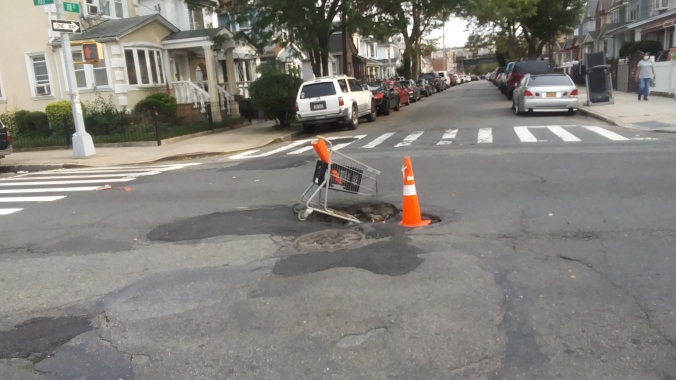
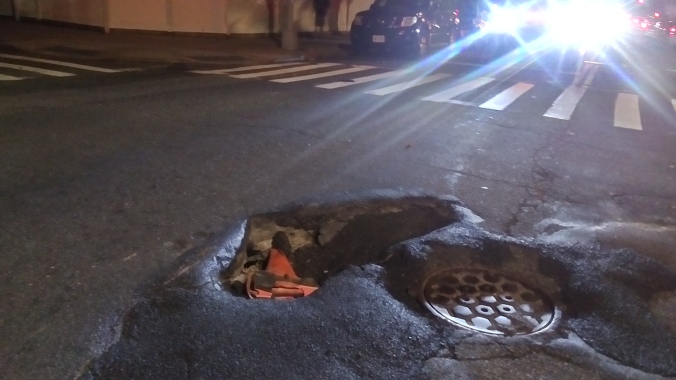
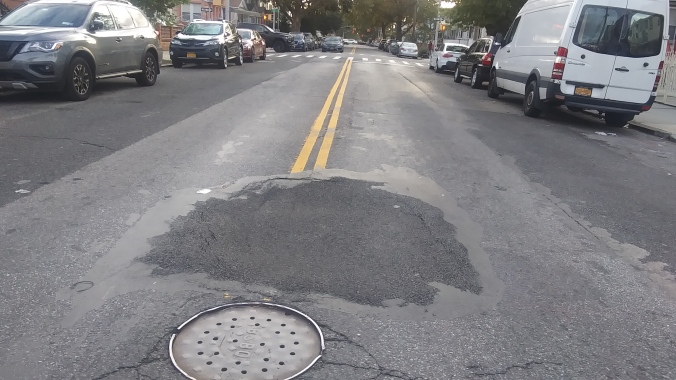
All signs indicate that current mayor de Blasio’s Department of Transportation, which is run by one of his Brooklyn aristocrat city planning buddies Hank Gutman, did a major less than half ass job laying the blacktop on this. Because this is what it looked like a week before some creative type did a near approximation of Homer Simpson’s rage motivated contemporary art piece.

Truly a WTF FUBAR in process.


Although this is another embarrassingly abominable display of city neglect and incompetence and another example of the city infrastructure dilapidation, this will eventually be remedied with a better and hopefully more thorough renovation, because this evolving crater is not to first to infect 103rd Ave. For their were similar former and potential cave-ins discovered on numerous blocks west from this current blight.


Wednesday, August 18, 2021

Queensbridge tenants draw up class action suit against NYCHA for purposeful neglect

A crumbling bathroom in an apartment at the Queensbridge Houses.
 

 NY Daily News

 Fed-up tenants of the Queensbridge Houses sued the New York City Housing Authority on Tuesday, citing hazardous conditions in the nation’s largest public housing complex and what they describe as illegal harassment.

Pamela Wheeler, 72, and Marilyn Keller, 58, are among 11 plaintiffs named in two lawsuits — one representing residents of the complex’s northern section, the other representing its southern section — filed in Queens Housing Court.

The suits come after years — and for some residents, decades — of complaints about quality-of-life issues in their homes, including asbestos, lead, mold, severe leaking and flooding, vermin, and other biohazards.

“I am tired of living with mice, roaches, waterbugs, lack of heat, holes in my walls and sink, waterlogged and rotting cabinets, and many more repair issues that are a threat to my health and safety and an affront to my dignity,” said Wheeler at a press conference.

Keller, abreast cancer survivor who suffers chronic health issues, described exposed electrical wiring, a broken radiator, rotted kitchen cabinets, and a broken door in her apartment she said frequently gets jammed.

 Her calls to NYCHA rarely, if ever, result in action, Keller says.

“Any type of repairs that need to be done in my house — I have to wait forever to get them done,” said Keller. “I put the ticket in. Then NYCHA calls me back to tell me the date they are coming.

“So, I prepare for the appointment, take everything out of the closet and cabinets, and ask for the day off work. But then they never come. They are a bunch of no-shows.”

The plaintiffs further allege the city’s trouble-plagued housing authority declines to make repairs in the hope that the Queensbridge Houses can be handed over to “private entities who would receive federal money in exchange for their agreement to keep the units affordable” under federal housing regulations and laws.

The “private entities” could be for-profit companies, or new government entities, the lawsuit says. In any case, the lawsuit says, it’s not clear that handing the project to new public or private managers “will benefit low-income renters more than it will harm them.”

So they don't care much about the new basketball court de Blasio's NYPD built there?

Saturday, July 24, 2021

Mayor Big Slow is the reason the sidewalks are jammed with unlicensed vendors

 https://nypost.com/wp-content/uploads/sites/2/2021/07/Bill-de-Blasio.jpg?quality=90&strip=all&w=1024 

NY Post


Does Bill de Blasio ever meet a deadline?

The infamously tardy mayor is over three months late appointing members to an advisory board established to review street vendor activity just as illegal peddlers have taken over whole sections of The Bronx, Manhattan and Queens.

A law the City Council passed in March stripping the NYPD of enforcement over street vendors required Mayor de Blasio and Speaker Corey Johnson to appoint a combined 10 members to the Street Vendor Advisory Board by April 21.

While Johnson has seated his six appointees, de Blasio has yet to choose his four representatives.

“It just goes to show you that they have no real care or sense of urgency in doing this,” said Jeff Garcia, head of the New York State Latino Restaurant, Bar and Lounge Association.

The board is supposed to review state and local laws related to street hawkers, including assuring that they’re at least 20 feet from building entrances— a rule is routinely broken by peddlers who crowd the sidewalks along Fordham Road in The Bronx, Main Street in Flushing, Queens and Canal Street in Lower Manhattan.

Tuesday, May 18, 2021

Queens tenants living in hell sue landlord


Have a tenant horror story for you. Tenants at 84-53 Dana Court in Queens have been living in disgusting squalor for months thanks to their negligent landlord who has let garbage pile up inside and outside the building and refuses to address the rats, cockroaches, mice infestations as well as water damage and mold. Mgmt company has also been harassing tenants, sending them fake bills for rent. One tenant’s daughter is actually afraid to go in the hallway because a rat once bit her. Tenants believe landlord just wants them out.


The landlord, Highpoint Associates run by Donald Ammons, who has been on the Worst Landlord List multiple times, fired the super back in September 2020 and now garbage continues to pile up inside and outside the apartment, causing a rat infestation among other issues. The landlord has racked up more than $800,000 in fines and fees, according to our calculations, and over 400 building violations. The tenants have sued the landlord for repairs and have a court date on Friday, May 20. 6sqft covered this landlord before here. Tenants are willing to talk to you and show you the building this week ahead of the court date. Thanks.

Best,
Seth Hoy, Director of Communications
Legal Services NYC
40 Worth Street, Suite 606
New York, NY 10013

Tuesday, November 24, 2020

de Blasio's Buildings Department is as absent minded as him.


NY Post

Mayor Bill de Blasio’s Buildings Department blew deadlines or failed to reinspect structures with dangerous conditions that threatened public safety more than 5,400 times, according to a blistering new audit from City Comptroller Scott Stringer.

Stringer’s investigation revealed that the DOB failed to conduct 2,986 of the nearly 6,381 required reinspections within the 60-day timeline required under the administrative code — and that it never scheduled another 596 reviews.

Additionally, the Comptroller’s office discovered that the DOB busted its 60-day deadline with another 1,819 subsequent followups.

“No one should have to live or work in fear of debris or unstable scaffolding crashing down on them in a home, place of work, or at any other site in this city,” said Stringer.

“Our audit of DOB’s internal procedures uncovered multiple failures that pose a direct risk to public safety,” he added. “DOB has a responsibility to protect the public – and it absolutely must live up to that promise.”

The probe focused on the violations that have been “identified as posing a threat of imminent danger to public safety or property.”

Stringer’s office also uncovered that the Buildings Department frequently misses its internal goals when it comes to reviewing paperwork to ensure repairs are properly completed, hitting the 21-day self-imposed deadline just 42 percent of the time.

City officials said in a formal reply to Stringer that they agree with the recommendations to redouble their efforts on the 60-day reinspections and to formalize the 21-day goal for processing certifications of repairs. In a statement, they broadly defended the agency’s performance.

“We’re improving our service levels across the agency to meet our other legally required timelines, all while handling a significantly expanded workload,” said DOB spokesman Andrew Rudansky. “New York City deserves safe communities, and we’ll do our part by holding our inspection work to the highest standards in the country.”

de Blasio's mobile Covid testing sites reported missing

 https://encrypted-tbn0.gstatic.com/images?q=tbn:ANd9GcRCgEl98sH5Lgnku0mlN9Pg0ajE9fds7zt9OA&usqp=CAU

Queens Eagle

The city’s Health and Hospitals Corporation said it would set up sorely needed mobile COVID testing sites this week in Jackson Heights and Corona. Residents there are still waiting.

Despite four-hour lines at COVID testing sites across Queens, HHC did not set up the testing locations as scheduled. A site that was supposed to administer tests Monday through Friday at Travers Park in Jackson Heights never opened due to inclement and severely cold weather, an HHC spokesperson said. HHC said the location will open Friday. 

To make matters worse, the testing site location is listed incorrectly on the HHC website, which says Travers Park is in Cypress Hills, Brooklyn.

The Eagle learned about the missing test site when a reader reached out to say they had tried to visit three times. Another sent a photo of the place where the test site was supposed to be Thursday.

State Sen. Jessica Ramos was on her way to get a COVID test at Elmhurst Hospital when contacted to see if she knew about the missing site. Minutes later, she said she contacted city officials and learned that the Travers Park testing site was closed “due to weather” despite the sunny skies Thursday.

Another mobile testing site in Corona has also yet to open, said Assemblymember Catalina Cruz, who reached out to officials after the Eagle contacted her about the Jackson Heights location. She blasted Mayor Bill de Blasio and city agencies for failing to inform local leaders and communities about the closed test sites.

“The failure to inform the local elected officials and community that these sites would be closed during cold weather is yet one more example of Mayor de Blasio’s complete incompetence,” Cruz said. 

“It is incredibly frustrating to hear him announce seemingly great initiatives meant to save lives, that once again fail to deliver,” she said. “These are matters of life and death for my community.”

The 7-day COVID test positivity rate in Corona’s zip code 11368 reached nearly 6 percent Monday, according to the most recent Health Department data. Jackson Heights’ zip code 11372, where Travers Park is located, reached 2.82 percent. Both neighborhoods were among the hardest hit communities in New York City during the pandemic’s peak.

Saturday, April 25, 2020

Escape from an Elmhurst adult care center


Propublica

As the coronavirus races through nursing homes and assisted living facilities across the country, many desperate family members are finding themselves like Roland, unable to learn the truth about what is happening inside.
 

In story after story, the owners of beleaguered facilities — because of greed, incompetence or fear — have kept the reality of circumstances murky or misleading.

 Many state health departments nationwide are refusing to provide up-to-date, or in some cases any, facility-specific numbers on COVID-19 deaths or infections to the family members of residents, to journalists or even to local politicians. 

And in New York, which has just begun releasing some information, state officials are relying on nursing homes to accurately report deaths and infections.
 

As a result, family members and local officials are turning into detectives and activists, forming alliances to track down clues about what’s happening inside the homes and what, if anything, state health departments are doing about it.

Tuesday, March 24, 2020

NYCHA continues its reputation for negligence even during a pandemic


Curbed NY


Less than a week after New York City announced its first confirmed case of COVID-19, Melanie Aucello reached out to officials with the New York City Housing Authority asking about precautionary measures the agency was taking to protect tenants in her Kips Bay apartment building.

Another week passed before the housing authority announced its cleaning and outreach efforts. By then, the city had 154 verified cases. Still, Aucello, who is president of the tenants’ association at 344 East 28th Street, says she saw little change in the roach-infested lobby and elsewhere in the building as she nervously watched reports of the city’s cases balloon well into the thousands.

Now, with more than 13,000 cases citywide, Aucello and other frustrated tenants have taken it upon themselves to make up for what they claim is a lack of cleaning in the building by sanitizing commonly-touched surfaces with their own supplies.

“We wipe down our own door handles, elevator buttons, mailboxes,” says Aucello, whose 250-unit development is across the street from Bellevue Hospital. “We check in on each other because if we waited for NYCHA we would all get sick.”

As the number of confirmed COVID-19 cases climb, NYCHA says it is aggressively cleaning its 2,200 buildings three times a week through a combination of in-house staff and outside cleaning services. 
These daily cleanings are concentrated in high-traffic areas across the agency’s 361 complexes, such as common area doors, mailboxes, and elevator controls. At its 71 seniors-only buildings, NYCHA hired EastCo Building Services to clean five times a week with “a hospital-grade disinfecting spray that kills viruses” called Smart Touch; those same surfaces are then treated with BioProtect, a water-based protective barrier, that remains on surfaces for up to 90 days. This method will be utilized on a 30-day cycle as an extra precaution in addition to basic cleanings, according to the authority.

These measures are crucial to keeping residents healthy at NYCHA developments, where nearly a quarter of the authority’s 400,000 residents are 62 or older—a group that is particularly susceptible to fatal infection by COVID-19—and where the average household income is $25,007, according to city data.

“Since this pandemic hit New York City, NYCHA has been working around the clock to receive guidance and implement measures to ensure our approach and plans are thorough and responsive to a changing environment,” NYCHA CEO Greg Russ said in a statement, stressing that the authority’s “top priority” is the safety of its residents and employees. “We are prouder than ever of NYCHA property staff, who remain central to keeping our developments clean and sanitary.”

Still, Aucello and the residents of the East 28th Street building are not alone in their assertion that the housing authority isn’t doing enough to properly maintain some of its buildings during the COVID-19 pandemic. A tenant leader in an Upper East Side complex says the elevators and their panels are persistently sordid. “It smells like it was cleaned with a mop of urine,” says La Keesha Taylor, a resident of the John Haynes Holmes Towers in the Upper East Side. In December, tenants filed a lawsuit against NYCHA to force repairs at the complex. “It doesn’t look clean, it doesn’t smell clean,” Taylor says. “But everyone touches the buttons because they have no choice. It’s the same old, same old.” She and other residents have been using bleach wipes to clean elevator buttons and doorknobs throughout the complex.

Saturday, March 14, 2020

How President Donald Trump handled the burgeoning global Wuhan Coronavirus pandemic


https://www.euractiv.com/wp-content/uploads/sites/2/2020/03/Trump-announces-ban-800x450.jpg

NBC News


Luciana Borio once worked on President Donald Trump’s National Security Council, but she left last year after a purge of the global health unit.

So when she realized how bad the coronavirus outbreak was likely to get — and saw that the Trump administration was not taking the necessary steps to contain it — all she could do was take her case to the public.

“Act Now to Prevent an American Epidemic,” was the headline of her Jan. 28 op-ed in The Wall Street Journal, in which she called for widespread testing and beefing up hospital preparedness. “The Wuhan coronavirus continues to spread at an alarming rate,” she warned in a subsequent op-ed a few days later.

Trump saw the situation much differently. While he blocked some Chinese nationals from entering the country in late January, his public message was simple: This is no big deal.

“We only have five people. Hopefully, everything's going to be great,” he said on Jan. 30. A few days later, he said, “We pretty much shut it down coming in from China.”

But in fact, the Trump administration hadn’t shut down the coronavirus. The testing that Borio and other experts called for never took place, even as Trump continued to downplay the risks and make a series of false statements that experts say muddied public understanding.

As the virus continues to spread across the United States, the nation is reeling, with schools closed, sporting and cultural events shut down, and an economy in danger of lapsing into recession. As many as 50 Americans have died.

An examination of how the Trump administration responded to the coronavirus outbreak that was first documented in December reveals a story of missed opportunities, mismanagement and a president who resisted the advice of experts urging a more aggressive response. All the while, Trump made a series of upbeat claims, some of which were flatly false, including that the number of cases was declining in the U.S. and that “anybody who needs a test gets a test.”

On Friday, Trump moved to take steps that experts said should have been done weeks ago, declaring a national emergency and launching a new, broader testing program.

Apparently, we just might have made these steps on day one when it was first reported if the President didn't decimate his National Security team.

In 2018, Trump fired his homeland security adviser, Thomas Bossert, whose portfolio included global pandemics. The next month, national security adviser John Bolton disbanded the NSC’s global health unit. Rear Adm. Timothy Ziemer, the top official in charge of a pandemic response, also left his job. 
So did Borio, whose title was director for medical and biodefense preparedness.

None of them was replaced. That meant Trump had no top advisers in the White House with expertise in global pandemics.

“You organize your NSC around the threats you care about,” said Jeremy Konyndyk, who led the U.S. government’s response to international disasters under the Obama administration.
Pandemics were deemed a lower priority for the Trump national security team, Konyndyk and other public health experts said.

I am going to get a lot of ribbing about this from a lot of devoted Crap readers, but right now it's better and definitively safer to have #TDS than the Wuhan Coronavirus.