Showing posts with label land use committee. Show all posts

Wednesday, September 15, 2021

Queens City Council crony acts as proxy for Brooklyn City Council crony to approve luxury public housing tower in her district

 https://www.brooklynpaper.com/wp-content/uploads/2021/05/Rendering-of-840-Atlantic-Avenue-Vanderbilt-Atlantic-Holdings-LLC-1.jpg 

Brooklyn Paper

 The City Council moved to approve the controversial 840 Atlantic Avenue rezoning this week, despite its failure to gain support from Community Board 8.

The City Council Land Use Committee voted to approve the application — which will allow for an 18-story building on the corner of Vanderbilt and Atlantic Avenues in Prospect Heights that currently hosts a McDonalds drive-through — on Sept. 13, leaving only the full City Council to vote before it’s written into law. 

An updated version of the proposal was presented to and approved by the community board’s land use committee on Sept. 2. The latest version of the proposal reduces the number of affordable units to about 54, but cements their affordability at a deeper level under the city’s Mandatory Inclusionary Housing program at option 3. It also reduces the building’s bulk by about 10 percent. 

The proposal to erect a dense mixed-use building at the corner of the two heavily trafficked thoroughfares was rejected numerous times by the boards land use committee, and by Borough President and would-be mayor Eric Adams, who requested a less dense alternative be proposed.

Committee members repeatedly raised concerns that the development was out of step with the long-planned M-Crown rezoning, which seeks to rezone the industrial corridors of Prospect and Crown Heights for development while retaining jobs in the area. The developer, Atlantic-Vanderbilt Holdings LLC, was asked by board members to resubmit their application.

Community boards play an advisory role in the Uniform Land Use Review Process, but they must officially weigh in before a project can move forward. 

The exact identity of Atlantic-Vanderbilt Holdings LLC remains murky, though Simon Duschinsky of the Rabsky Group development firm is known to be a passive investor in the project. 

According to sources familiar with the negotiations, Councilmember Laurie Cumbo, who represents the area and has the most influence over land use decisions, brokered a meeting between select committee members and the developer, which led to the most updated version of the proposal being presented to the committee and approved. 

Neither Cumbo nor any of her staffers participated in the meetings, which were attended solely by committee members and representatives for the developer, according to the source.

A statement read by City Council Land Use Chair Francisco Moya during a Sept. 10 meeting of the land use subcommittee indicated her support, though Cumbo has not attended any of the public meetings regarding the project. 

“840 Atlantic Avenue presents a rare opportunity to secure truly affordable housing and an affordable long term home for the beloved arts organizations and job-generating commercial space on a site that is currently home to only a parking lot and fast food restaurant,” the statement reads. 

A representative for Cumbo did not return a message seeking further comment. 


Wednesday, December 9, 2020

City Council approves Flushing Creek luxury housing and hotel plan


 QNS

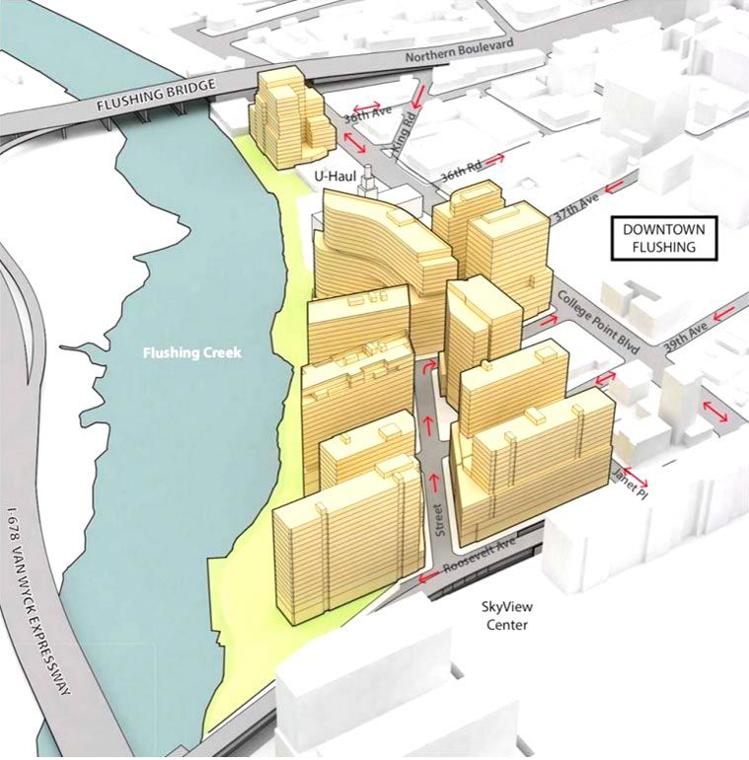
The City Council’s Subcommittee on Zoning and Franchises and its Committee on Land Use on Wednesday, Dec. 9, voted in favor of approving the Special Flushing Waterfront District — a 29-acre proposal that would bring waterfront access, environmental cleanup and new development to a decades-long isolated and polluted section of downtown Flushing.

The proposal will now move forward to the full council for a final vote on Thursday, Dec. 10. 

After delaying the vote on the matter in recent days, the council’s Subcommittee on Zoning had announced reaching a deal with the labor unions, Hotel Trades Council (HTC) and SEIU 32BJ, to ensure good jobs, community benefits and more for the Special Flushing Waterfront District (SFWD).

According to Councilman Francisco Moya, chair of the Subcommittee on Zoning, it was imperative for the committee to reach a deal that met with the union’s demands. 

“As I stated from the very beginning, it would have been irresponsible to approve this application without commitments to provide good-paying jobs for local community members and deep community benefits like real affordable housing,” Moya said. “I have always stood by my brothers and sisters in labor, 32BJ and HTC.” 

The developers of SFWD — F&T Group, Young Nian Group, United Construction and Development Group known as FWRA LLC. — said they have worked tirelessly with community members for years to activate what is currently an empty and polluted waterfront and finally give Flushing the future it deserves.

“This is a pivotal vote for New York City’s economic recovery, especially for a hardworking immigrant community like Flushing,” the group said in a statement. “We deeply appreciate the Council members’ support in moving Flushing forward, particularly the leadership of Council member Peter Koo, Chairs Francisco Moya and Rafael Salamanca, and Speaker Corey Johnson.”

 That hotel might actually come in handy with all the homeless people that will be produced from the gentrification this will cause. Especially with rents going up in Flushing during a pandemic. Happy Holidays.

Thursday, January 23, 2020

Massive Flushing development foments discord with area residents


https://bloximages.chicago2.vip.townnews.com/qchron.com/content/tncms/assets/v3/editorial/e/dd/edd797b1-d507-5256-8d78-6609c72899c0/5e29d20ed7b9f.image.jpg?resize=749%2C760

Queens Chronicle
 
Special Flushing Waterfront District protesters returned brandishing “Housing justice for all” and “The massive waterfront giveaway” signs for the developers’ presentation at Community Board 7’s Land, Buildings and Zoning Committee hearing Tuesday, Jan. 21.
 

“You have your signs and that’s great, it’s no problem. March around with your signs, but please kindly control the tone,” District Manager Marilyn McAndrews said at the start of the meeting, begging the protesters not to repeat their chants of the Jan. 13 public hearing meeting that disrupted the nursing home the meeting took place in.

“Flushing community members are concerned with increased congestion, pollution, construction hazards and mass displacement resulting from new luxury development,” MinKwon Center, the advocacy group that organized the protest, said in a statement.


The Brownsfield Opportunity Area plan, which allows for redeveloping the 29-acre stretch of waterfront industrial property and surrounding land in Downtown Flushing, aims to extend the district to the waterfront, improve pedestrian flow and vehicular movement, add affordable housing and improve the water quality of Flushing Creek. As the meeting progressed, CB 7 members, who hold the power to make an advisory vote, scheduled for Feb. 10, on the implementation of the plan, found themselves voicing similar concerns to the protesters.


“This is a vacant site. Other than U-Haul there is no activity,” said Ross Moskowitz, the attorney representing the project owners in response to a question about displacement, “The increase in this project should not have an impact on the local businesses ... these are local developers. They are long-established owners, operators, tenants, residents. They have invested in this community and will invest in this community.”

Wednesday, December 14, 2016

Council seeks to limit authority of the BSA

From Crains:

The City Council is set to discuss a package of bills Wednesday that would make it harder for property owners to bend the city's zoning laws, as they typically request in order to building bigger projects than would normally be allowed.

The 10 bills target the Board of Standards and Appeals, an obscure city body where owners argue that it is impossible to make a reasonable return developing a property without surpassing limits on things like the size and shape of buildings. A property might be oddly shaped, for example, preventing projects that conform to the zoning and are big enough to justify the investment. In order to make the economics pencil out, an owner might ask the board to relax height restrictions so more revenue-generating apartments could fit on the site.

According to the Manhattan councilman sponsoring five of the bills—which are to be heard Wednesday by the Committee on Governmental Operations—the board is persuaded too frequently. In 2011, it approved 97% of applications, many of which were opposed by local community boards.

Thursday, July 9, 2015

FBI SUBPOENAS CB7's FILES

From the Queens Tribune:

A federal grand jury in the Eastern District of New York has issued a subpoena for records to Queens Community Board 7 regarding land use decisions and procedures.

CB 7, which covers Flushing, College Point, Whitestone and other Northern Queens neighborhoods, has had many land use applications come before them as the area has undergone a development boom over the years. Construction in the past decade adds up to some billions of dollars, a number that will continue to grow as more and more developers set their eyes on Northern Queens.

Documents obtained by the Queens Tribune show the court issued an order on May 29 for records for the period of January 2005 to present. Records requested include minutes from board and board Land Use sub-committee meetings; letters, memos, recommendations and other communications from the board Land Use committee to CB 7, the district manager or others; documentation of any and all recusals or notification of potential conflict of any board members for matters that came before CB 7; and attendance and voting records.


According to the subpoena the Federal Bureau of Investigation, acting on behalf of a federal grand jury, requested the documents.

Some past projects that have gone before CB 7 were controversial, including relatively recent proposals for Flushing Commons, Willets Point and the RKO Keith Flushing Theater. No specific projects or proposals were mentioned in the subpoena.

Councilman Paul Vallone (D-Bayside), who found out about the subpoena on Wednesday, expressed shock at the probe.

“We are surprised at this week’s unexpected news regarding the investigation into Community Board 7,” the statement read.”This is the first we’ve heard of it and we will be watching the situation closely.”


You may recall this post from 2008:


The proposed Willets Point development undergoes land use review at Queens Community Board 7 during 2008. 
Recording © 2008. Originally published by Willets Point Industry and Realty Association.

Thursday, November 13, 2014

Surprise, surprise: Council now loves Astoria Cove project

From the NY Observer:

The massive Astoria Cove project is a major stride closer to launching today — as is long-proposed ferry boat service for the Queens waterfront area.

After months of negotiating and hours of backroom deliberation, the City Council’s powerful Land Use Committee today stamped its approval on the controversial 1,700-unit luxury development–permitted that it set aside 468 units for low- and middle-income tenants, hire unionized construction workers and building staff, include a co-operative supermarket, pay for improvements to local parks and a senior center and commit $5 million to the construction of a ferry dock.

“I am happy to say we have an agreement here at Astoria Cove that truly integrates this development into our community,” said Councilman Costa Constantinides, who represents the area where the development will take place, but does not sit on the Land Use Committee. “This deal is historic and we’ve changed the way development happens.”

The controversial luxury Queens waterfront project–which also includes retail and a new school–encountered considerable resistance over developer Alma Realty’s initial reluctance to hire union labor and to set aside more than a quarter of the new residences for low- and middle-income tenants. Mr. Constantinides–joined by Council Speaker Melissa Mark-Viverito and Queens Borough President Melinda Katz–had led the opposition and the arm-twisting, and the Council almost always defers on land use matters to the wishes of the local representative.

Mayor Bill de Blasio, however, was a supporter of the project–seeing it as a test case for his new mandatory inclusionary zoning policy, which requires developers to insert affordable units into new developments as a precondition for construction. Previously, the city had relied on subsidies and tax abatements to entice companies into adding below-market rate units.

Committee Chairman David Greenfield noted that the 27 percent of units set aside for below-market rents is the largest affordable housing percentage agreement in city history.


However, Alma's history with regard to affordable housing is a joke.

Friday, June 13, 2014

Council wants bigger say in development plans

From Capital New York:

The City Council's newly formed Economic and Community Development Division will provide "resources and support to council members," Speaker Melissa Mark-Viverito said Wednesday, describing how it could affect the governing body's land use process.

The division will work with the Department of City Planning to hammer out deals with developers who want to build in the city. Mark-Vivertio said it will be a collaborative body that will be more proactive.

"I think the land use unit we have now, obviously we are very proud of it and their work, but it really responds to applications that are coming before us for a vote," Mark-Viverito said.

"We may be looking at projects that even city planning hasn't been looking at," she said. "We may be looking at areas that could use possible development that are not even on the radar of city planning right now, that are not on the radar of the administration."

Typically, developers go before the Department of City Planning before presenting their project to the Council. The planning department operates under the direction of the mayor.

Creation of the new unit appears to help cement the role the Council plays in approving or opposing land use applications. Although the Council does not automatically review all proposed developments, it must review changes to zoning laws often required when big projects are proposed.

Friday, January 31, 2014

Melinda wants LPC decisions to be time-limited


From Crain's:

In their first joint public appearance, the city's five borough presidents—four of them new to their office this month—laid out their visions for development of their domains at a forum Tuesday hosted by Crain's. Borough presidents play an advisory but influential role in the land use review process, giving them the potential to spur, shape and sometimes kill projects.

Queens Borough President Melinda Katz called for a "real process" with more public input for planned developments at Flushing Meadow Park and Willets Point, and a "more finite" plan. "I think we need to take a little step back," she said. Ms. Katz, the former chair of the City Council's Land Use Committee, also is pushing for better transportation to the Rockaways.

The five borough presidents offered differing views on the creation of historic districts by the Landmarks Preservation Commission.

Ms. Katz offered another criticism of the process, saying proposals for historic districts linger for extended periods of time without being voted on, causing land to sit undeveloped. She once sponsored a bill setting a time limit for such proposals, and called for such a measure to be introduced again.

Monday, January 27, 2014

Can the new land use chair be trusted?

From Crains:

For real estate interests, the election of an unabashed liberal as City Council speaker this month was a setback. Another one holding the gavel of the powerful Land Use Committee could have been a real problem. So, Speaker Melissa Mark-Viverito's appointment of Brooklyn Councilman David Greenfield as chairman drew sighs of relief. Real Estate Board of New York President Steven Spinola said he expects Mr. Greenfield to be "diligent and fair" in running Land Use, which approves projects.

Unlike other powerful committee heads named, Mr. Greenfield is not a member of the labor-backed Progressive Caucus. He owes his position instead to helping broker the speaker deal for Ms. Mark-Viverito. That could grant him a level of independence.

Ms. Mark-Viverito and Mayor Bill de Blasio are promising broad changes in development policy, including mandatory affordable housing in rezoned areas. Mr. Greenfield did not immediately have a comment on that policy, but said he expected new council rules would leave chairmen "empowered to run committees independently."

Saturday, January 19, 2013

Melinda's impressive résumé


From DNA Info:

In the Assembly, she served as chairwoman of the subcommittee on urban health and fought against the privatization of public hospitals, she said. She was also responsible for a bill increasing penalties for domestic abuse.

Later, she went to work for Shulman, the borough president at the time, as a director of community boards, attending meetings around the borough and keeping the president informed about communities’ concerns.

In 2002, she was elected to the New York City Council.

As chairwoman of the land-use committee, she negotiated various down zonings in Queens and supported new developments, including Willets Point and Hunters Point.

Her tenure on the City Council won her a recent endorsement from former Mayor Ed Koch.
Katz “is the one candidate in the race that raises the level of conversation about balancing economic development with the community in Queens,” Koch said in a statement.

After she lost the Democratic primary for New York City comptroller in 2009, Katz went to work for a law firm, Greenberg Traurig, specializing in land-use issues and government relations.


Deputy Borough President under Shulman, promoted overdevelopment and eminent domain for private interests while chair of land use for the City Council, endorsement from Koch, and most recently worked for a lobbying firm. I can't think of anyone more qualified to be borough president. Can you?

Thursday, March 3, 2011

Crap in the yard requires variance

From Bayside Patch:

A plan to build a two-bedroom house on a “side yard” in Bayside Hills could be shaping up as a battle royal between Mayor Bloomberg and the City Council – and there hasn’t been an official meeting about it yet.

The budding brouhaha centers around 50-20 216th Street, at the corner of 51st Ave. A house sits on the wide end of what is basically a triangular lot and the owner has split the property into two tax lots, with the idea of building another house on the land.

But there’s a catch. The planned construction falls short of zoning requirements, so a “variance” is needed from the Board of Standards and Appeals (BSA), with an advisory vote from CB11.

Bonfilio [the owner] said that he feels that BSA will issue the variance anyway, based on “case law.”

So does City Councilmember Dan Halloran, and he has a problem with it. After meeting with residents who were at the meeting, he explained.

The problem as Halloran sees it is that the Mayor appoints the BSA and because of a loophole created by an earlier Charter revision, its decisions can only be challenged in court.

To close the loophole would require either another Charter Revision, or a state law, Halloran said. “The Mayor can knock out the former and exercise considerable influence on the latter,” he conceded.

Saturday, January 22, 2011

Day care limitations, only in Staten Island

From SI Live:

The City Council yesterday gave a break to Staten Islanders who are tired of oversized, out-of-character, parking-spot-stealing medical offices and day care centers sprouting up in their neighborhoods.

The Council approved new rules yesterday aimed at curbing the building of those facilities in residentially zoned areas here, and encouraging them to be built in commercial zones instead.

The legislation, which grew out of discussions between lawmakers, the Department of City Planning, Borough President James P. Molinaro and the Growth Management Task Force, passed the Council by a vote of 48-0.

All three of the Island's Council members, including Councilwoman Debi Rose (D-North Shore), voted in favor.

The measure unanimously passed the Land Use Committee earlier in the day.

Borough officials and residents have complained for years that the facilities, often added onto existing homes, are frequently expanded to the point that they dwarf and loom over the surrounding houses, destroying the character of neighborhoods.

Because the medical offices and day care centers were not required to provide on-site parking, visitors and employees often took up precious parking spots on surrounding streets, much to the chagrin of local residents.

There have also been safety concerns about children being dropped off and picked up in the street front of the day care centers.

Under the new regulations, new medical facilities in residential areas would be required to be on lots no smaller than 5,700 square feet. On-site parking must be provided, and owners will not be permitted to seek to have the parking requirement waived.

Day care centers would not be permitted on lots smaller than 10,000 square feet. Officials have said that this will cut down on the building of centers because lots of that size are scarce in residential neighborhoods.

Day care centers would also have to provide on-site parking for employees, and an on-site drop-off point for children.


I find it implausible that this is only a problem in Staten Island and not throughout the City.

Wednesday, July 21, 2010

Pols uneasy about cemetery at Flushing Commons

From the Daily News:

Leroy Comrie, chairman of the City Council's powerful land use committee, called on the city to ensure "gentle" treatment of any tombs at the plot set for Flushing Commons, a mix of housing and retail space.

The proposal is expected to be voted on by the land use committee on July 28 and then by the full Council. But Comrie said too many question marks remain.

"I'm not prepared to encourage the full body to vote because we have so many unresolved issues," Comrie said at a hearing Thursday near City Hall.

At Thursday's hearing, Comrie (D-Jamaica) pressed Seth Pinsky, president of the city Economic Development Corp., for details about new excavation plans.

"No one has said to date what will be done," Comrie said.

Pinsky defended the 1953 excavation as an "extensive investigation." But when Comrie asked how far down the hand-diggers went in 1953, Pinsky admitted, "I don't have that exact figure."

The News asked the city last month for records of the excavation to determine its scope, but the city has not yet produced any.

A spokeswoman for the city Law Department, which officially declared the cemetery nonexistent in 1954, said the agency is "still looking" for the report.

Pinsky also noted that community leaders did not mention the possibility of graves during numerous meetings with EDC.

"We have not received any evidence other than the story in the Daily News," Pinsky said. But, he added, "We would ensure the site would be treated with respect."

Later, Queens Borough President Helen Marshall echoed Comrie's calls for a careful check.

"There should be reasonable measures to ensure there are not human remains on the construction site," Marshall read from prepared testimony.

She lifted her head and continued off the cuff: "We treasure our people, both while they're alive and after they pass away."

Thursday, June 17, 2010

Leroy Comrie's kneeslappers

From the NY Observer:

How often do you meet people within the real estate industry, whether it be a developer, a lobbying group or a broker?

They're not contacting me on a regular basis, or asking me for anything...

The Council is a democratic party, a transparent body. We have a responsibility to make sure that anybody who comes before the Council has an opportunity to air all of the aspects of a project so that at the end of the day the residents can know exactly the pros and cons and why we came to the decisions we've made after hearing those pros and cons.


HA HA HA HA HA!!!

Sunday, March 21, 2010

Bar association comes out against community bribery

From the NY Observer:

The Association of the Bar of New York City doesn't seem to think all that highly of the process of landlords cutting formal, non-standardized deals with community groups—known as Community Benefits Agreements—to win approvals for planned developments.

CBAs proliferated in recent years, particularly in the late real estate boom, as community groups and elected officials rushed to try to wrest concessions and mitigations from developers who may or may not be financially prepared to shower a bounty on the community. The use of CBAs has been criticized, in part because of the somewhat arbitrary manner in which they are formed (there is no standard for which groups end up being signatories in a CBA or participate in the negotiations with a developer, for instance), and the offerings from developers may not necessarily benefit the larger public interest, but rather just assuage a certain small constituency that happens to be negotiating the CBA.

CBAs have popped up at Atlantic Yards, Columbia University's planned West Harlem expansion, and recently at the Kingsbridge Armory development in the Bronx, which was voted down by the City Council after the requirement of a "living" wage became a make-or-break for the elected officials involved.

The well-researched Bar Association's report piles on more criticism and suggests that the tit-for-tat linking of a council land-use approval with a CBA is improper, if not illegal, given that developers are effectively buying zoning changes by paying certain community groups.

Wednesday, February 10, 2010

Concern over community gardens

From NY1:

With the fate of the city's community gardens up in the air, advocates, elected officials and residents brainstormed ways to protect them at a West Village meeting Saturday.

City Council Speaker Christine Quinn and Manhattan Borough President Scott Stringer joined community members to discuss permanent solutions.

Since 2002, the city's community gardens have operated under a contract with the mayor and state attorney general. Yet that agreement is set to expire in September, leaving gardens vulnerable to redevelopment.

Residents said community gardens are vital to community development.

Quinn said a legally-binding solution is necessary to ensure the gardens are preserved.

The City Council is using the city's Land Use Process as one way to take care of the community gardens.

Sunday, January 31, 2010

Comrie takes over land use committee chair

From The Real Deal:

On the eve of his first meeting as chair of the City Council's Land Use Committee, southeast Queens Council member Leroy Comrie spoke with The Real Deal about how he will judge success, whether he has laid out specific goals and which upcoming land use projects could be the most controversial. Comrie was voted in as chairman last Thursday and is scheduled to call his first committee meeting to order today at 10 a.m. with three rezonings and 11 landmarkings to consider.

Is there anything that you as land use chair can do to spur development?

I think development will happen in its own course and time. Development will happen when they have the ability to create the financing, and the property vision. The council can try outside the committee to create legislation, [but] there is nothing that we can do other than be a bully pulpit.

Well you could take giant campaign contributions from developers in return for pushing their agendas through, like your predecessor did. Thankfully Melinda Katz is gone. Don't be a Melinda, Leroy!