Showing posts with label jamaica bay. Show all posts

Sunday, October 27, 2024

Graveyard Bay


 NY Post

Jamaica Bay is quietly earning a reputation as the Big Apple’s version of the Bermuda Triangle — with at least eight dead bodies discovered in and around the area over the past year, some under mysterious circumstances. 

Investigations into five of the eight “floaters” who washed ashore or turned up in either Jamaica Bay or the nearby Atlantic Ocean side of The Rockaways have been closed, authorities said.

However, many questions still remain.

The “manner of death” on four of the bodies was deemed “undetermined” by the city Medical Examiner’s office, including Emmy-award winning cinematographer and photographer Ross McDonnell, who authorities have said loved to “wild swim” in the ocean and other waterways.

The 44-year-old Irishman’s headless, armless torso washed up on a Breezy Point beach Nov. 17, two weeks after leaving his Brooklyn home. 

 Police initially said they believed McDonnell likely drowned taking a late-night dip, but the ME said it declared the cause of death “undetermined” based on the lack of evidence off the predominantly sparse skeletal remains found.

 Three other deaths remain under investigation by authorities, including Marco Ramirez, 48, of Brooklyn, who was found dead Oct. 15 along the Cross Bay Boulevard shoreline of the Jamaica Bay Wildlife Refuge in Broad Channel, and an unidentified female who washed ashore in Breezy Point on Oct. 5.

City coroners have so far only been able to determine both the cause and manner of death for one of the eight deceased — a headless man whose unidentified remains were found in April by a fisherman near 165th Avenue and Cross Bay Boulevard in Queens.

About a 1,000 feet away, authorities found a rope hanging from the Joseph P. Addabbo Memorial Bridge.

That case was declared a hanging suicide, according to the Medical Examiner’s office.

Councilwoman Joann Ariola (R-Queens), who represents much of The Rockaways, said she expressed concerns to authorities over the summer after the body count reached five — only to be told by law enforcement they didn’t believe the deaths were connected.

Tuesday, September 10, 2024

Sacrificial Hams

 Image

 NY Post

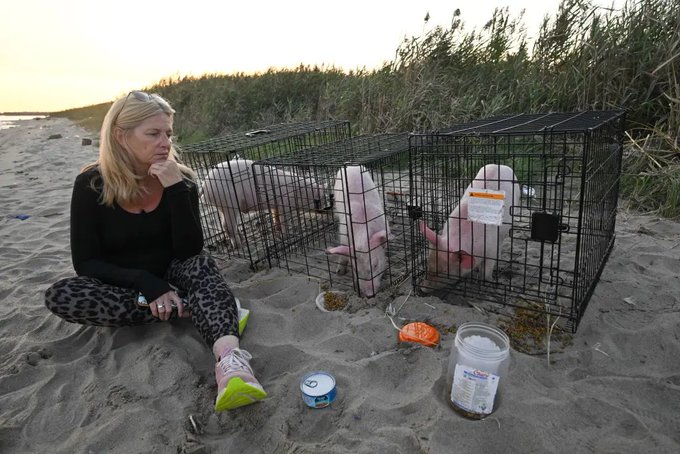
Animal sacrifices are surging in Queens, with chickens, pigs and rats being tortured, mutilated or killed in “twisted” religious rituals in parkland surrounding Jamaica Bay, The Post has learned. 

In a little over a month, at least nine wounded animals or carcasses have been discovered in the federally-managed Spring Creek Park in Howard Beach and the Jamaica Bay Wildlife Refuge in Broad Channel — including five live pigs with partially severed ears.

Creatures recovered from the revolting scene also include a near-dead baby rat tied up in a bag with chicken bones; a freshly-decapitated chicken head; a live hen in distress; and a dead dog with its neck snapped. 

“It’s continually getting worse. The animal sacrifices are happening more repeatedly, more times a week,” Sloane Quealy, co-founder and president of Zion’s Mission Animal Rescue, told The Post.

“The sacrificers know it’s open season.”

 One of the distressed pigs was found emaciated in a food-filled crate in July, with a deep gash running down its face and its body covered in oils and spices, said Kristen Latuga, who has taken in all five of the ailing swine at her Long Island animal sanctuary, Brucie’s Angels.

Several rescuers and a local religious leader suggested the torture was linked to a sect of Hindu devotees who worship the goddess Kali and have practiced animal sacrifice in the area surrounding Jamaica Bay for decades.

“It’s a misconstruing of what the scriptures say about conquering the animalistic values,” said Acharya Arun Gossai, who runs the Bhuvaneshwar Mandir temple in Ozone Park.

“They’ve twisted it and they’ve sacrificed an actual animal rather than sacrificing the animalistic qualities of man.” 

Jamaica Bay has been a popular religious site among members of the Hindu Guyanese and Indo-Caribbean diaspora living in nearby neighborhoods, including Richmond Hill and Ozone Park. 

Along the waterway, which has been nicknamed the “Ganges” by some, after the sacred body of water in India, people regularly gather to give offerings, typically flowers and fruits, and leave statues of deities as well as prayer flags. 

This week, The Post observed Quealy and another animal rescuer, Kim Fraser, track down a trio of piglets that had their ears and tails cut off — roughly 100 feet away from a pair of statuettes of Hindu deities resting atop a mound of turf alongside a trio of flags.

Prayer flags were spotted nearby bundled up in the brush.

Followers of other religions whose rituals involve animal sacrifice, such as Santeria and voodoo, also have been known to use beaches and parks surrounding Jamaica Bay to carry out bloody rites. 


Saturday, November 5, 2022

There's a delay on the A train because of delays building flood resiliency infrastructure

https://thecity.brightspotcdn.com/dims4/default/5abcaac/2147483647/strip/true/crop/2560x1707+0+0/resize/2048x1366!/format/webp/quality/90/?url=https%3A%2F%2Fcdn.vox-cdn.com%2Fthumbor%2FrWqFyNQ1oKk8HRPv06D-Nen3MzY%3D%2F0x0%3A2560x1707%2F2560x1707%2Ffilters%3Afocal%281280x854%3A1281x855%29%2Fcdn.vox-cdn.com%2Fuploads%2Fchorus_asset%2Ffile%2F24145758%2F2013_rockaway_sandy_repairs_1.jpg 

THE CITY

Hurricane Sandy isn’t done messing with subway riders in the Rockaways just yet.

A decade after extensive damage from the October 2012 superstorm knocked out A train service between Howard Beach and the peninsula for more than six months, remaining Sandy-related repairs along the forked line are running with delays and getting pricier, MTA records show.

The cost of federally funded resiliency upgrades to stations, bridges and viaducts along the tracks that links the peninsula with the rest of Queens is now forecast to hit $467 million — up $60 million from an earlier goal, according to MTA documents.

The remaining work is among the lingering remnants of a storm that caused billions in damage to the subway system and specifically wreaked havoc on the coastal section of the A line and the Rockaway shuttle.

“It was a horrible storm and I saw what it did to my community,” said Thomas Atehortua, 23, as he waited Thursday for an A train at Broad Channel. “So I’m not at all surprised that the damage was so impactful and long lasting along this line.”

While the MTA last year wrapped up Sandy-related repairs inside the last of nine under-river subway tunnels damaged by the storm, reopened the flooded South Ferry complex in 2017 and has come up with ways to protect 3,500 street-level subway openings from excess water, the work in the Rockaways is still years away from being completed.

“It is a complicated project,” Janno Lieber, MTA chairperson and CEO, told THE CITY after the agency’s October board meeting on Wednesday. “It also needs to be carefully coordinated with the community because it has impacts on A train service in and out of the community, which is obviously important to that waterfront community.”

Lieber said the agency has already poured $150 million into Rockaway Line resiliency efforts, including erecting a protective seawall to guard against storm surge along Broad Channel, protecting critical station infrastructure and restoring full service in May 2013, just months after Sandy swamped tracks and bridges.

Wednesday, November 2, 2022

Cross Bay Blvd on the verge of collapse

https://thecity.brightspotcdn.com/dims4/default/af876c5/2147483647/strip/true/crop/2994x1996+0+0/resize/2048x1365!/format/webp/quality/90/?url=https%3A%2F%2Fcdn.vox-cdn.com%2Fthumbor%2FLIVn8I6ch4vj8qOJrrqyang1lIk%3D%2F0x0%3A2994x1996%2F2994x1996%2Ffilters%3Afocal%281497x998%3A1498x999%29%2Fcdn.vox-cdn.com%2Fuploads%2Fchorus_asset%2Ffile%2F24149523%2F102722_04_cross_bay.jpg

THE CITY 

The cracked and crumbling Cross Bay Boulevard, one of the three paths out of the Rockaways, has been the subject of an outsized share of citizen complaints, according to an analysis by THE CITY. 

The thoroughfare has been a problem for decades, according to frustrated residents of Broad Channel. That’s the neighborhood on an island in Jamaica Bay just north of the Rockaways and south of mainland Queens, with the boulevard running through it and A train tracks immediately to the east.

“If there’s a roadway collapse, or if there’s another hurricane, Broad Channel has nowhere to go and people from the center of Rockaway have no way to get out,” local Community Board 14 Chairperson Dolores Orr told THE CITY.

The asphalt of the boulevard is pocked with deep, visible cracks and depressions, even ten years after the devastation of Hurricane Sandy highlighted the need for resiliency work in the area. These days, locals are renewing the call for a complete rebuild of the roadway — which has been the top item on Community Board 14’s capital project list since 1990, including in the most recent budget draft published in mid-October.

Dan Mundy Sr., 85, a lifelong Broad Channel resident and former president of the neighborhood’s civic association, recalled receiving a call in the early 2000s from a local homeowner upset that her house — just doors down from a concrete drainage tunnel that supports a section of Cross Bay Boulevard — shook when trucks passed it. 

Mundy said he eventually learned the problem stemmed from the installation of new sewers in the 1990s — a project that required digging trenches and hollowing out the concrete base that supports both sides of the boulevard. This, he said, in turn destabilized the tunnel — and the boulevard at large — as solid concrete was replaced by a patchwork remedy. 

Three decades later, trucks, buses and even cars thud loudly as they drive over the cracks formed where the tunnel walls meet the road.

 “It’s an accident waiting to happen,” said Mundy, pointing to the tunnel, which is usually walkable when the tide is low but was flooded by a high tide when THE CITY visited Thursday morning. “When you do go under there, you can really see where the concrete is falling off. The [steel] rebars are all sticking out.”

Mundy pointed to another section along the tunnel — also known as a culvert or “sluiceway” to locals —  where he said a pothole has opened up time and again. From inside the culvert, Munday said he can “almost put my hands up to the street” where the weak spot is.

“They keep coming and they fix it, and it falls apart again,” Mundy told THE CITY. “So it’s just a Band-Aid they’re doing on everything here.”

The cracks and potholes along the culvert are just one symptom of how the sewer installations that gutted the boulevard in the 1990s have, over the years, continued to destabilize the nearly century-old roadway, said Mundy. The boulevard is estimated to carry an average of about 25,000 cars a day.

I'm going to put this here like this because the people at the DOT really need the exposure:

The city transportation department, however, seems unworried. “The Cross Bay Boulevard culvert is structurally sound,” DOT spokesperson Vin Barone told THE CITY after conferring with DEP. “DOT is working with its sister agencies to conduct routine inspections while we continue to explore long-term infrastructure upgrades.”

Sure Vinny, tell Ydanis and your fellow bike zealots there to keep exploring, maybe more paint on the bike lanes will stop the next deluge. 


Saturday, June 11, 2022

Two boys drowned in Jamaica Bay

 https://www.nydailynews.com/resizer/JO6DZWGFmqdcI7QTP4loTrhJVG0=/800x0/filters:format(jpg):quality(70)/cloudfront-us-east-1.images.arcpublishing.com/tronc/RQILQHGNVRDJFBINTPCRTTS24M.JPG

 NY Daily News

Two Queens boys celebrating the start of summer died Friday after they fell into Jamaica Bay and never resurfaced, police said.

The two victims, who are both 13, were on an outcropping of rocks near Broad Channel at about 11:40 a.m. when they fell into the water.

Panicked onlookers called 911. NYPD divers recovered one of the two just before 1 p.m. and rushed him to Jamaica Hospital, where he died.

The second teen was found under the waves about 40 minutes later. He was rushed to Jamaica Hospital in extremely critical condition but he could not be saved, officials said.

Their names were not immediately released.

The two boys, accompanied by a group of friends, made their way to the bay in celebration of the first day of summer break, a shaken uncle of one of the teens said outside the hospital Friday evening.

“Yesterday was the last day of school and they were just trying to have a good time, messing around like kids do,” said Michael Rachel. “They were out on the rocks but when the tide comes in you couldn’t see them. They’re gone.”

Sunday, April 3, 2022

Endangered Spaces

Snow geese share the landscape with the A train in Broad Channel. The mix of wild natural features and city infrastructure  makes the area distinctive.

New York Times 

Don Riepe pointed to the line on the wall five and a half feet above his kitchen floor. That was where floodwaters reached during Hurricane Sandy in 2012.

His home, a humble two-story wooden structure, is decorated with nautical maps, horseshoe crabs and assorted maritime paraphernalia. It sits right on Jamaica Bay, with a small dock at the water’s edge, where he moors his 22-foot boat. He has a spectacular view of the east end of the bay with the spires of Manhattan in the distance.

Mr. Riepe, a former manager of the Jamaica Bay Wildlife Refuge, considers himself blessed to be surrounded by nature and still have all the perks of a big city a subway ride away. But he knows his neighbors’ time there may be coming to an end. During his four decades living in the area, Hurricane Sandy was the worst Mr. Riepe has seen; the flooring and all the electrical appliances on the first floor of his house were destroyed. Since then, during lesser storms and even high tides, he moves his computer and furniture upstairs, where he sleeps — and he hopes for the best.

Mr. Riepe is just one of tens of thousands of residents who live on the wild fringes of Queens, in communities like Hamilton Beach, Edgemere and Howard Beach, where the ocean threatens to encroach as sea level rises and coastal storms intensify owing to climate change. It is also the focal point of a major environmental restoration project that aims to protect the area — and in fact the whole city — by returning salt marshes and sand dunes to their natural states. How this will affect the community of Broad Channel (the only inhabited island in Jamaica Bay) remains to be seen.

Already, Mr. Riepe’s neighbors are scrambling to adjust to their new climate-changed reality — moving their cars to higher ground on high-tide days, and in some cases converting their ground floors into garages and shifting their living quarters upstairs and out of harm’s way. One thing that they are not yet prepared to do, however, is move out.


Crains New York 

Flushing Meadows–Corona Park, one of the most frequently flooded green spaces in the city, is getting a comprehensive plan on how best to adapt Queens’ largest park to climate change.

This month a congressional spending bill green-lit a $530,322 grant for the Waterfront Alliance to lead a climate resilience plan for the 897-acre park. Those federal dollars, which Queens Rep. Grace Meng requested from Congress last year, will enable the alliance to develop a road map of infrastructure projects and priorities to stymie prolific park flooding, which is only expected to worsen with increasingly heavy rains and sea level rise.

After heavy rainfall, it’s common for huge puddles to transform park basketball courts and fields into ponds for days. Overflow from both Meadow and Willow lakes frequently engulfs trails, making the park a challenge to navigate. Hurricane Ida laid those challenges bare with torrential rains that flooded the park and overflowed onto the Van Wyck Expressway and Grand Central Parkway, which spurred emergency rescues for drivers trapped on the roads.

That’s nothing compared to what’s on the horizon. Without upgrades, much of the green space, which is a former tidal wetland, could be permanently inundated by 2080, the New York Panel on Climate Change said.

Karen Imas, vice president of programs at the Waterfront Alliance, said the city must ensure the park is “prepared for our climate future.” The best way to do that, she said, is by developing a plan with those who know the park best.

“This is really an opportunity to work hand in hand with the community in and around the park and with city agencies to identify what are the greatest hazards and vulnerabilities, and how they can be addressed,” Imas said. That will likely be through a mix of projects, including wetland restoration, bioswales and revamped sewage infrastructure, she added.


Thursday, June 24, 2021

Jamaica Bay protection bill passes in Albany, awaits singature from Mario's son


QNS 

 Two Queens lawmakers applauded the passage of their legislation that would protect the pristine waters of Jamaica Bay, which has become home to marine life not seen in decades.

Assemblywoman Stacey Pheffer Amato and state Senator Joseph Addabbo vowed to navigate the measure through both chambers of the Legislature for a fourth time after Governor Andrew Cuomo vetoed the bill three times in past legislative sessions.

“The priority and necessity of this bill is clear. My colleagues in the Assembly see the value of this bill, and the importance of protecting our environment,” Pheffer Amato said. “Both houses have passed this bill for three sessions in a row, only for Governor Cuomo to veto it. It’s more important than ever to invest in Jamaica Bay and ensure that our standards are up to the highest standards, and we can never turn back.”

The legislation would increase the standard of dredging materials placed into Jamaica Bay’s borrow pits which are also known as a sandbox. It is an area where material such as soil, gravel or sand has been dug up for use at another location.

In his last veto statement on the bill, Cuomo said the legislation would change the criteria for filling Jamaica Bay borrow pits to comply with the federal criteria for the unrestricted ocean dumping of dredged material, which is not applicable to Jamaica Bay. Under the legislation, the state Department of Environmental Conservation would be required to utilize more restrictive and costly federal ocean dumping criteria to test the materials instead of DEC’s existing standard.

Wednesday, December 9, 2020

Cuomo doubles down against Jamaica Bay dredging bill


QNS

 Earlier this month, Governor Andrew Cuomo once again vetoed a bill sponsored by state Senator Joseph Addabbo and Assemblywoman Stacey Pheffer Amato aimed at increasing the standard of dredging materials that are placed into Jamaica Bay’s borrow pits.

The two-part bill would end the sunset clause on the original bill to protect the bay, so it would be permanent law in New York state instead of being voted on every two years. It also seeks to change the criteria for filling the Jamaica Bay borrow pits to comply with federal Ocean Dumping Act criteria.

“Even though the governor vetoed this bill again, I intend on reintroducing it next year and then continue to negotiate with the state agencies,” Addabbo said. “After seeing the incredible improvement of the water quality of Jamaica Bay, with advocates saying the bay is the healthiest it has been in decades, and with the reemergence of marine wildlife to the area, Assemblywoman Pheffer Amato and I believe the sunset clause on this bill should be removed and it should be made permanent.”

Borrow pits, also known as a sandbox, is an area where material such as soil, gravel or sand has been dug up for use at another location. In a veto statement, Cuomo said the legislation would change the criteria for filling Jamaica Bay borrow pits to comply with the federal criteria for the unrestricted ocean dumping of dredged material, which is not applicable to Jamaica Bay.

“The battle is not yet over,” Pheffer Amato said. “While I am disappointed that Governor Cuomo has vetoed this crucial legislation for the protection of Jamaica Bay, I’m looking forward to the restart of the legislative session so we can reintroduce this bill, and work with Senator Addabbo and the governor’s office to finally get this through the finish line. I also want to thank all of the advocates that have tirelessly worked on behalf of Jamaica Bay, and let them know that our work is just beginning.”

 Believe the science and know the facts, but only when it's expedient for Mario's Son


Saturday, November 28, 2020

Cuomo the fisherman allows dumping in Jamaica Bay

Yes, folks instedda workin, Gov Cuomo decided to veto legislation that would have protected Jamaica Bay from dumping because...drumroll...he wants DEC to be able to dump in it.

Last year, State Senator Joe Addabbo and Assembly Member Stacy Pheffer-Amato passed legislation to extend sunsetting environmental protections in place for the Bay:

In his veto statement, Cuomo said the legislation would change the criteria for fill Jamaica Bay borrow pits to comply with the federal criteria for the unrestricted ocean dumping of dredged material, which is not applicable to Jamaica Bay.

Under this bill, the Department of Conservation would be required to utilize more restrictive, and costly federal ocean dumping criteria to test the materials instead of DEC’s existing standard, and further, the legislation would make this enhanced standard permanent, Cuomo continued.

“The increased costs and time associated with the bill’s required fill standards will impact the availability of applicants with high-quality material for use as fill, which is critical for the restoration of these pits. This bill would make the procurement of this material, and in turn, the achievement of revitalization goals for Jamaica Bay extremely challenging, if not halt restoration altogether.”


Translation: We have to further contaminate the Bay in order to save it.

The bill was reintroduced and passed again, but the outcome was the same.

GOVERNOR CUOMO VETOES JAMAICA BAY PROTECTION BILL ! Looks like Governor Cuomo has vetoed the Jamaica Bay Protection...

Posted by Jamaica Bay Ecowatchers on Friday, November 27, 2020


This session, if the bill is passed again, it will likely survive Andrew "follow the science" Cuomo as there is now a veto-proof majority in the Senate.

Thursday, October 29, 2020

Queens Boat Crap


 QNS 

In the ongoing battle to clean up Jamaica Bay, Councilman Eric Ulrich joined members of the city’s Parks Department and the Jamaica Bay Ecowatchers for a demonstration that removed a derelict boat from its waters.

Earlier this year, Ulrich secured $55,000 in funding for a cleanup initiative that will remove abandoned vessels from the bay.

“Most people are not aware of just how widespread this problem is, especially in Jamaica Bay. Abandoned boats are one of the biggest problems in New YorkCity’s waterways,” Ulrich said. “Not only are they an eyesore, they present multiple ecological, transportation and safety hazards. I am proud to fund this cleanup initiative, which will target the most problematic areas in Jamaica Bay, a local treasure.”

Many vessels are abandoned when an owner can no longer afford to maintain them, and leave them adrift into Jamaica Bay instead of performing proper removal. Despite having removed about two dozen of these abandoned vessels from the waters and marshlands of Jamaica Bay over the past several years, the Parks Department estimates more than 100 abandoned boats remain in the city’s waterways.


Wednesday, January 8, 2020

Cuomo veto allows pollution to continue in Jamaica Bay

 https://external-content.duckduckgo.com/iu/?u=https%3A%2F%2Ftse2.mm.bing.net%2Fth%3Fid%3DOIP.oLB681TpNmwnq-lBt_c1-AHaHa%26pid%3DApi&f=1
QNS:

Disappointed and surprised by Cuomo’s decision to veto the legislation, Dan Mundy Jr., president of the Broad Channel Civic Association and vice president of the Jamaica Bay Eagle Watchers, said they’re hoping to persuade the governor to save the environment. 

“After 30 years of work, Jamaica Bay is the cleanest we’ve ever seen,” Mundy said. “This summer we had a humpback whale inside the bay, right now we have a resident seal population. Our group conducts scuba diving operations out here on a regular basis and we have a 70-foot-deep amazing shipwreck that we’re exploring.” 

Betty Braton, chair of Community Board 10, said the governor’s decision to veto the bill was “very shortsighted” and she hopes he reconsiders. 

“For many of us here, it’s been a lifelong work to make sure that this bay comes back to what it once was. You know, history tells us some bad decisions were made over the years. It had a very serious impact and people were working very hard to turn that around,” Braton said. “I hope that our legislators will continue the work they’ve been doing, which has been outstanding getting this bay back to what it once was: a jewel.”

Friday, July 12, 2019

Former Belt Parkway toxic dump mountain is now a state park


Curbed New York

70 years of promises, Brooklyn’s newest waterfront park is finally open for visitors.

The first section of Shirley Chisholm State Park recently made its official debut on a site that was previously known as the 110-acre Pennsylvania Avenue Landfill. Situated on the northern coast of Jamaica Bay in East New York, near Starrett City, this vibrant new green space has opened up the shoreline here for the first time in generations.

The words “charming” and “fun” don’t often come to mind when walking around New York City’s polluted landfills. Yet somehow, a walk through this new park is just that—a surprisingly enjoyable ramble through a delightfully varied landscape of wildflower meadows, native grasslands, hidden beaches, and bustling fishing piers. Butterflies and songbirds fill the air, while cooling breezes waft in from Jamaica Bay.

Though it has only been open for a week, the park is already a hit with the neighborhood. During its first weekend, the parking lot was filled to capacity and every two-wheeler was checked out of its Bike Library, which is run by Recycle-A-Bicycle. Parents pushed baby strollers along meandering gravel hiking trails, while fishermen lined the piers along Jamaica Bay, happily pulling in dozens of porgies.

The second section of this park, at the adjoining Fountain Avenue Landfill, won’t be complete until 2021, but for a community that has been cut off from the waterfront for decades, any access to the water is no small thing. “I’ve been waiting for this for 20 or 30 years,” said one fisherman, as he cast out into the waters of Jamaica Bay. “I moved here in 1986, and they were working on it then, piece by piece, off and on, over the years.”

Thursday, February 7, 2019

A modern tale of Queens' King of Crap and his port-a-potty empire.


https://farm3.static.flickr.com/2194/2302711366_78be17674c.jpg


New York Intelligencer

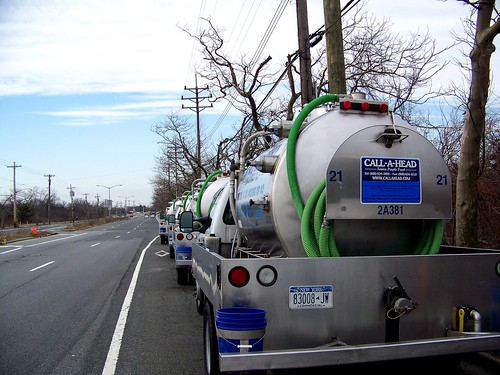
Charles W. Howard is the porta-potty king of New York City. The seat of his vast empire is Broad Channel, Queens; from this windswept rock in Jamaica Bay, you can see the lights of Manhattan twinkling across the water. Early every morning, while the city sleeps, dozens of trucks — tagged with WE’RE #1 AT PICKING UP #2 decals — snake through the five boroughs to clean his 18,000 toilets. The company boasts more than $35 million in annual revenue, thanks in part to “salesgirls” who head out each day in the company’s signature Volkswagen Beetles to poach contracts from competitors who are too shy to sell with sex. Charlie himself arrives at work only around midday in a black Cadillac Escalade. Young female dispatchers and clerks cry “Charlie! Charlie!” while men in orange slickers hose down toilets in the yard.


On a recent Thursday, the gleaming Escalade stops at a pizzeria, and Charlie, 53, steps out, a bit heavy and wearing a rumpled purple dress shirt. He’s brought along Kimberly, the star of his company’s YouTube channel. She’s beautiful, blonde, and his wife. Charlie favors superlatives, like another Queens businessman, and speaks with the accent you’d expect from a man so old-school New York there’s a neighborhood named after his family. And now, not far from Howard Beach, he explains why he’s the greatest toilet man in America. “I had different theories about business,” he says, “and they all turned out to be correct.”

  Nationally, portable toilets are a $2 billion business. Construction rentals are three-quarters of New York’s market, and as America’s real-estate sector has rebounded over the past half-decade, the industry has exploded. Developers pay $100 a month for a pump truck to visit once a week and hoover up blue-tinged waste. Profits are made by building dense routes: lots of toilets at a stop and lots of job sites close together. Events are a growing corner of the business. Go to Smorgasburg and count the toilets: Daily rentals run about $225 each. Use a luxury restroom trailer with flushing toilets at an upstate wedding? It cost the bride’s parents a few thousand bucks just for the night.

 
But now, Charlie might fall off his throne. More than 1,300 former pump-truck drivers, the men who literally haul his shit, are part of a class-action lawsuit that could put him out of business. The rest of the big five covet his empire.


“They would love for us to get destroyed,” Charlie says, though it’s quite a vague “they.” Spend enough time in his world and you wonder if he’s perhaps the most hated man in the city. Kimberly Howard nods. “Business,” she says, “is war.”


Tuesday, January 22, 2019

High school freshmen assemble at Jamaica Bay Wildlife Refuge to protest it's closing during Trump's shutdown of the government


QNS


About 120 ninth-grade students from Metropolitan Expeditionary Learning School in Forest Hills, rallied at the shuttered Jamaica Bay Wildlife Refuge Visitors Center on Thursday in an effort to raise awareness on how the ongoing federal government shutdown is impacting their education, school and communities as a whole.   

Students presented their solutions to environmental issues on Jan. 17 and advocated for the opening of the Jamaica Bay Wildlife Refuge Visitors Center — located at 175-10 Cross Bay Blvd. — where they’re unable to complete their fieldwork investigations, due to the government shutdown.

The students acknowledged the hardworking rangers at the refuge — and other national parks — who aren’t being paid, saying, “They’ve done so much for the bay such as cleaning it up, and making sure people have a good time.” 

Together they chanted, “Don’t shut down my education…whose parks…our parks!” as they concluded with their final message: “Speak your mind, reach out, make your voice heard, after all power comes with unity.”


Each year, ninth-grade students in Living Environment class work with the Jamaica Bay Wildlife Refuge, which is part of the National Parks System, to study ecological systems and human impact in a real-world setting. At the conclusion of every semester, students present their findings at the Visitors Center as part of their final presentation of learning.

Monday, May 7, 2018

Sandy's lesson not learned?

From Crains:

The community of Rockaway Park, Queens, has mixed opinions on a plan to replace a historic firehouse badly damaged by Superstorm Sandy.

New York Fire Department officials say they want to build a new firehouse on the site of a former bank, shuttered after the 2012 storm. WCBS-TV reports the local community board voted against the location but was overruled by the city Planning Commission.

The property sits across the street from the sea wall of Jamaica Bay and is considered a flood zone. Resident Bianca Sepulveda said Monday that she feels it is a risk to have a firehouse right on top of the water.

The FDNY said in a statement that the planned building will meet all flood resiliency standards.

Friday, January 12, 2018

Huge new park coming to Jamaica Bay

From Brooklyn Daily:

The site of some old trash will soon be Brooklyn’s latest treasure.

Gov. Cuomo is gifting the borough with the city’s largest state park that will occupy a massive federally owned, vacant plot in East New York that once was a toxic landfill at the edge of Jamaica Bay, the pol announced during his annual State of the State address on Wednesday.

“This new state park will be a treasure in the heart of Brooklyn, offering hundreds of acres of beautiful parkland on the shores of Jamaica Bay,” Cuomo said in a press release. “We are committed to ensuring every New Yorker can access the recreational, health and community benefits of open space, and this park will open new doors to wellness for New Yorkers who need it most.”

The state will spend $15 million to transform 407 acres of remediated land — bounded by Pennsylvania and Fountain avenues, the Belt Parkway, and the bay — into a lush green space that will be the largest state-run park in all the five boroughs. The only other exclusively state-run park in the Borough of Kings is Williamsburg’s East River State Park, which is a mere seven acres along the waterfront. And Manhattan’s more-than-500-acre Hudson River Park is managed by a state-and-city partnership.

The East New York meadow will include comfort stations, shade-providing structures, and concession stands, and park-goers can bike, hike, kayak, and fish there when it opens later this year or in early 2019, according to a New York State parks spokesman.

Friday, October 13, 2017

The chronic flooding of Hamilton Beach

Great photo essay at Curbed:

If you’d like to get a good picture of New York City’s struggle against sea level rise, head to Hamilton Beach and stand in the middle of the road.

Every month during the highest tides, the streets of this small Queens community are flooded by the waters of Jamaica Bay. At first, as the saltwater starts to trickle in from Hawtree Creek, the small puddles forming around curbs and storm drains don’t appear to be so bad. But as the tide continues to rise, the roads are quickly submerged.

Soon, tiny fish begin to swim across the concrete, and the water is above your ankles. Then swans start to paddle into empty lots, and the water has reached your calves. Suddenly, the flooding is knee high, and the nearest dry land is much too far away. It is a deeply disconcerting feeling, to be standing in seawater in the middle of a neighborhood.

Yet for those living in Hamilton Beach, and in many other neighborhoods around the city, street floods like this are a regular, everyday occurrence. “This is nothing,” says Ginny Dunker, looking out from her front door at a recent six-and-a-half-foot high tide that had flooded midway up her block. “Come back on a rainy day, and then you will see something.”

Hamilton Beach is just one of several New York City communities that are regularly flooded by high tides. Many of these neighborhoods are clustered around Jamaica Bay, including nearby Broad Channel and Howard Beach, and in each of these areas, saltwater has come up into the streets every month for decades. In recent years, however, residents have reported a dramatic increase in the frequency and volume of these floods.

Tuesday, October 10, 2017

An all-too-familiar problem

Hi QC,

I recently attended the Community Council meeting at the 105th precinct. I expressed my concerns about an illegal businesses being run out of a residential home on 107-16 Springfield Blvd in Queens Village. These individuals are fixing cars at all hours of the day right on Springfield blvd. In the process, they are dumping oil all over the street and sidewalks, and discarding oil down the sewer drains which eventually drains into Jamaica Bay. They have a tractor trailer parked in the driveway, and a full blown junkyard in the backyard! A couple residents at the meeting expressed concerns about this place as well, since it's bringing down the quality of life in our neighborhood and devaluing our homes. The community affairs officer told me that they'll be paying them a visit, and she'll contact the DEP. I also contacted the NYS DEC Police twice and they were very helpful. I also filed 311 complaints with the DSNY and DOB, for the messy conditions, illegal parking of the tractor trailer, and of course the junkyard in the back. I just want to show your readers some of the ghetto nonsense that we deal with in SE Qns on a daily basis. Thanks.

- Philster

Sunday, April 16, 2017

Edgemere's vision for its future

From Curbed:

As sea levels continue to rise, difficult choices are facing Edgemere and many other communities around New York City, and the outcomes of the strategies used here will only become more relevant in the years to come.

The Resilient Edgemere plan presents a variety of short- and long-term projects for the neighborhood, comprising zoning changes, new residential development, and transportation improvements. Some of the highlights include a $14 million investment into creating an elevated berm along the neighborhood’s unprotected coastline, a $68 million investment into NYCHA’s Beach 41st Street Houses, and the elevation of 41 attached homes above flood risk levels.

The most striking physical changes proposed in the plan are a new rocky shoreline that could replace the existing salt marsh habitat along the coast of Jamaica Bay, and the numerous illustrations showing that the northernmost part of Edgemere’s residential community, on Beach 43rd Street above Norton Avenue, would be replaced by open space and a new park. “As a proposal of de-densifying the area above Norton Avenue, the short-term tool there would be to change the zoning so that new construction of housing would not be possible,” explains Morris. “Over the long term, this area would transition from a housing area to a less-housed area. What that means is maintaining the balance of the population of the community and moving it to a safer space.”

Thursday, April 6, 2017

Lots of crap in Bergen Basin!

"Hi,

Just thought that QUEENS CRAP might be an appropriate addressee for this CRAP.
It is over 719 hours since CRAP first started being dumped in Bergen Basin.
That's just about 30 days.
That's alot of crap!" - anonymous