Showing posts with label hospitals. Show all posts

Saturday, November 27, 2021

Governor Kathy brings the pandemic back to where it started based on speculation

https://nypost.com/wp-content/uploads/sites/2/2021/11/hochul-044.jpg?quality=90&strip=all&w=744

NY Post 

Here we go again.

Gov. Kathy Hochul signed an executive order Friday to postpone elective hospital surgeries — something that hasn’t been done since the worst of the initial coronavirus outbreak last year.

Hochul said she made the move to deal with staffing shortages and boost bed capacity amid an anticipated “spike” in new cases and the emergence of the new Omicron variant in South Africa. The strain is named after a letter of the Greek alphabet.

“We’ve taken extraordinary action to prevent the spread of COVID-19 and combat this pandemic. However, we continue to see warning signs of spikes this upcoming winter, and while the new Omicron variant has yet to be detected in New York State, it’s coming,” Hochul said.

“In preparation, I am announcing urgent steps today to expand hospital capacity and help ensure our hospital systems can tackle any challenges posed by the pandemic as we head into the winter months. The vaccine remains one of our greatest weapons in fighting the pandemic, and I encourage every New Yorker to get vaccinated, and get the booster if you’re fully vaccinated.”

The edict curbing non-essential surgeries will kick in for hospitals with a limited capacity — defined as at or below 10 percent of available staffed bed capacity.

The new protocols will take effect on Friday, Dec. 3, and will be re-evaluated based on the latest COVID-19 data on Jan. 15.

Maybe Kath can ask Uncle Joe to send another battleship hospital to the Intrepid dock. Maybe we'll use it this time.


Sunday, August 23, 2020

Cuomo's Lethal Ill-Logistics


Impunity City

Where does one begin to discuss the current global pandemic induced phenomenon and cult of personality that is the governor of New York, Andrew Cuomo? Since he locked down the state back in mid-March as coronavirus cases grew by thousands and thousands and thousands, Mario’s son had become the chosen one; elder statesman of all things COVID-19 and the default rebuttal warrior against Donald Trump’s consistent, insistently brazen and meta-comical errors of the novel disease and how to fight it. (Bleach and sun anyone?)

Like the spiky red-pockmarked handball looking pathogen, Andrew has become quite the pop culture icon himself with his daily afternoon government issue polo shirt press briefings on the outbreak. It’s become as much national institution as the Price is Right used to be at 12 p.m. every day as snippets of his videos and images have gone viral; thoroughly giving his constituents and viewers across the country and the globe essential information about the contagion’s spread and the status of his state.

His briefings have managed to even produce a spin off show via Fredo’s Chris Cuomo’s prime time “news” hour program on CNN. It’s quite a big ratings grabber despite the huge ass conflict this comes with as his kid brother “interviews” him about his brah governing the response and recovery while gushing about him in dreams and blatantly egging him to run for President.

 About that. Because of all this attention, social media had dubbed and trended Andrew as #PresidentCuomo and corporate news grabbed onto to that to fill their webpages and hyperlinks with blanket speculation and suggestions about the COVID19 superstar to run for the white house too. Not to mention dozens of articles proclaiming how the suddenly hunky Cuomo is the boyfriend of America, but that’s just icky and gross so I’ll end it there.

Since this is supposed to be a devastatingly serious column,(note the header photo) but all that shit had to be prefaced to illustrate and elaborate how the goddamn Governor Cuomo does not deserve all these adulation and accolades or should still have a job right now regarding the consequences of his inaction and very suspect actions to stem the spread of the novel virus in his state besides lamely ostracizing people to wear masks.

As the days counted down to the cruelest April of our lifetime and humankind, Cuomo continued his daily briefings as a salve to his constituents and a reassurance to the nation following them as an alternative to Trump’s alternative facts.

Immediately at the start of the month the plague really came in. Yet here was the resilient and virile leader on the dais every afternoon in front of the camera, an exhibition of transparency reading out the morbid death tolls while quite oddly talking about flattening the curves as casualties started to mount. Yet the veneration levied to him by social and news media continued to shower on him…

…until he weaponized that veneration and adulation to shield himself

Saturday, July 25, 2020

What about Elmhurst Hospital, Senator Schumer and Senator Gillebrand?


Queens Chronicle 

Four Queens hospitals that have been designated as “hot spot” care providers during the COVID-19 crisis will begin receiving more than $21.8 million combined from the federal government to offset unreimbursed expenses or lost revenue due to the pandemic.

The funding is part of more than $680 million allocated to 86 New York State hospitals in a new $10 billion relief package. U.S. Sens. Chuck Schumer (D-NY) and Kirsten Gillibrand (D-NY) said in a joint press release on Saturday that the money is in addition to $4.3 billion secured for frontline hospitals in April; and that the new funding should begin this week.

Flushing Hospital Medical Center is in line for $11,265,905. St. John’s Episcopal Hospital in Far Rockaway will receive $8,700,257. Jamaica Hospital Medical Center qualifies for $1,128,335. NYC Health + Hospitals/Queens in Jamaica will receive $760,265.

Friday, May 8, 2020

Film production set team builds and donates intubators under supplied hospitals


A team of film and television set builders are using their carpentry skills to build life-saving equipment for struggling hospitals. 

Greenpoint set builder Bret Lehne learned about the need for intubation boxes — plexiglass containers that keep doctors safe during the most dangerous moments of operation — when a doctor friend contacted him a week into the pandemic asking if he knew anyone who could make them. After reviewing the schematics, Lehne came to a realization.

“This, both in material and in complexity, is an average blueprint that I might get in a workday,” he said to himself. “I know an entire industry that can build these.”

With set workshops empty due to social distancing guidelines, Lehne first had to search for a space that would allow him and a team of volunteers to work there for free, eventually landing on the training workshop of the IATSE Local 52 Studio Mechanics Union in Queens.

Sunday, April 19, 2020

Contractor Gadget has come up short on PPE supplies


Nearly 13 million virus-blocking N95 and similar face masks ordered in March for the city’s public hospitals and other emergency services have still not arrived as medical staff at Bellevue and other facilities plead for protective supplies.

Of the nearly 34 million masks contracted for between March 6 and April 11 by the Department of Citywide Administrative Services, only 637,760 had been received as of Friday, according to the department.

Also still missing are at least 2,000 ventilators purchased last month, toward which City Hall paid $9 million — even as Gov. Andrew Cuomo has announced plans to ship hundreds of surplus ventilators to other states combating coronavirus.

None of the two million N95 masks secured in a March 25 contract with a New Jersey company called Digital Gadgets have been delivered, according to the Department of Citywide Administrative Services, which signed the $8 million deal.

Out of a March 28 deal for six million similar KN95 masks with the same firm, just 137,760 have come in so far, DCAS reports.

The Digital Gadgets masks are “designated as medical and are intended for use by Health + Hospitals,” a DCAS spokesperson told THE CITY.

The Health and Hospitals Corporation told THE CITY it has 745,000 N95 masks on hand.

In all, a review of city contract records indicates, vendors have delivered N95-type masks in just two out of 14 DCAS emergency contracts made between March 6 and April 11.

And only one company, Tivuna Systems Inc., has produced its goods in full, providing 500,000 KN95 masks in a deal signed by DCAS on April 2.

Most of those companies, including Digital Gadgets, had never before done business with the City of New York. Under an emergency order issued March 16 by Mayor Bill de Blasio, those contracts and companies bypassed standard reviews by the city contracts office and comptroller.

“Estimated delivery dates are constantly shifting due to overall demand and supplier manufacturing capacity,” said Nick Benson, the spokesperson for DCAS. “There is not a fixed delivery date for these or most of the COVID-19 related orders.”


On Sunday, de Blasio hinted at a news conference of troubling delays in delivery of crucial supplies.


“We have a huge number of orders out around the world that if we started to see a little more consistency on the deliveries, we would be in much better shape,” he said.


For weeks, nurses have railed against the dangerous conditions inside the city’s 11 public hospitals where they say they’ve been forced to care for a wave of virus patients without proper protective gear.

 Eventually, de Blasio will make it up to all these hospitals with more clapping, donuts and coffee.

Sunday, April 12, 2020

Nurses and funeral home directors are pissed about the bureaucratic bullshit affecting their jobs from the state and city


 https://thenypost.files.wordpress.com/2020/04/trashbags.jpg?quality=90&strip=all&w=915


NY Post

 New York State nurses and other hospital workers are being exposed to “dangerous working conditions” amid the coronavirus pandemic because of “critical shortages” of personal protective gear, and they want “urgent action” from Gov. Andrew Cuomo to provide them with the equipment they need.

 That’s the message in a blistering April 11 letter sent by the New York State Nurses Association’s director to Howard Zucker, the state health commissioner, obtained by The Post.

The letter contradicts comments made by Melissa de Rosa, secretary to Gov. Cuomo, at a press briefing last week, in which she said that hospitals were receiving stockpiled PPE equipment and that no health care facilities in the state would have to resort to “crisis conservation.”

That means the reusing of masks, hospital gowns and other equipment meant to guard against the spread of COVID-19.


“At this point most hospitals and nursing homes in the New York City metropolitan area, which is the national epicenter of the pandemic, continue to operate under ‘crisis conservation’ standards because they do not have enough PPE to distribute to our desperate staff,” wrote Patricia Kane, the executive director of the Nurses Association, the union which represents 42,000 frontline nurses in the state.

NY Post

Frazzled funeral home directors are complaining about the invasion of the municipal body snatchers.
At least two Queens funeral directors say the city’s red tape is making their grim backlog of bodies even worse, as remains are sent to Randall’s Island for storage with little or no notice — and retrieving them has become nearly impossible.

Omar Rodriguez was scheduled to pick up two bodies last week from Elmhurst Hospital, only to find out the night before they’d been packed into two mobile morgues and taken to Randall’s Island.
But once there, workers on the island told him the bodies needed to go back to the hospital before they could be released, he said.

“I spoke to everybody and their mothers about how to get the bodies but no one had an answer,” he told The Post. “I was going back-and-forth. I told them I’m here, release the bodies to me. Eight hours later they were released on Randall’s Island.”

Saturday, April 11, 2020

New York's decisions to prioritize upscale real estate development and speculation has led to death and malaise in the epicenter of the COVID-19 pandemic


https://pbs.twimg.com/media/EVP53FBUMAoJFSi?format=jpg&name=small

Association for Neighborhood & Housing and Development


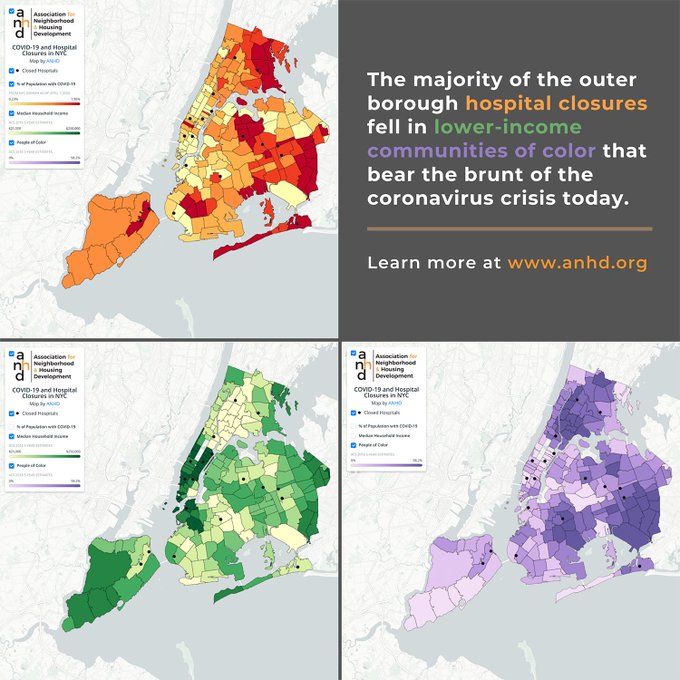
New York City remains the epicenter of the global COVID-19 pandemic, but its effects are being felt differently across neighborhoods. As ANHD's  previous analysis  shows, this virus is hitting low-income communities of color the hardest. The neighborhoods with the highest range of positive COVID-19 cases in the city are home to communities of color whose residents are disproportionately employed in frontline service occupations and face among the highest rates of rent burden and overcrowding. These communities – the epicenters of the epicenter - are home to the largely invisible workforce that is keeping New York City running in this moment of crisis, and they are the ones who are bearing the brunt of its impacts. Recent data released by the City’s Department of Health shows that Black and Latinx New Yorkers are dying at twice the rate of whites - making clear that this pandemic is not only a public health crisis, but a crisis of racial and economic justice as well.   


Among the host of historic inequities behind the disparate impact of COVID-19, one is particularly striking: the string of hospital closures that took place in these communities over the past few decades. At least 18 hospitals have closed all of their inpatient services in New York City since 1998 - leading to the loss of thousands of hospital beds - with two-thirds of those closures occurring in the outer boroughs. A look at the data shows that the majority of these outer borough hospital closures fell in lower-income communities of color that bear the brunt of the coronavirus crisis today. These community hospitals catered to neighborhood residents, many of whom lack private insurance; the mass closure and downsizing to outpatient services means less access to necessary health services, especially in a time of crisis. Households without health insurance have few options if they get sick, other than visiting the remaining public hospitals, adding to the likelihood of exposure to coronavirus and the further straining of the healthcare system. 

 While community hospitals were being closed in low-income communities of color, hospitals in wealthier sections of the city were being converted into luxury residential buildings, further depleting the city's overall supply of hospital beds. Of the 18 hospitals that closed in the last two decades, over 40% have been replaced by residential developments, most of them with rents or sales prices that are astronomically out of reach for the average New Yorker. At the site of St. Vincent’s Hospital in Manhattan, where countless poor New Yorkers received care during the AIDS crisis, now stands Greenwich Lane, a luxury condo building. Long Island College Hospital in Brooklyn, a community medical facility known as America’s first teaching hospital, was replaced by 5 River Park where a studio apartment was recently sold for $1.15 million.

In Queens, the epicenter of the COVID-19 crisis, the closures of St. John's Hospital, Parkway 
 Hospital, and Mary Immaculate Hospital have led to massive overburdening of nearby medical facilities. Each of the neighborhoods where these hospitals were once located in have some of the highest rates of COVID cases in the city.

 029


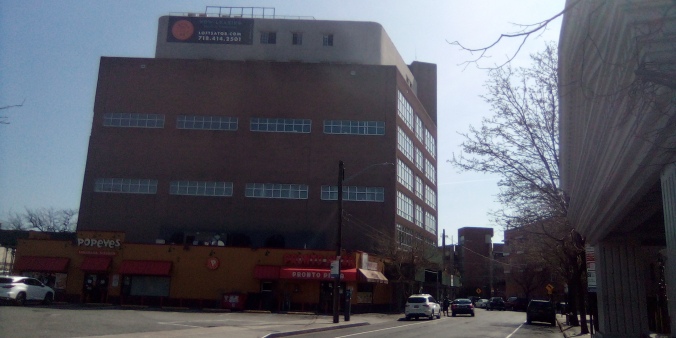
 The former site of St. John’s Hospital is located just blocks from Elmhurst Hospital - the same hospital that has seen among the most COVID-19-related deaths in the country. What stands in its place now is Queens Pointe, a market-rate apartment building. The former site of Mary Immaculate Hospital in Jamaica - another COVID-19 hotspot - was transformed into a residential development in 2009. Nearby Parkway Hospital, which once served low-income Queens residents, was also torn down to make room for a residential building in 2008.

 014

 019

020

 As these hospitals continued to serve poor and uninsured New Yorkers, financial restructuring and an inability to pay their bills contributed to a spate of closures in the late 2000s. The deprioritization of hospital infrastructure and subsequent development of residential - particularly luxury residential buildings - on these former hospital sites is the direct result of the City’s land use decisions. The Bloomberg era saw a pattern of high profile rezonings of both public and private land to facilitate luxury residential development, with few if any public benefits secured in exchange for the enormous value these conversions provided to private real estate developers. The prioritization of profit over community need has left a long-lasting legacy across New York, and communities of color have continued to face the brunt of it through displacement, housing instability, job loss, and health disparities. Communities and advocates have long said that these land use decisions have life and death consequences; we as a city are now forced to reckon with the consequences of those decisions in this moment.

Tuesday, March 24, 2020

The city has implemented a hospital to shelters pipeline for homeless people who tested positive for coronavirus

THE CITY


City hospitals are sending apparently homeless people who test positive for coronavirus but aren’t in need of intensive medical care to the shelter system for isolation, THE CITY has learned.


Meanwhile, the number of homeless people with coronavirus infections living in city shelters more than doubled over the weekend as social services officials grappled with how to handle the growing number of cases affecting some of the most vulnerable New Yorkers.


The Department of Homeless Services confirmed Monday that the number of shelter residents with COVID-19, the disease caused by the virus, jumped from seven on Friday to 17 by Sunday night. That’s a major increase from 10 days ago when only one shelter resident had registered a positive test.


Homeless people with the virus have now been found in 12 shelters across the city, DHS said.

Now the city-run hospital system is transferring patients who’ve tested positive for the virus into the shelter system if the person has no known address and isn’t deemed to require acute medical care.


As of Sunday, one such patient had been sent to the city homeless shelter system. Isaac McGinn, a DHS spokesperson, said the person only needed isolation.


Four of the 17 shelter residents with COVID-19 remained hospitalized, while the other 13 were “only exhibiting mild illness and do not require intensive hospital care at this time,” McGinn said.


Most of those with the lower-level symptoms were taking up beds in an isolation ward DHS has set up at an unspecified location, he said.


Sunday, August 23, 2015

Wyckoff wants to join North Shore-LIJ system

From the Queens Courier:

America’s health care industry is changing, and Wyckoff Heights Medical Center on the Ridgewood/Bushwick border is looking to partner with a regional health care giant to expand and enhance its services.

According to Wyckoff Heights CEO Ramon Rodriguez, the hospital is in discussions with the North Shore/LIJ Health System regarding an affiliation agreement designed to retain Wyckoff’s independence while also providing additional health care options and “support for quality of care and clinical decisions.”


Serving tens of thousands of patients annually from both sides of the Brooklyn/Queens border, Rodriguez said, the hospital needs to transform its services to keep up with the national health care trend that has seen the rise of urgent care centers and outpatient/ambulatory services along with a reduction in extended hospital stays.

To that end, the board recently authorized Rodriguez to seek out affiliations with larger medical organizations in the New York City area. In responding to a request for proposals, he noted, North Shore/LIJ offered what the board considered to be the best options for Wyckoff Heights.

Saturday, August 22, 2015

Waiting for care at Queens hospitals could kill you

From the Queens Tribune:

The status of hospitals in Queens has been a major topic for years, notably the care that’s given to patients. Patients being treated in hallways, wait times in the emergency care units and the short staff within the hospitals have topped the list of problems.

Emergency Room times in Queens hospitals can be anywhere from three to six hours.

Hospitals such as Flushing Hospital Medical Center, Jamaica Hospital and Elmhurst Hospital are three of the largest in Queens, especially after St. Johns Hospital closed in 2009. The vacant building is now being turned into a residential building for the surrounding community.

The total emergency room wait time for Elmhurst Hospital is on average about five hours and 57 minutes, Jamaica Hospital averages to about four hours and 48 minutes and Flushing Hospital averages to about three hours and 10 minutes, according to hospitalstats.org. These times, of course, depend upon the severity of your condition and any ambulance that was sent out during that time.

The total average wait time in an emergency room before being seen by a doctor in New York State as a whole was 27 minutes, time on average for a patient spending time in the emergency room before being sent home was two hours and 44 minutes and the average wait time for a patient to be taken to their room was two and a half hours, according to propublica.org.

Friday, January 23, 2015

What about a hospital for Queens?

From Capital New York:

State officials are considering using hundreds of millions of dollars to construct a new hospital in Brooklyn that could replace the perennially troubled Brookdale Hospital, according to a person familiar with conversations about the funding.

The money would come from a $700 million pot set aside in Governor Andrew Cuomo's budget proposal for capital construction in east or central Brooklyn.

A new hospital would make sense for Brooklyn, said Stephen Berger, an investment banker who chaired the New York State Commission on Health Care Facilities in the 21st Century, a panel formed in 2005 to study the changing state of New York's health care delivery system.

The commission predicted that some New York City hospitals would close in future years because of high overhead and infrastructure costs and changing national trends in health care delivery.

Berger has previously called for closing some Brooklyn hospitals and consolidating others, but a new hospital in the borough would be a good idea, provided that it differed from the 20th century notion of a hospital.

"It can’t just be a 12-story building with lots of beds," Berger said. "Rather, it must be the center of a health network that provides for emergency and acute care while also embracing an ambulatory care model that focuses on managing population health and keeping people from having to use the acute care portion of the building."

Tuesday, October 7, 2014

Ebola? No problem!


From NBC:

Mayor Bill de Blasio says he's "very confident" the city's hospital system could handle an Ebola outbreak.

De Blasio touts the public health system in the nation's biggest city, the ability of its first responders and its ties to the leadership of the Centers for Disease Control and Prevention.

De Blasio said Monday his city has a "much more aggressive and coherent game plan" than other U.S. cities to fight a potential Ebola case. He says anyone who suspects he or she has Ebola should call 911 or rush to the nearest emergency room.


HA HA HA! NYC emergency rooms couldn't even handle swine flu a few years back.