From the Daily News:
A Queens City Councilman is slapping Mayor de Blasio with a lawsuit charging that he was illegally shut out of a conservancy formed for Flushing Meadows-Corona Park.
Councilman Rory Lancman says de Blasio barred him from choosing a board member because he’s not a political pal — and broke city law that requires such conservancies to have a rep for each Council district that covers part of the park.
“I represent almost half of Flushing Meadows Park, and because I’m not a political ally of the mayor...I don’t get an appointment,” Lancman said. “It’s a private, off the books scheme for funding projects in Flushing Meadows Park without the representation that is required.”
The United States Tennis Association, in a deal to win approval for the expansion of its tennis center in the park, is contributing $350,000 a year for the next three years, and then $200,000 annually for 20 years after that for the conservancy.
De Blasio announced the new conservancy for the 900-acre park in November — but only Julissa Ferreras-Copeland, a mayoral ally, got to fill a seat on the board.
Showing posts with label conservancies. Show all posts
Wednesday, July 6, 2016
Thursday, November 19, 2015
New FMCP conservancy a total sham and a total shame
From The Observer:
Mayor Bill de Blasio rebuffed attacks from a Queens city councilman that a new nonprofit set up to raise funds for Flushing Meadows-Corona Park “plays politics” by only granting a councilwoman aligned with his liberal agenda an appointee on the conservancy’s board—and leaves Mr. Lancman and his constituents without a voice.
Shortly before Mr. de Blasio joined Queens Councilwoman Julissa Ferreras-Copeland—a member of the Council’s Progressive Caucus and chairwoman of its powerful Committee on Finance—to announce the creation of the park’s new funder and caretaker, Councilman Rory Lancman, a fellow Democrat, sent out a press release entitled “Mayor de Blasio Plays Politics With ‘Flushing Meadows-Corona Park Alliance’ and Disenfranchises Hundreds of Thousands of Park Users.” Mr. Lancman, whose district covers the southern end of the park, argued only granting Ms. Ferreras-Copeland a representative on the Alliance board was part of a pattern for the mayor—pointing out that both of the mayor’s only town halls while in office have been in the districts of Progressive Caucus members.
“The mayor can’t just have town hall meetings in disticts with council members that are his core allies. He can’t dole out appointments to oversee spending of money in public parks just to his allies,” Mr. Lancman told the Observer in a phone interview, claiming the administration refused to meet with him for months to discuss the Alliance’s creation. “I think there are a lot of communities in this city who look at mayor and ask themselves: Is he really representing us? People here feel he’s not representing them. This decision just reinforces that.”
When asked about the apparent imbalance today, Mr. de Blasio made the disputable assertion that Ms. Ferreras-Copeland’s district “covers the vast majority of this park,” and said that the Alliance board would engage with all stakeholders. He also said that, since he has held just two town halls, it was too early to claim he was only holding them in the districts of political allies.
From Capital New York:
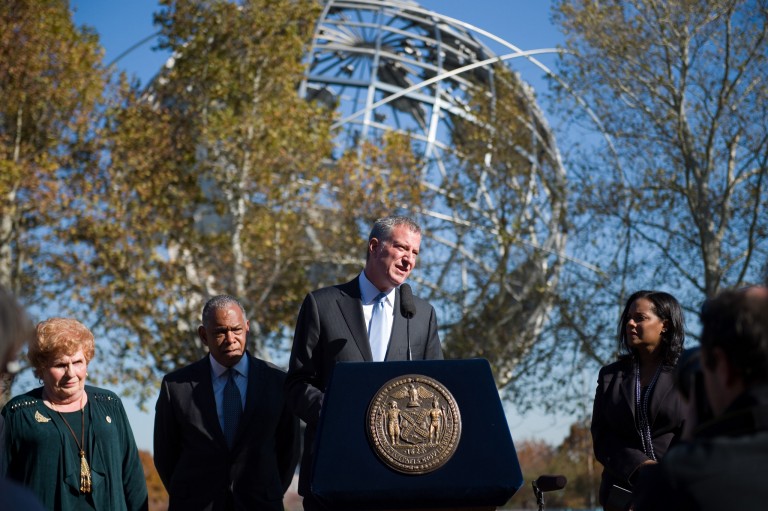
“This is something to invest in!” said de Blasio, speaking to reporters and park advocates at a press conference sandwiched between the Queens Museum and the Unisphere, a steel relic from the 1964-1965 World’s Fair.
Nearly two and a half years after the United States Tennis Association agreed (under duress) to invest a total of $10.05 million into a conservancy to help maintain the park it occupies, de Blasio announced the conservancy’s formal creation.
Parks may be a public and publicly-owned good, but de Blasio, a self-defined progressive, argued, “[T]here are limits to what public funding can achieve."
Today, the city is investing some $20 million into capital projects in the park, he said.
But, he added, "I think it’s wise to get additional funding in for the parks that have the ability to do that."
From the Forum:
“This deal is a sham,” said Geoffrey Croft of NYC Park Advocates. “This entire Alliance initiative and model is based on businesses commercially exploiting Flushing Meadows Corona Park, including taking parkland away from the public. Instead of the city properly investing in the park, as they are legally required to do, the administration is championing this plan in exchange for money. They should be ashamed of themselves. This is certainly not ‘progressive.’
Mayor Bill de Blasio rebuffed attacks from a Queens city councilman that a new nonprofit set up to raise funds for Flushing Meadows-Corona Park “plays politics” by only granting a councilwoman aligned with his liberal agenda an appointee on the conservancy’s board—and leaves Mr. Lancman and his constituents without a voice.
Shortly before Mr. de Blasio joined Queens Councilwoman Julissa Ferreras-Copeland—a member of the Council’s Progressive Caucus and chairwoman of its powerful Committee on Finance—to announce the creation of the park’s new funder and caretaker, Councilman Rory Lancman, a fellow Democrat, sent out a press release entitled “Mayor de Blasio Plays Politics With ‘Flushing Meadows-Corona Park Alliance’ and Disenfranchises Hundreds of Thousands of Park Users.” Mr. Lancman, whose district covers the southern end of the park, argued only granting Ms. Ferreras-Copeland a representative on the Alliance board was part of a pattern for the mayor—pointing out that both of the mayor’s only town halls while in office have been in the districts of Progressive Caucus members.
“The mayor can’t just have town hall meetings in disticts with council members that are his core allies. He can’t dole out appointments to oversee spending of money in public parks just to his allies,” Mr. Lancman told the Observer in a phone interview, claiming the administration refused to meet with him for months to discuss the Alliance’s creation. “I think there are a lot of communities in this city who look at mayor and ask themselves: Is he really representing us? People here feel he’s not representing them. This decision just reinforces that.”
When asked about the apparent imbalance today, Mr. de Blasio made the disputable assertion that Ms. Ferreras-Copeland’s district “covers the vast majority of this park,” and said that the Alliance board would engage with all stakeholders. He also said that, since he has held just two town halls, it was too early to claim he was only holding them in the districts of political allies.
From Capital New York:
“This is something to invest in!” said de Blasio, speaking to reporters and park advocates at a press conference sandwiched between the Queens Museum and the Unisphere, a steel relic from the 1964-1965 World’s Fair.
Nearly two and a half years after the United States Tennis Association agreed (under duress) to invest a total of $10.05 million into a conservancy to help maintain the park it occupies, de Blasio announced the conservancy’s formal creation.
Parks may be a public and publicly-owned good, but de Blasio, a self-defined progressive, argued, “[T]here are limits to what public funding can achieve."
Today, the city is investing some $20 million into capital projects in the park, he said.
But, he added, "I think it’s wise to get additional funding in for the parks that have the ability to do that."
From the Forum:
“This deal is a sham,” said Geoffrey Croft of NYC Park Advocates. “This entire Alliance initiative and model is based on businesses commercially exploiting Flushing Meadows Corona Park, including taking parkland away from the public. Instead of the city properly investing in the park, as they are legally required to do, the administration is championing this plan in exchange for money. They should be ashamed of themselves. This is certainly not ‘progressive.’
Tuesday, September 1, 2015
FMCP bathrooms in decrepit condition
"Two weeks ago i was at the park and after running 4 miles i decided to use the men's room located just outside the main entrance to the USTA Tennis Center (Willets Point ramp area). i have never been so fucking disgusted. The minute i walked into the bathroom my nose was hit with stench that i could only describe as homeless person smell mixed with urine,shit, and armpit funk. After going into one of the stalls to pee i nearly puked. i just kept on gagging and almost peed on myself because the stench was fucking bad. The lighting inside the bathroom was very poor which is perhaps why they keep the door wide open. The sink was old and the hand dryer machine was not even working.
Every summer thousands of people from Europe, Asia and the rest of the world flock to see the US Open. We all know that this single event generates so much cash for Queens & the city. Why isn't that money going towards fixing the walking paths around the park, landscaping, better signage, new benches and better lighting installed (i wont even mention the lake). Flushing Meadows Park needs it's own conservancy (if it doesn't already have one) that actively seeks out donors throughout the city to fund construction projects and BASIC MAINTENANCE of the park. Why doesn't this administration (and i will include our governor a.k.a 'King Of New York') do something about this. Tourism is one of the many things this is city is known for. People don't spend thousands to take their family on a vacation to let's say, Newark, Hoboken??. They all want to come to this city and in the summertime they want to come to Queens for the US Open.So much park land has been given to the USTA but what are we getting in return??" - Anonymous
Tuesday, February 24, 2015
What a tangled webs she weaves
From Brownstoner Queens:
Last week, Council Member Julissa Ferreras delivered her State of the District address — the Council Member represents District 21 which covers Elmhurst, East Elmhurst, Corona and Jackson Heights.
...as part of the Willets Point deal Council Member Ferreras helped negotiated in 2013, there’s a new affordable housing development slated for Corona. The 67-unit rental building will be located 54-25 101st Street and will house low-income seniors. Amenities include a garden, community area and medical referral services, and there will be an early childhood development center on the ground floor. Construction should begin at the end of 2015 and is expected to last 18 months.
As part of the Willets Point deal, 67 units of affordable housing is to be built off-site? Wow, this makes the lengthy delay all worth it. Does this mean that no on-site affordable housing is planned?
The push to establish a Flushing Meadows Corona Park Alliance is also making headway. According to the Council Member, she “plans to hold the Mayor’s Office to its promise of establishing [the alliance] by spring.” An alliance would serve to protect the park’s historical significance and green space and establish more community programming.
Hmmm...the mayor's office is establishing the alliance? I thought the USTA and other stakeholders were. This gets better and better.
Last week, Council Member Julissa Ferreras delivered her State of the District address — the Council Member represents District 21 which covers Elmhurst, East Elmhurst, Corona and Jackson Heights.
...as part of the Willets Point deal Council Member Ferreras helped negotiated in 2013, there’s a new affordable housing development slated for Corona. The 67-unit rental building will be located 54-25 101st Street and will house low-income seniors. Amenities include a garden, community area and medical referral services, and there will be an early childhood development center on the ground floor. Construction should begin at the end of 2015 and is expected to last 18 months.
As part of the Willets Point deal, 67 units of affordable housing is to be built off-site? Wow, this makes the lengthy delay all worth it. Does this mean that no on-site affordable housing is planned?
The push to establish a Flushing Meadows Corona Park Alliance is also making headway. According to the Council Member, she “plans to hold the Mayor’s Office to its promise of establishing [the alliance] by spring.” An alliance would serve to protect the park’s historical significance and green space and establish more community programming.
Hmmm...the mayor's office is establishing the alliance? I thought the USTA and other stakeholders were. This gets better and better.
Thursday, October 9, 2014
DeBlasio park announcement a headscratcher
Much to-do was done about Mayor DeBlasio's announcement that parks in low income neighborhoods would be rebuilt. But here's the list of Queens parks that the money is going toward:
Astoria Heights Playground
Bowne Playground
Corona Mac Park / Simeone Louis Park
Grassmere Playground
Rockaway Community Park/Conch Playground
Van Alst Playground
I wouldn't exactly consider Astoria and Flushing to be "low income" and it's hard to believe that Jamaica has no playgrounds in need of an overhaul. The biggest laugh is that he expects private conservancies to voluntarily hand over money they've raised to fix up other parks.
Astoria Heights Playground
Bowne Playground
Corona Mac Park / Simeone Louis Park
Grassmere Playground
Rockaway Community Park/Conch Playground
Van Alst Playground
I wouldn't exactly consider Astoria and Flushing to be "low income" and it's hard to believe that Jamaica has no playgrounds in need of an overhaul. The biggest laugh is that he expects private conservancies to voluntarily hand over money they've raised to fix up other parks.
Labels:
Astoria,
Bill DeBlasio,
conservancies,
Corona,
Far Rockaway,
Flushing,
funding,
parks
Sunday, April 13, 2014
Miss Heather asks a good question
From New York Shitty:

Lest any of you are wondering what this is, it is the “Ed Shed”. The “North Brooklyn Boat Club” (via Open Space Alliance North Brooklyn — remember the latter handles money for the previous) secured a $25,000 grant for this educational facility. Yes, you just read me correctly. This structure will feature a “Sewer In A Suitcase”, material/date about water quality and various art projects for the edification of school groups.
How is it that an “educational facility” located on private property (which is under lock and key) can receive a $25,000 grant (and assistance from our local parks conservancy group) and public park whose fence was seriously damaged ten months ago is seemingly not worthy of attention — much less the funding — required to conduct repairs and routine maintenance?


Lest any of you are wondering what this is, it is the “Ed Shed”. The “North Brooklyn Boat Club” (via Open Space Alliance North Brooklyn — remember the latter handles money for the previous) secured a $25,000 grant for this educational facility. Yes, you just read me correctly. This structure will feature a “Sewer In A Suitcase”, material/date about water quality and various art projects for the edification of school groups.
How is it that an “educational facility” located on private property (which is under lock and key) can receive a $25,000 grant (and assistance from our local parks conservancy group) and public park whose fence was seriously damaged ten months ago is seemingly not worthy of attention — much less the funding — required to conduct repairs and routine maintenance?

Labels:
conservancies,
damage,
funding,
grants,
North Brooklyn Boat Club,
open space alliance,
parks
Sunday, March 30, 2014
Squadron dead wrong on park funding
From the Daily News:
State Sen. Daniel Squadron (D-Brooklyn) has introduced controversial legislation — supported by Mayor de Blasio — that would force certain park nonprofits to allocate 20% of their budgets from private donations to other parks — a means, he says, to help address the inequity.
Squadron’s “Neighborhood Parks Alliance,” would form partnerships between a “well-financed” conservancy and less fortunate parks.
Under the plan, a “poor” park would perform tasks like gathering signatures from local residents, establishing its own conservancy group. It also would need a commitment from the city and local lawmakers to maintain the current level of public financing.
This well-intentioned but deeply misguided law shows a clear lack of understanding of the enormous problems facing our vast but resource-poor park system. Relying on what, in reality, are a few conservancies to deliver the tens of billions of dollars in capital needs, and another three quarters of a billion dollars annually for maintenance and operation, is deeply misguided.
Squadron testified Thursday that he thought his proposal could generate approximately $15 million dollars annually; in other words, enough to build a few bathrooms.
Another unfortunate consequence of this conversation is that it is detracting from the real issue — that our elected officials refuse to fund parks as an essential city service.
The administration needs to take responsibility by dramatically increasing the parks budget and ensuring the funds are distributed according to need — not on politics or private interests — while demanding accountability from an agency that is in desperate need of reform.
We need to attack the very system that allows and encourages this enormous disparity and discrimination in the first place, not invite more.
Until these things happen, nothing will change.
The full op-ed can be found here.
State Sen. Daniel Squadron (D-Brooklyn) has introduced controversial legislation — supported by Mayor de Blasio — that would force certain park nonprofits to allocate 20% of their budgets from private donations to other parks — a means, he says, to help address the inequity.
Squadron’s “Neighborhood Parks Alliance,” would form partnerships between a “well-financed” conservancy and less fortunate parks.
Under the plan, a “poor” park would perform tasks like gathering signatures from local residents, establishing its own conservancy group. It also would need a commitment from the city and local lawmakers to maintain the current level of public financing.
This well-intentioned but deeply misguided law shows a clear lack of understanding of the enormous problems facing our vast but resource-poor park system. Relying on what, in reality, are a few conservancies to deliver the tens of billions of dollars in capital needs, and another three quarters of a billion dollars annually for maintenance and operation, is deeply misguided.
Squadron testified Thursday that he thought his proposal could generate approximately $15 million dollars annually; in other words, enough to build a few bathrooms.
Another unfortunate consequence of this conversation is that it is detracting from the real issue — that our elected officials refuse to fund parks as an essential city service.
The administration needs to take responsibility by dramatically increasing the parks budget and ensuring the funds are distributed according to need — not on politics or private interests — while demanding accountability from an agency that is in desperate need of reform.
We need to attack the very system that allows and encourages this enormous disparity and discrimination in the first place, not invite more.
Until these things happen, nothing will change.
The full op-ed can be found here.
Labels:
conservancies,
Daniel Squadron,
funding,
Parks Department
Sunday, November 3, 2013
Selling off public parkland is now common practice

From City Limits:
The audacity of the mayor's final development campaign has been unprecedented. "I can't recall any comparable push by lame-duck mayors to cement their ‘legacies' with such chutzpah," says Tom Angotti, a professor of urban planning at Hunter College. Angotti had worked in city government under Koch, Dinkins, and Giuliani, and he was on the inside when two of those administrations drew to a close. "It really does seem that Bloomberg is trying to make it difficult for the next mayor to take a different path," he says.
But will the next mayor take a different path? The candidates have their own ideas, but both de Blasio and Lhota would essentially build on Bloomberg's development agenda, supporting such current initiatives as the rezoning of Midtown and the expansion of public-private partnerships in parks. De Blasio has even said the Flushing Meadows soccer stadium is "worth discussing" if the league provides funds to fix up the rest of the park. Both candidates would allow new construction on public-housing property, though de Blasio insists any towers must contain affordable housing and Lhota says developers would not be allowed to take playgrounds.
Also from City Limits:
While Manhattan and Brooklyn have ended up with some showplace parks, no one is interested in operating, say, Highland Park on the Brooklyn-Queens border or Ferry Point Park in the Bronx. Donald Trump has struck a deal to take about half of the 413-acre Ferry Point to build a private club and a "world-class" golf course on what had been a garbage dump , but he won't be sharing the revenue with the park, and it's unlikely the patrons of his luxury facility will be the residents of the neighboring public housing project.
Even middle-class and well-heeled areas have been forced to pick up the slack, with volunteers maintaining such parks as Juniper Valley Park in Middle Village, Queens, and Dag Hammarskjold Plaza in Manhattan, right across the street from the United Nations. Half of the city's 1,800 parks and playgrounds now depend on some type of private group to at least chip in on maintenance, according to the Parks Department, but many, if not most, of these groups struggle.
Some people, like Public Advocate and mayoral candidate Bill de Blasio, have pinned their hopes for more equitable parks funding on legislation proposed by state Senator Dan Squadron that would create a Neighborhood Parks Alliance to take 20 percent from the budgets of large park conservancies and distribute that money to the parks most in need. "It will make for a fairer city," says de Blasio, "and I think it's a great idea."
But the proposed alliance would be blocked from accessing a large part of the nonprofit funds, says James J. Fishman, a professor at Pace Law School. Endowments would be off-limits, and if donors make restricted gifts, then that money can't be diverted to another use. Nonprofit-law experts consulted by City Limits say the legislation is sure to face legal challenges.
Fact is, the proposed fund would draw from the same private-money system that led to the great disparities it seeks to correct, and the redistribution of money simply won't be enough to right the deeper wrongs. There is no such thing as a free lunch: Taxpayers still cover a portion of the budgets for even the biggest park conservancies, and that means they would end up funding the Neighborhood Park Alliance too. In the end, most public parks remain the responsibility of the public.
Though Ferreras compared her new nonprofit to the Central Park Conservancy and the Prospect Park Alliance, she had created a new model, funded not by philanthropic contributions but by extracting money from businesses that want parkland.
When Ferreras told City Limits of her plans to ask the Willets Point developers for money, she listed other businesses located in the park, including the Mets and the Terrace on the Park banquet hall, noting that all of these businesses already operate under agreements with the city—the Terrace on the Park, for example, pays the city $2.5 million a year, or $100,000 more than the U.S.T.A.
But some park advocates fear Ferreras's forging of separate deals will now set a dangerous precedent, encouraging more development in underfunded parks. The Willets Point deal was "shameful," according to Richard Hellenbrecht, president of the Queens Civic Congress, an umbrella organization of 106 civic and community groups. The Congress opposed the mall plan not only for its taking of parkland but for the harm it could cause to local small businesses, not to mention the likelihood of more traffic and congestion.
"It's taking parkland, mapped parkland," Hillenbrecht says of the "Willets West" shopping mall. "It makes me angry. I worry about this in a lot of ways, and it upsets me that it could have been approved so quickly, ignoring all the concerns of Queens residents. We're going to have a new administration in a few more months. Why couldn't it wait?"
Several community groups have told City Limits they're contemplating a lawsuit over the city's claim that the shopping mall is permitted under a 1961 law that allowed for the financing of Shea Stadium. They claim the administration wants to avoid the burden of alienating that parkland, which would require state legislation to strip the land of its legal protections. Alienation legislation mandates the replacement of lost parkland or a payment for other park improvements equal to the land's fair market value.
As for the combined $25.5 million for Flushing Meadows from the mall and tennis projects, more than half of it will be spent on one-time capital improvements while the rest gets spread over two decades. That might sound like a lot of money, but it amounts to an annual $550,000 over most of the life of these two deals.
"That really won't do much," Hellenbrecht says. "It might pay for some more staffers, but not many. It's not enough to make a dent in what needs to be done, either operationally or even capital-wise. It's better than nothing, but I'd rather not have somebody taking parkland."
Sunday, July 28, 2013
See...it actually does exist!
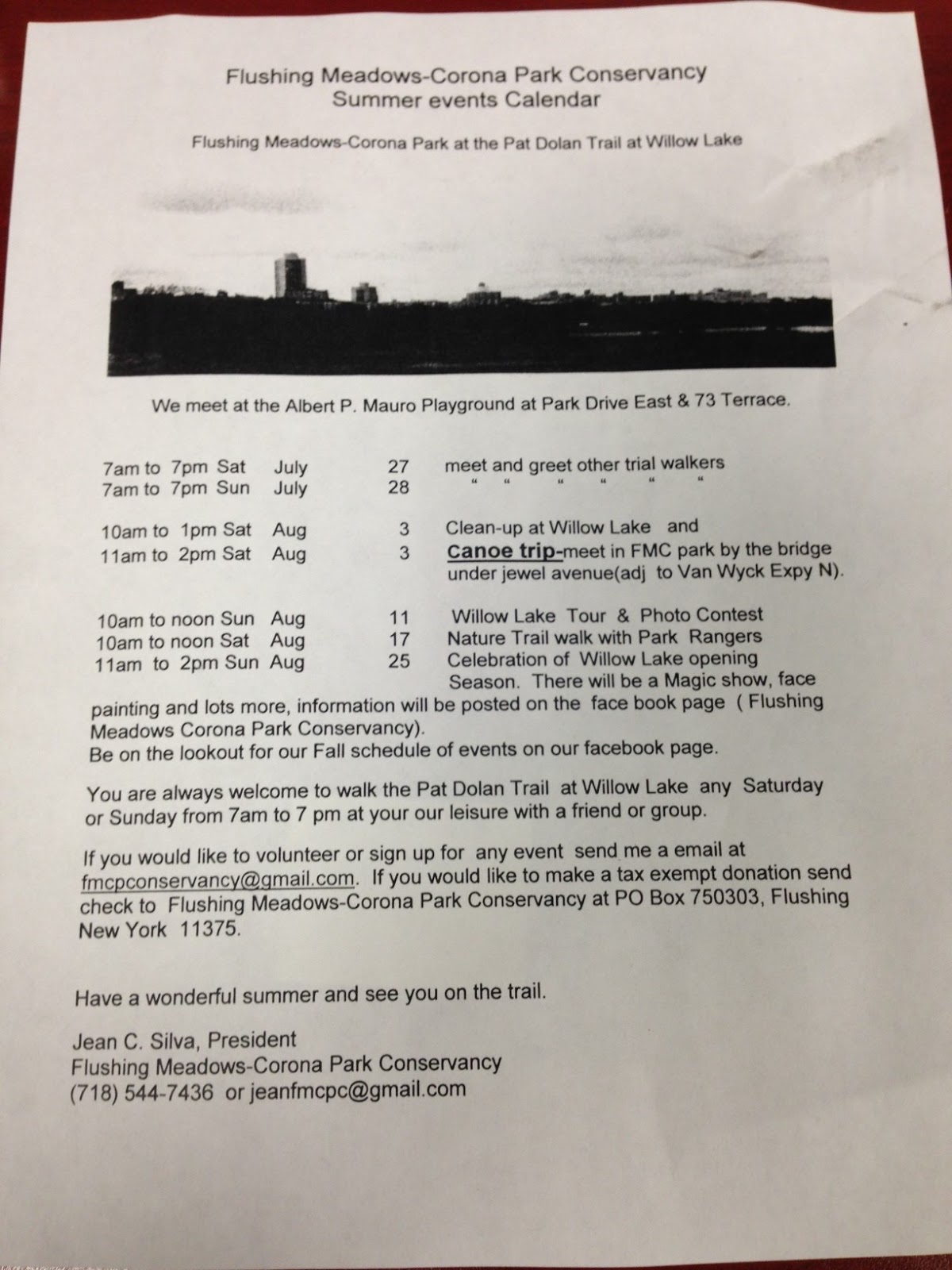
Do you think Jean Silva is now kicking herself for testifying in support of the USTA deal since her group is effectively being replaced with a new conservancy run by the USTA? If only Pat were still alive...
Labels:
conservancies,
Flushing Meadows-Corona Park,
Pat Dolan,
USTA
Thursday, July 25, 2013
Deal done: USTA's pocket change buys parkland
From Capital New York:The United States Tennis Association, eager to win City Council approval for its National Tennis Center expansion plans, has agreed to provide ongoing funding for Flushing Meadows Corona Park.
The USTA had no immediate comment, but according to Councilwoman Julissa Ferreras and New Yorkers for Parks, who have been working to secure a funding agreement, the U.S. Open organizer has promised $10.05 million for the park.
The agreement starts in 2014 and means $5 million for capital projects; $350,000 a year for three years for maintenance and programming, and then $200,000 a year for the ensuing 20 years.
That's on top of the $500,000 the USTA pays in rent each year to the city's general fund.
That funding will help underwrite the creation of a public-private partnership to help maintain the park, similar in function (if not in scale) to the Central Park Conservancy and Prospect Park Alliance. The USTA will sit on its board.
So, an average of less than $500,000 per year? That's it?
Comment from Mayoral Candidate Bill DeBlasio:
“In a city where outer-borough parks have been consistently shortchanged, today’s announcement represents a major step forward. I congratulate Council Member Julissa Ferreras for securing an ongoing and increased commitment from the United States Tennis Association to help fund park maintenance and upgrades at Flushing Meadows Corona Park, and for laying the foundation for a new conservancy that will help improve Queens’ crown jewel park for years to come. We must ensure that whenever private interests lease or use city parkland, those parks receive sustained and substantial funding in return.”Sustained? Substantial? Why do we need a new conservancy, when we already have the Flushing Meadows-Corona Park Conservancy? Especially since part of the park was recently named after its late former president, Pat Dolan? So the USTA can dictate that the money be used on the tennis courts they're not really giving up and flowers outside their new stadiums?
From the Daily News:
“This will be a win-win partnership,” said park advocate Will Sweeney, who bitterly opposed the expansion until the USTA made the $10 million contribution. “The investment can lead to Flushing Meadows-Corona finally reaching its potential as a world class park.”
A win for the phony park advocates!
But not everyone was a fan of the revised deal.
“It’s very disappointing,” said Geoffrey Croft, president of New York City Park Advocates, who added local elected officials should be the ones to pay for the park maintenance. “They’re taking up more park land.”
Look folks, this is how it's going to work: The USTA money is not going to supplement Parks funding, it's going to replace it.
And what happens after 23 years? They sell off more of the park to another billion dollar corporation?
The final City Council vote was 47-1. The only person to not vote in favor was - Dan Halloran!
Wednesday, July 24, 2013
Here comes the royal screw job
From Crains:It's match point for negotiations to expand the Billie Jean King National Tennis Center in Flushing Meadows, with the City Council poised to vote on the plans Wednesday. But with the local City Councilwoman and the U.S. Tennis Association sparring over funding for the park and other community benefits, the outcome remains unclear.
The USTA has proposed a $500 million expansion of the 46-acre National Tennis Center, but in order to do so, a 0.68-acre strip of park that is currently public must be taken over. Locals have long complained that the tennis center was a hulking presence within Queen's largest park, one that turns its back on Flushing Meadow until it overwhelms it each August and September during the U.S. Open. Among the complaints: thousands of cars that park on public lawns, limiting recreation space.
To appease local opponents the USTA has promised to open to the public a 1.5-acre set of tennis courts on the eastern edge of its campus. The association, however, would retain use of the courts during events such as the Open.
The bigger sticking point is demands from local Councilwoman Julissa Ferreras and parks advocates that the USTA pay into an annual maintenance budget for the park.
The hope is that with seed money from the USTA, Flushing Meadows could establish its own conservancy.
Here's where Julissa thinks we're all stupid. Flushing Meadows already has its own conservancy. And the place still looks like crap.
USTA will get their expansion and Queens will get the shit end of the stick, once more.
Tuesday, July 16, 2013
Silly electeds prefer tweeding to budgeting
Here we have State Senator/Public Advocate candidate Daniel Squadron promoting the idea that not only are public-private partnerships good, but that we should fund our entire park system off the back of the Central Park Conservancy. Peter Vallone has endorsed the idea in the City Council.
And then there's NYC Public Advocate and mayoral candidate Bill DeBlasio shilling for the same thing over the weekend at the Unisphere.
No morons, we shouldn't rely on money from charities. We should stop the corporate welfare and tweeding programs and use that money to fund park maintenance, as required by law. You guys also realize that forcing a charity to fund other charities is most likely unconstitutional, right?
Here's former Parks Commissioner Adrian Benepe, his biggest defender, Holly Leicht of New Yorkers for Parks - a partner group with the NYC Parks Dept, and a landscape architect who reaped the benefits of working for the Central Park Conservancy, defending having charity pay for necessities, vs. Geoffrey Croft of NYC Park Advocates, who wants the city budget to allocate adequate funding.
Thursday, June 20, 2013
Liu rejects Central Park Conservancy contract as unfair to rest of City
June 19, 2013
Honorable Michael R. Bloomberg
Mayor
City Hall
New York, NY 10007
Dear Mayor Bloomberg:
My office has returned the ten-year, $90 million Central Park Conservancy contract submitted by the NYC Department of Parks & Recreation and is currently reviewing an additional $60 million capital contract with the Conservancy.
I write to ask you to reflect on the wide disparities that exist among parks in the five boroughs. For example, St. Nicholas Park, located just a few blocks north of Central Park in Harlem, recently received a score of 77 out of a possible 100 points from New Yorkers for Parks because of trip hazards, litter, and out-of-service drinking fountains.
The Parks Department can and should amend both Conservancy contracts so that they help provide more equity among parks. These modifications should also take into account the exceptionally strong financial condition of the Conservancy.
We recommend that the following changes be made:
· Eliminate or reduce the Conservancy’s revenue-sharing agreement. Currently 50 percent of the estimated approximately $12 million Central Park net concession and special event revenue is distributed to the Conservancy. In contrast, very few if any other City parks have such a beneficial arrangement.
· Reallocate capital funds toward higher-needs parks. If we are serious about equitably distributing scarce resources, we need to reallocate a portion of the City’s capital contributions for Central Park to parks with higher needs that are over-reliant on discretionary funds.
· Increase financial transparency. The Conservancy’s 2011-2012 tax filings show revenues of $47 million. Other public sources indicate that the Conservancy has a workforce of approximately 300 employees, ranging from seasonal grounds technicians paid $18,228 to the President and CEO, who received total compensation of $456,319. Like the Parks Department and every other City agency, the Conservancy should publish spending and payroll data on Checkbook NYC, the City’s financial transparency website. Mandatory federal tax filings do not provide adequate transparency.
· Encourage expanded support of area parks. The Conservancy should work with the Parks Department to identify struggling parks throughout the five boroughs that would benefit from the Conservancy’s operational and development expertise. Such a collaboration could help mitigate some of the widespread concerns that public-private partnerships favor only a handful of elite parks.
According to its most recent tax return, the Conservancy has more than $215 million in assets. This staggering number does not take into account the recently announced $100 million private donation.
The City should ensure that parks across the five boroughs—and not just Central Park—are being funded adequately and equitably. When the City is unable to provide funding for basic maintenance and much-needed capital projects, one must question whether it is appropriate to provide our wealthiest park with $150 million of new resources.
Let’s work together to maintain Central Park and provide equity among all of our parks.
Sincerely,
John C. Liu
Labels:
Bloomberg,
central park,
conservancies,
John Liu,
parks
Sunday, June 9, 2013
Council Members act clueless at park hearing
From the Daily News:Hundreds of millions of dollars are being generated each year in Flushing Meadows-Corona Park by big-money operations like the Mets, but Queens lawmakers say the park isn’t getting its slice of the pie.
The Mets and the U.S. Tennis Association pay a total of $2.5 million to lease their sites from the city. Meanwhile, the 900-acre park operates on $11.6 million in city funds and counts only 18 full-time city maintenance workers.
“It’s incredibly frustrating that this city has not identified a way to have our park be able to collect on the revenue it generates,” said City Councilwoman Julissa Ferreras (D-East Elmhurst), who called a Council hearing on Friday to address the lack of city funding to help pay for the park’s upkeep.
Ferreras said during the packed hearing that she is in talks with the city to create a public-private alliance — similar to the Central Park Conservancy — to fund much of the maintenance of the nearly 900-acre park, which is surrounded by predominantly immigrant and low-income communities.
Ferreras would like to fill the coffers of the alliance with private donations and a cut of the almost $7 million in annual concession fees and rents that are paid by the businesses and stadiums in the park.
Queens officials and parks advocates blasted the city after learning Citi Field pays only about $155,000 a year to lease its Flushing Meadows site from the city. That amount is slated to jump to $400,000 in 2014.
The U.S. Tennis Association, which hosts the U.S. Open in the park, pays roughly $2.4 million a year.
Meanwhile, Terrace on the Park, a banquet hall in Flushing Meadows, pays the city roughly $2.5 million a year.
“It’s ridiculous,” said Geoffrey Croft, president of New York City Park Advocates. Citi Field is “clearly not paying their fair share.”
City Councilman Peter Vallone Jr. (D-Astoria) said, “there’s something fishy in those numbers.”
“It sounds to me like Citi Field and the USTA are getting off really easy,” added Vallone, who said he will introduce a bill requiring all park conservancies with more than $5 million of annual income to give 20% to maintain other needy city parks.
So let me get this straight... The City Council voted to give the Mets a sweetheart deal when they came to them for permission to build a new stadium, yet now this same legislative body is shocked that the Mets have a sweetheart deal? Nice try, but we weren't born yesterday. And what difference does it make how much rent each entity pays under the current system? It goes into the general fund and hardly any of it goes back to Flushing Meadows anyway.
Hey City Council, how about DOING YOUR JOB by budgeting adequate funding for ALL city parks as you are required to, so there will be no need to further privatize our parks or have dog-and-pony show hearings?
Meanwhile, we have Parks Commissioner Veronica White, who conveniently skipped the FMCP hearing, telling Brian Lehrer (at about 14:00) that Parks chose to fund the High Bridge instead.
Sunday, April 21, 2013
Want a nice park? Raise a lot of money!
From the NY Post:Central Park is about to get even more green.
Six months after hedge-fund billionaire John Paulson pledged $100 million to the Central Park Conservancy, the nonprofit that oversees the lush 843-acre park is due to get $90 million from the city under a new 10-year management contract.
That’s a huge increase over the current pact, which expires on June 30 and provides $39.2 million over eight years.
Parks officials defended the higher spending as necessary to keep the heavily used park in peak condition.
“Clearly, the city thinks they’re doing a great job, which they are, for the most part,” said Geoffrey Croft of New York City Park Advocates, who has never shied away from pointing out parks shortcomings.
But Croft questioned how other parks in the 29,000-acre system will get by without wealthy benefactors or large city subsidies.
“There is an enormous difference [in] what this park gets and what others parks get,” he said.
Labels:
budget,
central park,
conservancies,
not for profit,
nyc park advocates
Saturday, October 27, 2012
A question of fairness

From Bloomberg:
New York devoted about $338 million, less than 0.5 percent of its $68.5 billion operating budget this year, to its 29,000- acre park system, down from $380 million. The city budget supports about 15 percent of Central Park’s $45 million annual operating costs, according to the conservancy website.
By comparison, the Chicago Park District, a semi-autonomous authority funded through dedicated property taxes, revenue from facilities such as Soldier Field and private donations, intends to spend $407 million on its 7,800-acre system, plus more than $80 million in capital improvements, said Jessica Maxey- Faulkner, a spokeswoman. Los Angeles spends $189.5 million of its $7.2 billion budget on parks.
In fiscal 2013, the city has earmarked $28.8 million for parks in Manhattan, almost double the amount in the Bronx, which has more than twice as much park acreage. The city budgeted $25.3 million for parks in Queens, $23.4 million for Brooklyn and $10.2 million for Staten Island. Staffing in city parks has declined 25 percent since 2009, to 5,744 employees.
Flushing Meadows Corona Park, a 1,255-acre expanse in Queens that was the site of the World’s Fair in 1939 and 1964, is marred by barren fields where grass once grew and shuttered recreation facilities “where the city could easily spend $100 million,” [NYC Park Advocates President Geoffrey] Croft said.
Ferry Point Park in the Bronx “now functions as a public toilet,” Croft said, after officials reduced staff, abandoned ball fields and closed public restrooms. “Without any security or supervision, men set up roulette tables for open-air gambling,” he said.
[John] Paulson’s gift “is a good thing not just for Central Park but for parks generally because it highlights how important parks are to people,” said Holly Leicht, executive director of New Yorkers for Parks, an advocacy organization.
“It also puts the onus on the city to make sure there’s enough money in the maintenance budget to properly maintain the 1,700 other parks that can’t draw this level of private funding,” Leicht said.
The best solution to the problem of funding all the parks would be the creation of a citywide conservancy-like institution to attract private and public funding, said Melissa Mark- Viverito, a Democrat who heads the City Council’s Parks and Recreation committee and whose Manhattan district of East Harlem includes a portion of Central Park.
“The challenge is to prevent our parks from becoming a two-tiered system where some have conservancies and some don’t,” said Mark-Viverito.
“We can’t have the city walking away from its obligation and responsibility for upkeep and maintenance,” she said. “That’s not the message we should be sending.”
Sunday, June 17, 2012
Hey Estelle, where did the dough go?
From the NY Post:At least $90,000 raised by the nonprofit conservancy that supports Flushing Meadows Corona Park has been misspent, officials confirmed to The Post.
The situation is now the subject of three separate investigations, and has already forced the longtime administrator of the massive city park — who also ran the conservancy Unisphere Inc. — to resign both her positions.
Officials pointed fingers at Estelle Cooper, the 82-year-old Republican leader and one-time candidate for Queens borough president who spent 17 years running Flushing Meadows. She earned $101,500 from the city.
Cooper first came under scrutiny from Unisphere’s board last summer, when questions were raised about a rental arrangement she had worked out between the Parks Department and a camp operated at the park by Cooper’s daughter.
Then, when the conservancy tried to reconcile the year-end books, board members learned that thousands of dollars had been taken out of the group’s coffers without approval, they told The Post.
“Debits were being made multiple times, and being made on the same day, many of them in Atlantic City,” said Mark Scheinberg, who recently quit the board.
“I was very shocked to see what happened,” said Queens Republican boss Phil Ragusa, who does Unisphere’s accounting.
Ragusa insisted he had no clue that money was being withdrawn without approval until last fall, when he alerted board members.
Saturday, June 25, 2011
Second-Class Parks?
From City Hall:On any given day, about 700 acres of New York City parkland—almost all of them in Manhattan—are patrolled by 78 parks enforcement officers, close to half of the parks department’s manpower. The remaining 86 officers are left to cover the other 28,000-plus acres.
The difference in staffing levels comes down to who’s footing the bill: the city or private parks conservancies.
As staffing for the city’s Parks Enforcement Patrol plummets due to an ongoing hiring freeze, a two-tiered system that favors affluent neighborhoods is being thrown into sharp relief. Hudson River Park, Brooklyn Bridge Park, Washington Square Park and others are always well staffed, because private associations—not taxpayers—hire PEP officers. While Battery Park has some 30 officers, the entire borough of the Bronx has only 15—and officers say that official figure is higher than the reality.
Tuesday, July 13, 2010
Estelle Cooper makes $101K?? Damn...
From the Daily News:The city is setting up increasingly cozy relationships with nonprofit parks boosters - even paying some of their staffers a second salary out of the public till, a Daily News review found.
Critics say the entwined arrangements with conservancies - nonprofits that support individual parks - mean that a handful of well-connected parks are ending up with more attention and money than the rest.
"New York is creating a two-tier system," said Geoffrey Croft of New York City Park Advocates, a frequent critic of the Parks Department.
"The nightmare is that all these deals are going on behind closed doors and that people are taking city dollars away from other parks," Croft said.
The situation is unusual. Although it is not uncommon for the city and nonprofits to hire from the same pool of advocates and experts, it is extremely rare for people to work for both at the same time.
No other agency has as many employees who have been cleared to work for nonprofits while simultaneously collecting a city salary, according to the Conflicts of Interest Board.
The News found seven top-salary city employees working on nonprofits that support specific parks, including four who got money from both.
Estelle Cooper got $101,507 as assistant commissioner of Queens parks in 2009, while she also ran Unisphere, a nonprofit that supports Flushing Meadows Corona Park. Unisphere did not list a salary for her and did not return calls.
In 2008, Stephanie Thayer became director of the Open Space Alliance for North Brooklyn - and the Parks Department's director of North Brooklyn Parks.
Records show Thayer got $86,528 from the city. She said her work for the nonprofit is voluntary.
"I'm still fighting the good fight," she said. "I'm just doing it in a different way."
Figuring out which hat Thayer is wearing has created frustration among some park advocates.
Laura Hofmann, a member of Open Space's steering committee, said Thayer spurned her when she tried to find out how many trees would be planted in a new park.
"She basically told me you have to trust the Parks Department and you have no business asking for this kind of information," Hofmann said.
New York has more than 1,700 city parks - but only 58 registered conservancies, which support specific parks by recruiting volunteers, creating programming and funding upkeep with a mixture of public and private cash.
Half of them - 24 - are in Manhattan and most are connected with parks in affluent neighborhoods.
Subscribe to:
Posts (Atom)