Showing posts with label community. Show all posts

Monday, November 27, 2023

Casinos of Yes


 NY Daily News

The Department of City Planning on Monday introduced a measure that it says would cut red tape for casino applications in the Big Apple — but which would ice out community boards, critics say.

The measure, which was quietly filed by the department on Friday, comes as big-name developers are vying for one of three coveted downstate casino licenses from the state.

The action, formally known as a zoning text amendment, was billed as a way of streamlining city and state processes by City Planning Commissioner Dan Garodnick during a Monday meeting.

“What we are proposing will create an even playing field for these facilities as they make their case for the economic benefits they aim to bring to New York City,” he said. “We are trying to set up a process here which just enables the conversation to happen in an organized way.”

The state decides who gets approved for a license. On the local level, the city’s existing land review procedures are inadequate for new casinos, putting New York at a “competitive disadvantage,” Garodnick and City Council Speaker Adrienne Adams said in October.

The text amendment would streamline review and allow for state-approved casinos to be developed “without any potential conflicts with zoning” or “unnecessarily duplicating” the state’s lengthy licensing process, Garodnick said.

Two of the downstate licenses are expected to go to existing “racinos” in Yonkers and South Ozone, Queens, but there is stiff competition in New York City for the remaining slot.

Aside from the Queens racino, City Planning confirmed eight contenders across the boroughs: five in Midtown Manhattan, one in the Bronx at Ferry Point, one in Queens from Mets owner Steve Cohen and one in Brooklyn by Coney Island.

 The proposed Coney Island Brooklyn casino resort called The Coney.

The new zoning measure would mean the individual applicants would not have to go through the city’s sluggish land use process, which can be used as leverage by community members and lawmakers to secure certain commitments from developers.

A committee consisting of the governor, mayor and local electeds will be created to view each gaming facility application based on the site’s location. The Community Advisory Committees, as they’re known, will have to hold public meetings but — unlike the city’s land use mechanism, known as ULURP — will not include a representative of the local community board.

Former Buildings Commissioner Charles Moerdler described the move as an “outrage” that would curtail local input.

“The concept of depriving the community and people of an opportunity to be heard … is anathema to a democracy,” Moerdler told the Daily News. “It is a stupid idea dreamed up by people who have no interest in the public or the community.”

A community board leader in Midtown Manhattan, where locals have expressed opposition to a casino, said she has heard concerns from several stakeholders about the text amendment.

“The current version of the text is too thin on specifics and details and does not really address the environmental impacts the casino would have,” said Layla Law-Gisiko, chair of CB 5’s Land Use Committee, criticizing the “blanket, one-size-fits-all” approach as opposed to the site-specific method of ULURP.

“Currently, the text really is too anemic to provide any guidance on what a casino should look like.”

Planning commission members were critical of part of the text that would allow developers to include related establishments such as hotels, restaurants, bars and “other amenities” like theaters in the approval process.


Friday, October 7, 2022

East and South Queens redistricting maps leading to wider schisms

Queens Chronicle 

 Update

The Districting Commission voted to send the revised proposal to the City Council Thursday by a vote of 13-1, with one absence. 

ORIGINAL STORY

As the city’s meticulous reapportionment process draws on, the Districting Commission is set to vote on a revised proposal for City Council district lines today, Oct. 6.

Thursday’s meeting comes just two weeks after the commission voted 8-7 against its own proposal. The body spent three hours last Thursday night and four and a half hours last Friday tweaking the map, taking into account 286 items of public testimony that had come in after the rejection two weeks ago.

Among the most significant changes to the Queens lines to come from last week’s discussions is the return of part of Fresh Meadows to District 24. Councilman Jim Gennaro (D-Hillcrest) had taken issue with the previous draft in large part because, in moving that portion of the neighborhood to District 23, members of the area’s Orthodox Jewish community would be separated from the rest of the enclave. Should the commission approve that draft, District 24’s eastern boundary would be 188th Street, as it is now.

Asked for comment on the proposal, Gennaro said, “This community and I, as its representative, made our objections to the first two proposals loud and clear. Last Friday, the Districting Commission did the right thing by completely reuniting the Orthodox Jewish community within the 24th District.”

Later, he added, “We look forward to this plan being passed by both the commission and the City Council.”

THE CITY 

In the hours following the five-alarm Richmond Hill fire in June that ravaged a row of houses, killed three family members, and left more than 40 people homeless, Annetta Seecharran felt abandoned in her efforts to scramble for resources and support for the victims. 

Not one elected official showed up that day, Seecharran told THE CITY.

“I called and I called and I called,” Seecharran, who heads the Indo-Caribbean and South Asian community development organization Chhaya in Queens, told THE CITY. “And there was no response.”

Mayor Eric Adams visited family members the next day and said “the whole city is mourning.” Apart from that, however, Seecharran recalled this week how disheartening it was for her and other community members to have to fight for attention in the aftermath of that tragedy in City Council District 28, represented by Speaker Adrienne Adams. 

Seecharran, along with other locals and activists from Southeast Queens’ majority Indo-Caribbean and South Asian neighborhoods, gathered outside a Sikh temple in Richmond Hill on Tuesday with the fire in mind. 

Their goal: to call attention to the way electorally divided communities like theirs have been historically “underserved by the government” — and how the NYC Districting Commission’s draft map for new City Council districts, released in mid-July, would perpetuate that problem. As THE CITY previously reported, these redistricting efforts are part of a mandatory process to reflect population changes in light of the 2020 census and ahead of off-cycle elections in what will be newly drawn districts next year. Under the Voting Rights Act of 1965, the maps must not deny or dilute the voting power of racial and language minorities.

“Ultimately this is about power,” Seecharran told the crowd. “Our power has been limited because we have been divided.”  

But elected officials in other nearby neighborhoods have expressed a similar interest in keeping their predominantly Black communities from being divided between different districts. And they’re not alone: Across the city, various groups are pushing for map changes that would enhance their voting power in what can seem like a zero-sum game. All are racing to have their desires registered before the commission votes on a final map on Sept. 22. 

For example, a related battle is playing out in Brooklyn, as the draft map creates a new majority Asian council district in Brooklyn while splitting up what’s been a majority Latino district covering Sunset Park and Red Hook for the past three decades.

If nine of the 15 districiting commissioners agree on a map, it will then be released to the public and voted on by the City Council. If the draft does not get voted through, the commission would continue revising the map until passing one, though commission spokesperson Eddie Borges told THE CITY “that’s not even a prospect.”  

While eight of the 15 commissioners were appointed by the Council, five were selected by Speaker Adams, leader of the 44-member Democratic caucus. Minority Leader Joe Borelli, one of its seven Republicans, picked the other three, who potentially could join with the mayor’s members to pass a map.

In a letter addressed to the commission’s chairman and obtained by THE CITY, several elected officials in majority Black districts in southeast Queens outlined concerns about numerous ways that the draft map would divide and dilute voting power across their districts. Those officials include Majority Whip Selvena Brooks-Powers of District 31, which currently covers the eastern Rockaways, Laurelton, Rosedale, Brookville and parts of Springfield Gardens, and Councilmember Nantasha Williams of District 27, which currently covers Cambria Heights, Hollis, Jamaica, St. Albans, Queens Village, and Springfield Gardens. 

Among their concerns:

  • The removal of downtown Jamaica from District 27, and the inclusion of  parts of Springfield Gardens, which cuts across “the middle of different ethnic communities and neighborhoods,” according to the letter writers;
  • The removal of Rochdale Village from District 28, which is home to a minority-owned Mitchell-Lama cooperative: a 20-building complex housing 25,000 working-class residents, most of whom are Black;
  • The removal of parts of Springfield Gardens that are mostly Black from District 31, which would “misalign the community’s collective voice,” according to the letter-signers. The district would gain parts of the Rockaway peninsula that have a white plurality and of South Ozone Park that have an Asian plurality, according to an analysis by THE CITY.

Some community members shared similar concerns in a virtual town hall convened by Queens Borough President Donovan Richards on Wednesday night. Community Board 12 Chairperson Rev. Carlene O. Thorbs, for one, was firm that Rochdale should stay whole and intact.

“It doesn’t even make any sense that anybody even entertains that. The historical value in our area needs to stay the same,” Thorbs said. “We are still the largest voting bloc — we can’t even ignore that.”


Monday, May 16, 2022

Kew Gardens tower jail already is a pain in the ass

 Showing the Construction of the upcoming Kew Garden Jail at 80-25 126th Street.

NY Post

New York City is ramping up construction of a new jail in Queens as part of its plan to phase out problem-plagued Rikers Island — sparking outrage from residents, The Post has learned.

The presence of a lockup became more tangible for Kew Gardens locals recently when the Department of Design and Construction sent out a notice that it was restricting access to the area around Queens Borough Hall to lay the groundwork for the jail.

“We are upgrading the infrastructure in your community. These temporary access restrictions are necessary to facilitate preliminary work for the offset of a 48” Trunk Water Main for the Queens Borough Based Jail in the above-mentioned location,” the DDC said.

The community bulletin was a gut punch for many residents who said they don’t want their neighborhood to house accused criminals.

“I oppose the jail. It’s simply a safety issue,” said 31-year-old neighbor Michael Brocking.

Yan Lin, a mother of three boys ages 7 to 14, added: “We don’t need the criminal element around here.”

  don’t like the jail. We have a good community. I love this community,” the concerned mom said.

Howard Cohn, a 75-year-old retired school teacher, said, “I don’t want to be living next to criminals.”

“A jail is going to lower the property values here,” he added.

Mayor Eric Adams had promised to deliver on former Mayor Bill de Blasio’s $8.3 billion plan to shutter Rikers Island’s troubled jail complex and replace it with four smaller, more humane high-rise lockups in each of the city’s boroughs but Staten Island.

Update:

This was found at one of the borough tower jails development site in Chinatown. The DDC is being quite defiantly defensive about what they are doing.

Saturday, January 22, 2022

Public housing residents emphasize necessity of cars during D.O.T. hearing for new bus lanes

Sides dig in on 21st Street bus lane plan 2 

Queens Chronicle

The city’s Jan. 12 presentation on plans to put bus lanes on a two-mile stretch of 21st Street in Astoria appeared to change few if any minds.

Residents who have said in the past that the Department of Transportation is going too far for traffic and pedestrian safety upgrades still thought so. Also unmoved were those who think the DOT’s preferred option does not go far enough.

More than 100 people participated in the virtual meeting at one point or another.

And the DOT still is presenting a plan to remove a lane of traffic in each direction between Hoyt Avenue North and Queens Plaza North as its preferred of three options.

The stretch runs from the approaches to the RFK/Triborough Bridge in the north and the Ed Koch-Queensborough Bridge to the south.

The roadway has been tagged as a bus priority corridor by the Metropolitan Transportation Authority, as it is served by the Q66, Q69 and Q100 routes. It also is a Vision Zero priority corridor based on the number of fatal and serious accidents in recent years.

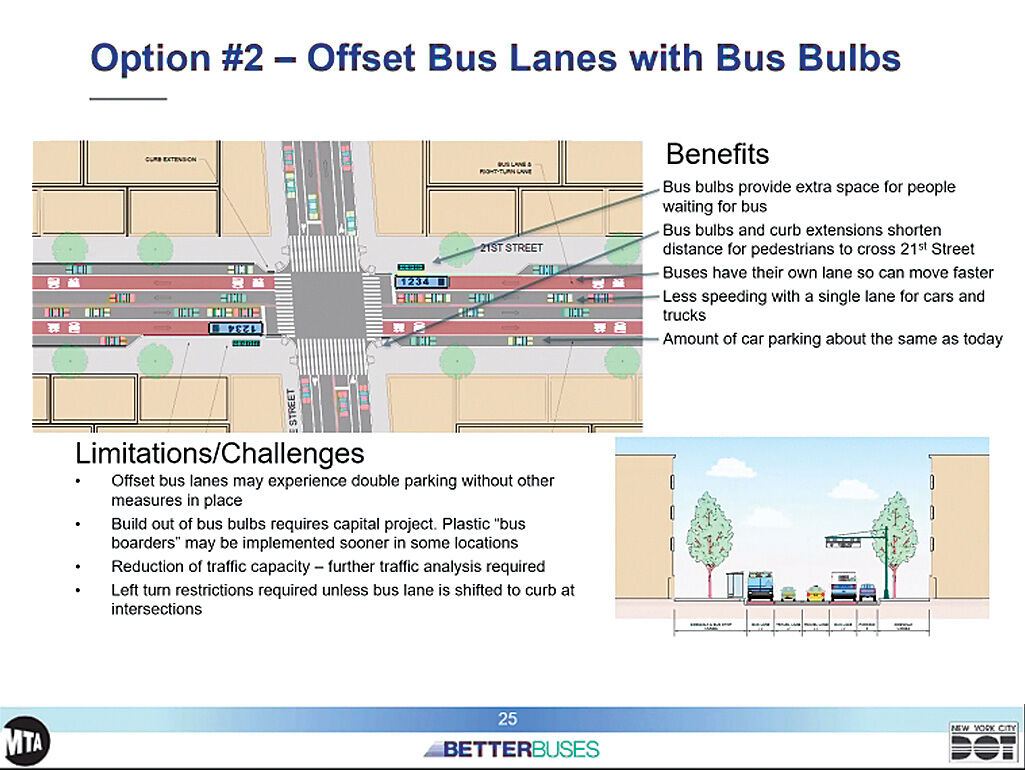
Christopher Hrones, director of strategic transit initiatives for the DOT, said the city prefers bus lanes that run between cars parked at the curb and what would be the lone remaining travel lane in each direction. Concrete extensions, known as bus bulbs, at intersection bus stops would shorten the distance that pedestrians would spend in the street while crossing.

Hrones said those changes would have minimal impact on existing parking, as they would mostly keep buses away from the curb.

He acknowledged that there initially could be traffic backups; and that left turns in many places would be eliminated. Several bus stops would be eliminated in order to speed up each individual bus’ trips. Double-parking by delivery trucks would have to be addressed.

Hrones said that any backups wold eventually thin out over time as people adjusted their behavior, either switching from cars to buses, taking different routes or driving at different times of day.

Many residents were not convinced.

“You can’t have one [traffic] lane on the 21st Street corridor,” said resident Margaret Cooper.

“I have to drive. I can’t take a bike,” said Gloria Maloney. “I know there are people who want everyone to use bicycles, but that is not feasible.”

Maloney also said the elimination of bus stops, particularly near housing projects with a high concentration of senior citizens, would pose a hardship for many.

Community participation highly lacking in participatory budgeting program

 https://images.squarespace-cdn.com/content/v1/5b9ffe0f1137a680c2c08250/8cf82890-35a9-42d5-8ae0-5c6b88fb591e/participatory+budgeting.jpeg?format=750w

Queens Eagle

There’s millions of dollars of taxpayer funds on the line – and a select few Queens residents are going to help decide how it gets spent.

With the new City Council in place, participatory budgeting season has begun. The process allows each councilmember to allocate money to project proposals voted on by residents of their district. The money must go to physical infrastructure projects that benefit the public, last for at least five years and cost $50,000 or more. Residents as young as 11 are eligible to vote.

However, councilmembers can choose whether or not they do participatory budgeting, and this year in Queens only a few neighborhoods will have the opportunity to participate.

Of the 15 councilmembers whose district is either entirely or partially in Queens, only three are doing participatory budgeting this year. They include Councilmembers Tiffany Cabán (Astoria, East Elmhurst, Jackson Heights and Woodside), Adrienne Adams (Jamaica, Richmond Hill, Rochdale Village and South Ozone Park) and Jennifer Gutiérrez (Ridgewood, Bushwick and Williamsburg).

With the exception of Staten Island, where none of the borough’s three councilmembers are participating in the program, Queens has the lowest rate of participating members when compared to the other boroughs.

Though those doing participatory budgeting are in the minority in each borough, four of Manhattan’s 10 members are participating, four of the Bronx’s nine members are participating and 4 of Brooklyn’s 15 members are participating.

Participatory budgeting was suspended at the start of the pandemic in 2020 and councilmembers were slow to restart it last year, with only a handful from around the city participating.

The program, in its eleventh year, began informally in 2011, when then-Councilmembers Brad Lander, Melissa Mark-Viverito, Eric Ulrich and Jumaane Williams first started a voting process to dole out discretionary funds.

The program became more formalized in 2018 through a charter revision that tasked the city’s Civic Engagement Commission with expanding participatory budgeting citywide.

Prior to the pandemic, a majority of the council took advantage of the program. In 2019, 33 members participated – more than double the members that are participating this year.

Former City Councilmember Costa Constantinides, who served from 2014 until 2021, said community members would get excited over the program and launch campaigns to make sure their projects got the most votes.

One group, who was looking to clean up a dog park near the entrance to the RFK Bridge, made stickers and buttons to hand out to residents urging them to vote for the project. The project was a winner, and although many of those behind the campaign ended up moving, Constantinides said he was proud of their efforts.

“It’s not about them, it’s about the community,” he said.

Friday, November 19, 2021

Community and Council member calling for investigation of bad Blaz's bribe derived blood center tower deal

 A view of the New York Blood Center on 67th Street in Manhattan, New York. 

NY Daily News

A community group opposed to a contentious Upper East Side rezoning is demanding two city watchdog agencies investigate Mayor de Blasio and a law firm pushing the land-use change, citing what it describes as de Blasio’s “potential conflict of interest.”

De Blasio, who supports the rezoning, owes the law firm Kramer, Levin & Naftalis an estimated principal debt of $300,000 for work it did to defend him against multiple corruption investigations starting in 2015. With interest, the total debt comes to about $435,000 — but so far, none of it has been repaid.

New York City Mayor Bill de Blasio

Kramer Levin is also representing the New York Blood Center, a non-profit blood bank, which is pursuing the rezoning so it can replace its three-floor headquarters with a tower more than 300-feet tall.

The plan has been a lightning rod in the community, with locals saying the proposed building isn’t a good fit for the mostly residential neighborhood and area elected officials lining up against it.

 De Blasio and several members of the City Council, however, are backing the plan, which has led one community group that opposes it — Eastsiders for Responsible Zoning — to question the mayor’s considerable debt to Kramer Levin, citing it as a red flag that the city’s Department of Investigation and Conflicts of Interest Board should further examine.

“Mayor de Blasio currently owes Kramer Levin a substantial sum stemming from Kramer Levin’s representation of the mayor in multiple corruption probes of his fundraising activities,” the group’s co-founder Bill Angelos wrote in a letter to DOI dated Nov. 8. “The non-payment of this debt represents a potential conflict of interest.”

Angelos goes on to write that the mayor’s support for the project and his efforts to whip votes in its favor stems in part from “the substantial obligations the mayor owes Kramer Levin.”

“Most concerning is that there’s no payment plan disclosed,” he continues. “With each passing month, this debt grows by an additional $4,000, creating more and more leverage for Kramer Levin against the mayor.”

Wednesday, November 17, 2021

Long time Astoria blog closing down

http://www.astorians.com/community/Themes/2011/images/theme/lanseaux_header.jpg 

Astorians

 I'm writing to announce that this website will be closing down on December 31st.

It's hard to believe this forum is over 17 years old. It all started in 2004 when a small group of us realized there wasn't really a good online forum to share information about some of the great spots in Astoria and just talk about the neighborhood we loved. At first it was just a few of us posting on here, but as the "Freeze Peach Cafe" (managed by my partner Meesh and I) opened and the community around the cafe grew, this online community also grew bigger and bigger.

For many years astorians.com was the most active community discussion site in the community, and it thrived with lots of active posts, and some awesome volunteer moderators that kept all of us relatively well behaved. Lots of people met here (some even got married!), and we talked A LOT about a lot of stuff.

But here in 2021 it feels that there are more options than ever for discussing community issues online, and that the time for a site like this has largely faded. The activity level on the site is much lower than it was at its peak, and it's a significant struggle to try and keep things going and fend off spam (which admittedly I haven't done a great job of for a long time). Rather that let it get taken over by spammers and hackers I've decided it's time to put the site to rest. All good things come to an end.

Many thanks to all who have made this site possible and giving it life all these years:
Moderators or major contributors: mcdirk, daisy, AJTNYC, Astoria Luv, 28Grand, megc, wasabisam, jayme and others

And of course; thank you.

I'd love if you took a moment to share a memory or two about how the site was useful to you through these years, or maybe a memory from your interactions with the people here.

Sincerely,
merm