Showing posts with label cases. Show all posts

Tuesday, March 23, 2021

COVID variant tied to resurgence in infections and surge in reinfections

 Image

 NY Post

New York’s homegrown COVID-19 variant may be infecting people who have already had the virus — or even been vaccinated, the former head of the Food and Drug Administration said Sunday.

Dr. Scott Gottlieb said it remains unclear if the COVID-19 variant, known as B.1.526, is driving viral surges in Brooklyn, Queens and Staten Island.

“What we don’t understand with 1.526 is whether or not people are being reinfected with it and whether or not people who might have been vaccinated are now getting infected with it,” Gottlieb told CBS anchor Margaret Brennan on “Face the Nation.”

The New York variant contains a mutation similar to the South African variant B.1.351, which has shown “in certain cases” to reinfect people who have already had the bug, Gottlieb said.

“The question is whether [B.1.526] is responsible for some of the increases that we’re seeing in New York right now and whether this is the beginning of a new outbreak inside the city,” he said.

The former Trump administration official said public health experts currently lack sufficient data to draw any clear conclusions.

He called on the CDC to work with New York officials to identify potential coronavirus reinfections tied to B.1.526, which he warned are “probably more prevalent than what we’re detecting.

Friday, December 11, 2020

Cuomo keeps moving the COVID goalposts


The Daily Poster 

 With cases surging in New York, Governor Andrew Cuomo announced this week that he was canceling all further in-person press conferences. 

“Since the beginning, we’ve talked about the important role the media has played in educating the public about this pandemic,” said senior Cuomo advisor Rich Azzopardi in a statement. “But given the new stricter [Centers for Disease Control and Prevention] guidelines released Friday and the reality of rising cases in New York, going remote is now the most prudent action.”

While the press pool may be breathing a collective sigh of relief, workers across the state are still being compelled to head into offices, schools, and restaurants. 

New York has continued to allow indoor dining as cases increased — though on Friday, Cuomo announced that he will be suspending indoor dining in New York City starting on Monday. 

At the same time, the state has not been providing up-to-date information on the spread — instead, its maps tracking the coronavirus are often not updated or even showing decreases as the pandemic worsens. And as the virus surges, Cuomo suddenly changed the method for evaluating whether areas should be locked down — and the shift would allow more businesses to continue forcing employees back to their workplaces.

New York is experiencing a surge of COVID-19 cases similar to the wave it recorded in the spring when Cuomo’s late shutdown saw hospitals and morgues overwhelmed. Unsurprisingly, much of that surge is represented in New York City where less than 20 percent of hospital beds are vacant compared to 23 percent statewide.

Despite the surge, employers across the state have been calling workers back into offices, schools, and restaurants. Some remote-capable employees have also been compelled back. These workers face a difficult choice between their health and their financial security at a time when more than 19 million Americans are receiving unemployment aid.

Monday, November 16, 2020

Long COVID winter is coming

‘It was bad before. Now it’s worse.’ 1 

Queens Chronicle

The rate of positive COVID test results has increased in Queens over the past week as officials have begun to warn that it could mark the beginning of a second wave.

After Gov. Cuomo designated Ozone Park as part of a yellow zone at the end of October, South Queens has continued to have warning signs of higher infection.

When the city Department of Health updated its website to show real-time data on COVID positivity rates by ZIP code, it showed that Richmond Hill had the second-highest seven-day COVID test positivity rates in all of New York City as of Monday, at 4.43 percent.

The increase is not isolated to Richmond Hill. Farther south, Arverne and Broad Channel had the fifth-highest seven-day positivity rate in the city. That data came to light shortly after Cuomo removed Far Rockaway’s yellow zone designation at the end of last week, based on state data.

The seven-day rolling average for the entire Queens yellow zone has increased from 2.68 percent positive Monday Nov. 2 to 3.12 percent Nov. 9, with daily rates of positivity shooting up in the last couple days of this week, according to the state data.

Queens Chronicle

The relationship between small business and government during the pandemic has been an uneasy one.

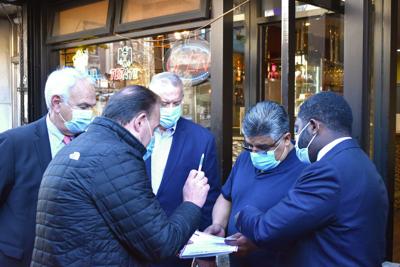
“It was bad before. Now it’s worse,” said Councilman Mark Gjonaj (D-Bronx), during last Thursday’s tour of businesses on Fresh Pond Road in Glendale. “The city is not listening. They’re hearing the issues. They have not addressed the concern.”

Gjonaj, chairman of the Council’s Committee on Small Business, visited stores with Councilman Bob Holden (D-Middle Village), Myrtle Avenue Business Improvement District President Ted Renz, Queens Chamber of Commerce President Tom Grech and Small Businesses Commissioner Jonnel Doris.

“For us, we’re here to help small business. That’s our job,” Doris said. “While we’re the government, we’re still their advocates.”

He said about 30 walking tours have been done around the city and though some changes in policy have been implemented because of feedback, Doris acknowledged “we have to rebuild their trust, too.”

Among the problems raised by elected officials and business owners around the city are the fines being imposed, sometimes with contradicting advice from city agencies.

“I don’t like when the government descends on businesses that were closed for so long and then they start fining them instead of warning them,” Holden said.

Grech believes one person needs to oversee everything, “kind of like a COVID czar.”

Gjonaj said store owners can be fined if a customer is not wearing a mask but believes that is unfair to the owner, saying that there have been attacks on people who are demanding masks be worn.

“They’re not policemen. They’re business people,” he said. “They’re working behind the counter. They’re sweating. They’re not supposed to act as enforcement. You can’t hold them reliable. You go tell someone with mental illness that they can’t enter because they don’t have a face mask. Let’s see how far that gets you.”

Saturday, April 11, 2020

6,000


NY Daily News

About 6,000 homeless New Yorkers who are suffering from coronavirus or are at risk of getting the disease are going to taken out of shelters and put into hotels, Mayor de Blasio announced Saturday.

“We think it is the right balance to strike to make sure that they get what they need and be safe,” the mayor said during a press conference from City Hall. “We will use those hotels aggressively as a tool to support homeless individuals, to strike the right balance in our shelters to make sure people who need to be isolated are isolated."


The move from shelters to hotels should be completed by Monday, de Blasio said. The hotels will be available to singles, not families.


Priority placement will be given to seniors, anyone with COVID-19 symptoms or anyone diagnosed with the virus, de Blasio said.

 “They, of course, will be isolated in hotel settings,” the mayor said.


NY Post

 More than 6,000 people in New York City have succumbed to coronavirus, the latest figures show.

The Big Apple’s death toll now stands at 6,367, an increase of from the 5,463 previously reported on Saturday, according to the NYC Health Department.

There have been more than 98,000 cases in the city, resulting in at least 27,000 hospitalizations, the health department said.

The highest rate of cases has been reported in Staten Island, which is followed by the Bronx and Queens, according to the figures.

Sunday, April 5, 2020

20,000

QNS

On the same day that Governor Andrew Cuomo indicated that New York State was nearing the grim apex of the coronavirus outbreak, New York City reported yet another surge in additional infections and deaths.

Data that the city’s Health Department through 5 p.m. on April 4 indicated that there were now a total of 60,850 infections and 2,254 deaths citywide. That represents an increase of 4,579 cases and 387 deaths over a 24-hour period.

An estimated 12,216 New Yorkers — or 20.9% of all coronavirus patients in the five boroughs — have been hospitalized, according to the city’s Health Department.

One-third of all coronavirus patients come from Queens, which has been the epicenter of New York City’s outbreak almost from the start. As of 5 p.m. April 4, the borough registered 20,371 cases.


Thursday, March 26, 2020

Mayor de Blasio is refusing to release information about what exact areas in the five boroughs have the most COVID-19 cases


Residents of Los Angeles can go to a county website to look up how many confirmed coronavirus cases there are in Beverlywood, or Koreatown, or Echo Park. Officials in Charlotte, North Carolina, have released figures at the ZIP code level. The South Korean government is sending geotargeted texts to alert citizens to positive cases near them.


In New York, now at the center of the outbreak, Mayor Bill de Blasio has resisted releasing what the city knows about a basic question: Where, precisely, is the virus?


Answers could take the form of a number of data points — tests, confirmed infections, hospitalizations or deaths — each of which shed light on a different part of the crisis.


Instead New York, along with several other state and county governments around the country, has released daily data only on the county, or borough, level. That means there is just one figure for COVID-19 cases in all of Kings County — Brooklyn — which has a population larger than 15 states. 

The roughly 4,600 confirmed COVID-19 cases among Brooklyn’s 2.6 million residents account for 8% of the confirmed cases in the entire country. There is also just one coronavirus case figure for the 2.2 million residents of Queens, where there are just over 5,000 confirmed cases.


The lack of detailed information makes it difficult for medical workers, journalists and the public to establish whether particular communities in the city are being harder hit and to get beyond anecdotal accounts of which of the city’s roughly 60 hospitals are already overwhelmed.


Dr. Michael Augenbraun, director of the infectious diseases division at SUNY Downstate Medical Center in central Brooklyn, said that while he knows the city has its hands full, the data could be useful for doctors. “Everyone is struggling to make sense of this evolving picture,” he said. “I think it would be useful to us in the hospitals to get a detailed situational appraisal, to know how much of the burden we are confronting.”


Augenbraun noted that more precise data could reveal important trends in how the disease is affecting different New Yorkers. “There are many things that may correlate with the spread of infectious diseases,” he said. “Race might be one, poverty might be another.”


But some of those same factors, particularly ethnicity and race, may account for the city’s reluctance to make public more localized data that could point to clusters in particular neighborhoods, among certain communities. Around the country, there have been disturbing reports of bias attacks against Asian Americans by assailants blaming Chinese communities for the spread of the virus.


“The risk is that certain communities would be unfairly stigmatized, especially if communities with many COVID-19 cases already shoulder poverty or high crime,” said Dr. Jessica Justman, associate professor of medicine in epidemiology at Columbia University. “On the other hand, communication and information are always important and especially important in a pandemic setting.”

Some experts argue that the city should be releasing more granular information, perhaps even down to the block level.


“More detailed information will allow everyone to target their efforts much more effectively than only county-level information,” said John Mollenkopf, director of the Center for Urban Research at the CUNY Graduate Center.
 
In Newark, the largest city in neighboring New Jersey, Mayor Ras Baraka has disclosed that there were three coronavirus hot spots where residents should take extra precautions. On March 21, the city released detailed maps of the areas, which cover between 50 and 100 square blocks; it did not release the specific number of cases for each area.


New York has held fast on the policy the mayor laid out during a March 12 press conference when he was asked by a reporter if the city could go beyond borough-level numbers and break down cases by neighborhoods. The mayor declined, saying only that the city would release figures in the case of what he called a “cluster.”


“When we say ‘community spread,’ the assumption should be that this is something that is going to reach every corner of the city, whether we like it or not,” he said at the press conference. “And I don’t think it’s particularly productive. I don’t know what you do with that information. I don’t know how you change your life. Unless there is an indication of a cluster, that’s something we absolutely will talk about.”

THE CITY 

The city is sending homeless shelter residents and public hospital patients with coronavirus to hotels — but won’t say where.

And officials aren’t providing hotel staff or the city employees monitoring the infected guests with masks or any other form of protective equipment — instead instructing them to maintain social distance.

“Going into a hotel room with an infected patient is the same as going into a room of a hospital with an infected patient,” said City Councilmember Stephen Levin (D-Brooklyn), who called for protection for the workers.

The news came as officials confirmed the first death of a homeless New Yorker who succumbed to COVID-19.

The city’s Department of Homeless Services and the Health + Hospitals Corporation said the shelter residents and patients sent to the hotels are all experiencing low-level symptoms and do not require intensive medical care.

As of Wednesday, DHS had placed 65 individuals from shelters into hotel rooms.

Among them: residents who are infected, people who came in close contact with those who tested positive and shelter clients with potential coronavirus symptoms who haven’t been tested, officials said.

Overall, the city has lined up 500 rooms in four hotels, though only two facilities were being used as of Wednesday afternoon, officials said.
Isaac McGinn, a DHS spokesperson, declined to reveal the locations of the hotels, citing shelter residents’ privacy.

HHC wouldn’t say how many patients it had sent to the hotels so far. At least one HHC patient with COVID-19, the illness caused by the coronavirus, had no known address and was routed to a hotel, via DHS.

 The number of shelter residents infected with the virus jumped from 17 to 39 between Sunday night and Tuesday night, with the illness spreading from 12 to 27 separate shelters across the city during that time, DHS officials said. Twelve people have been hospitalized — including the unidentified person who died Tuesday.

Queens has the most COVID-19 cases in the city with 6,420 and had the biggest gain in the last 3 days at last count on THE CITY's website.

Followed by Brooklyn with 5,232, Manhattan with 3,616, Bronx with 3,532 (second biggest gain) and Staten Island with 1,166. 

A total of 285 citywide have died by the virus. 

I'm going to take a break for a few days.