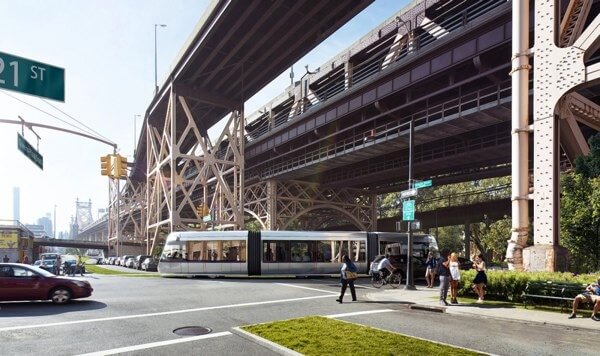
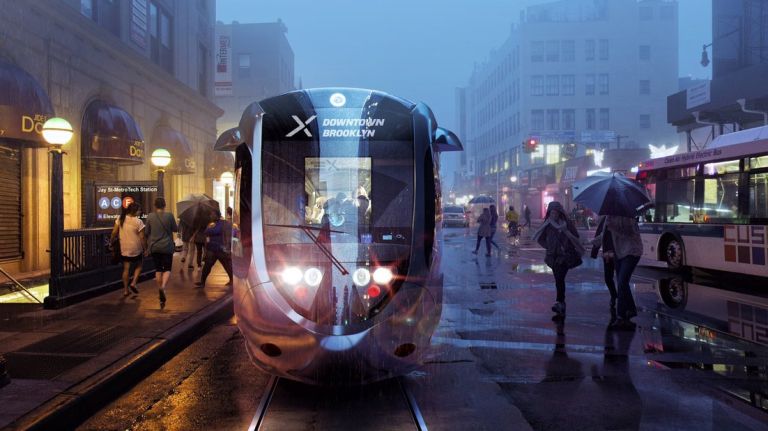
The future of the $2.7 billion streetcar connecting western Queens to
the Brooklyn waterfront will be up to the next mayor of New York City,
Mayor Bill de Blasio announced Thursday. The coronavirus pandemic and fiscal constraints have significantly
delayed the timeline of the project, dubbed the Brooklyn Queens
Connector or BQX. The city had just begun the environmental review process for the
11-mile streetcar project in February but the pandemic brought the
process to a screeching halt. It was scheduled to begin scoping and
public hearings in May and June, but has been delayed indefinitely. Yesterday, de Blasio said the next administration will decide the fate of the project, as his term ends in 2021. “We’re going to continue to do the work to prepare,” he said at a
press briefing. “The decisions will have to be made by-and-large in the
next administration given the time that’s been lost here.” The project also comes at a time when New York City faces a
multi-billion-dollar budget hole due to economic fallout from the
pandemic. At the end of April, de Blasio said he was unsure
whether the city had the funds to cover its share of the costs — given
the budget crisis. He said that “substantial federal funding” was needed
to make the project a reality. Critics of the BQX argue that the project is not worth the
multi-billion dollar cost. Many transit advocates say the money would be
better spent on improving MTA buses and bus lanes, which cost much
less.
The city’s budget crisis brought on by the coronavirus pandemic could
be the death knell that finally derails the controversial $2.7 billion
Brooklyn-Queens Connector project.
Public hearings on the state-of-the-art light rail system were set to
begin May and June and the city planned to finish a draft environmental
impact statement by spring 2021 but that has been postponed during the
COVID-19 crisis. The BQX would connect commuters to 13 subway lines, nine NFY Ferry
landings, and more than 100 Citi Bike stations. Critics of the proposal
have long-claimed the BQX project was a boondoggle that would line the
pockets of waterfront real estate developers and residents and business
owners objected to the erasure of 2,000 parking spots along the
corridor. During his COVID-19 briefing on April 29, Mayor Bill de Blasio
admitted the proposal would be put on hold during the public health
emergency. “Something like the BQX, which we had just begun a whole phase of
environmental review, it’s going to be looked at now with all other
major capital initiatives,” de Blasio said. “It will be discussed in the
budget process and be part of what we say around the budget in June.
It’s a very good example of the kind of thing that now has to be thought
of very differently simply for the budget ramifications alone.”
The nonprofit organization that has
been advocating for a streetcar system along the Queens and Brooklyn
waterfront since 2014 made a change in leadership just as the city
launches a wide-ranging community engagement process.
The Friends of the Brooklyn Queens
Connector recently named Brooklyn resident Christopher Torres as its new
executive director to replace Jessica Schumer, who left at the end of
the year to pursue a new opportunity.
“Jessica had a tremendous run with
Friends of the BQX and we thank her for outstanding work over the past
three years,” a Friends of the BQX spokesperson said. “With its
environmental review in full swing and a public review process ahead,
we’re glad to have Chris at the helm as we head into a big year for the
BQX.”
Torres was an organizer for the
Working Families Party, where he helped lead campaigns in Arizona,
Wisconsin, and, most recently, for Public Advocate Jumaane Williams.
Torres also worked with Make the Road New York Action Fund as its
director of field operations, where he spent five years working to build
electoral power in immigrant communities through grassroots and
community driven campaigns in New York and Pennsylvania. He views public
transportation as a social justice issue.
“It makes all the difference in
getting your mother to her doctor’s appointment on time, getting your
children to school, or in some cases keeping your job,” Torres wrote
Monday to board members.
“This belief must be the foundation of our work
if we are going to change the landscape of NYC and build a robust
transit system for all New Yorkers.”
The controversial proposal for the
$2.7 billion state-of-the-art light rail system, which would run along
an 11-mile corridor from Astoria to Red Hook, Brooklyn, would provide a
crucial north-south transit option for the 400,000 people who live along
the corridor and the 300,000 who work along the fastest-growing
business corridors in the city. The city’s Economic Development
Corporation has launched an extensive community engagement process that
will include presentations to community boards and public workshops that
will focus on community priorities, suggestions and concerns.
“There are myriad reasons why we want
to see the BQX happen. For me, one stands out more than most:
implementing quality public transit access for those who have been
historically neglected by city planners,” Torres wrote. “From Astoria,
Queens, to Red Hook, Brooklyn, no one feels the sting of walking more
than a half mile on a rainy day to a delayed subway or bus more than the
folks who live in public housing along the route. This year we will
work to broaden and strengthen our support in NYCHA with the help of the
resident association presidents who share our vision.”
Puh-leeze, the only reason why Jessica Schumer is gone and replaced with this young man is not to promote diversity or transit equity, but because this piece of shit trolley needs federal funding to pay for the cost of building it, which keeps rising every year. Also, Schumer is Senator Chuck's daughter and that would have been a huge conflict of interest, and it seems the Mayor and his developer overlord donors have had their fill with that. Or so it seems, the ferry's are still costing the city more money last time I/we checked.
Couldn't find a better guy to push your trolley agitprop NYC EDC. Have fun pissing away our tax dollars, Chris.
In 2016, Mayor Bill de Blasio announced that the city would begin working on the Brooklyn Queens Connector,
a $2.5 billion streetcar that would trace the waterfronts of the two
boroughs from Astoria to Sunset Park. The mayor's announcement came
after a group of real estate developers somehow had the same idea, and donated nearly $250,000 to de Blasio's nonprofit, but the mayor assured everyone that the BQX would pay for itself, thanks to rising property values.
A year and many "visioning sessions" later, Sunset Park residents fought to take their neighborhood off the BQX's map, leaked documents and independent reports showed the city's funding scheme to be extremely dubious, the streetcar route was found to be susceptible to serious flooding, and the BQX looked to go the way of the carriage horse ban: a full-throated promise backed by stacks of cash that turned into a whisper in the wind.
But the BQX wasn't dead, just dormant. The de Blasio administration released a new plan for the streetcar in 2018 with a shorter, 11-mile route from Astoria to Red Hook and a bigger price tag, $2.7 billion.
This week the city's Economic Development Corporation and Department of Transportation pledged to start presenting their case
to the public early next month, with the goal of coming up with a final
design by 2023, and finishing construction in 2029—eight years after
Mayor de Blasio leaves office. In the short-term, the city is
aiming to get a draft Environmental Impact Statement done by 2021, de
Blasio's final year in office.
“From community board presentations
and on-the-ground outreach to briefings with elected officials and
public workshops, NYCEDC and NYC Department of Transportation are moving
forward with a far-reaching process that provides multiple
opportunities for feedback prior to the environmental review phase," the
city said in a statement.
Thought this interview with the dope from park slope needed to be included, as the Blaz tells Errol Louis (who hilariously presumed that this was dead) that even though the city is earmarking another 2 billion to get the BQX started, it's going to need federal funding. Surely because everyone in the towns that it will traverse and the district council members are all dead set against it. Just quit it, Bill.
If the MTA is redesigning the Queens Bus Network and including a limited stop Astoria-Downtown Brooklyn route (QT1), why the hell are we moving forward with the BQX (other than tweeding)? Non-brainwashed minds want to know.
Mayor Bill de Blasio’s plan for a shiny new streetcar through Brooklyn and Queens took a step forward Wednesday.
The
NYC Economic Development Corporation, which also runs NYC Ferry
service, announced it approved a contract with a consultant to oversee
the environmental review process for the Brooklyn-Queens Connector, or
BQX.
The
trolley, which was first announced in 2016, looked to be dead in the
water last April when Deputy Mayor Alicia Glen questioned whether it was
worth its $2.5 billion price tag.
But the city released a revised plan
for the BQX in August, which slashed the length of the streetcar's route from 16 miles to 11, and inflated its cost to $2.7 billion.
The updated route terminates in Gowanus in the south and Astoria in the north.
The new transit option has garnered a good deal of controversy since it was announced. Like the NYC Ferry, it has raised concerns about gentrification and housing prices.
Friends of the BQX, a real estate-backed nonprofit that has been advocating for the project, praised the progress Wednesday.
“We
are pleased with the city's commitment not just to moving the project
forward, but to community engagement, which must play a central role,“
said the group’s executive director Jessica Schumer, daughter of Senate
Majority Leader Chuck Schumer. “As the city grapples with a transit
crisis, now is the moment for it to take control of its mass transit
destiny and expand access wherever it can.”
The city hopes to have the trolley completed in 2029 — it still hasn’t determined how it will be funded.
Yeah, the headline above is a little bitty bit of editorializing, but I said that this was going to happen regardless. Because what the real estate overlords want, the real estate overlords get. And I don't like it anymore than you do.
Since Amazon announced that its HQ2 was coming to Queens, New Yorkers have wondered how the fraught NYC subway system and other infrastructure throughout the city will be able to handle the influx of workers. Now, Queens Borough President Melinda Katz has an idea.
Katz on Monday called for Amazon to pay for the construction of the Queens-Brooklyn Connector (QBX), also called the Brooklyn-Queens Connector (BQX).
The BQX is expected to stretch 16 miles, from Sunset Park, Brooklyn to Astoria, Queens, Mayor Bill de Blasio detailed back in 2016.
“A substantial and meaningful investment by Amazon that helps ensure the feasibility of QBX would be a fair investment into its new home, and a welcome opportunity for a good corporate neighbor to directly benefit the existing, impacted communities of Western Queens,” she continued.
The connector should also include a free transfer to MTA subways and buses and reduced ‘Fair Fares’ for lower-income New Yorkers, according to Katz. But since subways can still easily become overcrowded when Amazon HQ2 moves into Queens, she added that the Long Island City and Hunterspoint Avenue LIRR stations should become “full-time stations with enhanced service.”
Katz previously said that Queens is “primed” for Amazon and overall supports the deal, but is now acknowledging the neighborhood’s infrastructure needs.
Let's hope this ass becomes DA so we don't have to deal with her land use stupidity anymore.
As the de Blasio administration looks to move forward with the proposed Brooklyn-Queens Connector, called BQX, there’s renewed hesitation among local elected officials, experts and some residents about the merits and prudence of the project.
The latest skepticism comes after a summer report in which the administration outlined that the streetcar, now envisioned to run along the waterfront of Brooklyn and Queens from Red Hook to Astoria along an 11-mile route, would cost more and take longer than estimated to build while running a shorter route.
"We would be able to add additional bus service — bus lines, express bus, Select Bus — we’d be able to do that extremely quickly, much more efficiently and at much lower cost,” said City Councilman Jimmy Van Bramer, whose district includes Long Island City, Queens, which the streetcar would transverse.
The de Blasio administration today released plans for its Brooklyn-Queens Connector, a streetcar officials envision running along the waterfront between the two boroughs. It has been delayed by complex infrastructure challenges.
The original streetcar was expected to cost $2.5 billion and run roughly 16 miles between Astoria, Queens, and Sunset Park, Brooklyn. But the updated plan calls for a shorter route to Gowanus instead and will cost $2.7 billion. That translates to an increase in per-mile cost from roughly $156 million to $248 million.
De Blasio first announced plans for the streetcar in February 2016. But as officials looked further into potential routes, they found that the rat's nest of underground infrastructure presented enormous potential for increasing costs and would need to be thoroughly studied. As Crain's reported late last year, the problem presented officials with a catch-22: By studying the infrastructure more carefully, the city insulated itself from risk in the event it had to scrap the project, but doing so caused delays and drove up costs.
The original project was supposed to be completed in 2024 and be paid for through property tax revenue as the land around the route increased in value. The updated version of the project is now expected to be operational in 2029 and would require $1 billion from the federal government, according to a report in The New York Times, which noted that the city tax revenues originally thought to be available for the BQX are being spent on other priorities, including affordable housing.
There’s not a single rail in the ground, but the mayor’s plan to create a trolley along the Brooklyn waterfront has already cost the city at least $7 million in taxpayer money, The Post has learned.
That’s the current price tag on a delayed feasibility study — spearheaded by the consulting firms KPMG and WSP — that will determine whether the controversial project is even plausible.
Economic Development Corp. officials had initially said the review would be completed in the fall of 2017, but this week they wouldn’t put a timeline on its release.
Transit honchos in charge of fixing the dilapidated Brooklyn–Queens Expressway want the mayor to hit the breaks on his controversial $2.5-billion streetcar plan because the two massive infrastructure projects will butt heads.
The Department of Transportation must repair the 1.5-mile stretch of the decrepit roadway between Atlantic Avenue and Sands Street in Brooklyn Heights before the triple cantilever — which runs beneath the neighborhood’s promenade and above Furman Street — crumbles beneath the weight of the thousands of big-rigs that rumble across it daily.
But Hizzoner’s plan to lay 14 miles of light-rail tracks from Sunset Park to the outer borough of Queens that would run along streets in Red Hook, Fort Greene, Dumbo, and Brooklyn Heights, including on Atlantic Avenue, will impact the city’s work on the expressway and cause even more chaos on the local thoroughfares, according to the city’s Deputy Commissioner of Bridges.
“I had a conversation with somebody who was working on the BQX. They are thinking about it going down Atlantic Avenue and across Columbia [Street], and I said ‘Look we’re going to be there, I don’t think it’s a good idea,’ ” Bob Collyer said during a public meeting about repairs to the expressway’s triple cantilever on Dec. 11. “That’s as far as we got.”
The leader of the developer-backed advocacy group for the Brooklyn-Queens Connector, the mayor’s streetcar project, is stepping down.
Ya-Ting Liu, executive director of the Friends of the BQX, plans to leave the group on Friday after 18 months in the position, but before significant planning or outreach for the project has been completed. A spokesperson said that Liu felt this was an appropriate time to step down, and Liu did not immediately return calls for comment.
Deputy director Jessica Schumer, the daughter of Senate Minority Leader Chuck Schumer, will serve as interim executive director until the position is filled. Schumer had served as the policy director for Tim Kaine on Hillary Clinton’s 2016 presidential campaign and had worked in the White House during the Obama administration.
Gone are the grand visions of urban redevelopment that rose Athena-like from the City Hall bullpen under Mayor Michael Bloomberg. De Blasio has retained lofty language to describe his ideas—adding adjectives like “transcendent” and “historic” when presenting proposals. But his attempts to remake swaths of the city in a Bloombergian manner have sputtered.
Sunnyside Yards in Queens, where the mayor hopes to build an 11,000-unit affordable housing complex on top of a platform, is a years-long dream that may never be realized. His transit plans, including a $2.5 billion streetcar project along the Brooklyn-Queens waterfront and a new subway line through Utica Avenue, haven’t gotten past preliminary stages. And his administration has equivocated over the future of Willets Point, where the courts blocked plans to build a mall and 2,500 units of housing on the blighted site next to Citi Field.
Instead, de Blasio made affordable housing the centerpiece of his agenda and touted pro-tenant measures, including rent freezes for rent-stabilized units.
“The real estate community, like any other business sector, prefers certainty,” explained Ken Fisher, a Cozen O’Conner attorney and former councilman. “After four years of working with Bill de Blasio and his team, people have a pretty good idea of expectations. He has a strong preference for affordable housing, but the mayor has taken a very clear position that he’s for many different kinds of housing development, not just low-income housing.”
De Blasio made that clear in his 2015 State of the City address when he proclaimed that the other successes of his administration would be at risk if the city and developers didn’t build enough housing for residents of all income levels.
Rather than wrestle with real congestion problems, Mayor de Blasio is pushing an expensive boutique project for new transit infrastructure that will fail to address any of the city’s most pressing transit needs or significantly reduce traffic congestion.
The Brooklyn-Queens Connector, or BQX, would run from Astoria in Queens to Sunset Park in Brooklyn. It is the brainchild of a group of developers who are sprouting luxury towers on the Brooklyn-Queens waterfront. They corralled celebrities and willing non-profit groups to create Friends of the BQX, a vanity group set up by the developers . The mayor is using the city’s time and money to close the deal with this group.
It is time the city proposed long-term solutions that go beyond absurdly expensive projects like the Second Ave. Subway, No. 7 extension and BQX, which are more about promoting high-end real estate development than solving transportation problems.
A serious bus rapid transit system (Select Bus Service is a modest beginning) and improvements to pedestrian and bicycle infrastructure need to be part of the plan. The city must look many decades ahead and not just to the next election, and beyond the 20-30 years during which developers typically recover their investments.
Finally, it makes no sense to sink billions of dollars into a trolley line lying in one of the city’s most vulnerable flood plains. No one can be certain how many feet the waters will rise in decades to come. The added costs of elevating buildings, protecting infrastructure and buying flood insurance will be considerable. Protecting the BQX rails at street level during floods would be difficult if not impossible.
Mayor Bill de Blasio’s plan for a streetcar along the Brooklyn and Queens waterfront may not pay for itself after all, according to an internal City Hall memo.
A confidential memo sent by the administration’s “BQX Project Team” to Deputy Mayor Alicia Glen in February says that the “successful implementation” of the $2.5 billion, 16-mile Brooklyn Queens Connector “faces several serious challenges,” including its financing model.
Since de Blasio unveiled the proposal in his February 2016 State of the City address, critics have questioned why the mayor would consider funding a developer-driven streetcar through already gentrified neighborhoods, rather than putting more capital behind another of his ideas, a subway extension into working class neighborhoods along Utica Avenue.
The administration has consistently argued that the BQX project can pay for itself, since the city can capture a piece of the rising property values that would be spurred by the creation of the streetcar. It’s a financing model known as “value capture.”
The February memo acquired by POLITICO New York suggests that the city’s confidence in the streetcar’s ability to pay for itself may be wavering.
Among the “four serious challenges” listed in the memo is the following: “Value Capture not providing sufficient revenue to fund the entire project as originally stated.”
In part, that's because, as the memo also notes, it's really expensive to move and rehabilitate the water, gas and sewer mains that lie along the streetcar’s proposed path between Sunset Park and Astoria.
Streetcars, America’s transit de jour, have proven difficult operations in other cities like Atlanta and Washington, D.C. Beyond the latent ire of community boards in New York, there are major hurdles revolving around nearly every aspect of the project, including how the streetcar will interact with vehicles; the use of value capture financing; and its placement in a flood-prone corridor.
Other transit experts believe the city is oversimplifying the scope of the project. De Blasio’s streetcars would carry almost 50,000 riders per day at a speed of about 12 miles per hour, according to city estimates. When you weigh costs and capacity against the Second Avenue subway, the BQX doesn’t add up, said Jon Orcutt, a spokesman for TransitCenter.
The streetcar was first proposed by the Friends of the BQX, a support group with several large development firms on its executive committee and board of directors. De Blasio has had to vehemently fight the perception that the streetcar isn’t a handout to developers in an area that is not quite the “transit desert” that he describes.
A trip on the BQX would cost the going rate of a MetroCard, but it’s still unclear if the BQX will be integrated with the MTA’s fare payment system.
The city claims the big-money developers who lavished cash on Mayor de Blasio’s campaign and nonprofit are not involved in the planning of the multibillion-dollar Brooklyn Queens Connector (BQX) trolley line.
Yet an insider says a developer and a high-powered advocacy group created and led by another developer are not only in on twice-a-month interagency phone calls on the project but they are driving the discussion.
Ya-Ting Liu, the executive director of Friends of the Brooklyn Queens Connector, participates, as does a rep from Two Trees Management, the company that came up with the streetcar idea and which will benefit from a new transit link to its swanky waterfront projects.
“They, in effect, run the call,” said a city source familiar with the project, which would connect Sunset Park, Brooklyn, and Astoria, Queens.
In fact, city schedules refer to the conference call by the name of the nonprofit advocacy group — the “FoBQX meeting.”
But it is a government call with staffers from the Department of Transportation and Economic Development Corp. It sometimes includes Adam Giambrone, the city’s streetcar czar.
The participants discuss the progress of the $2.5 billion project that de Blasio began trumpeting in February. But the outsiders are guiding the city’s strategy for community outreach and identifying those who can be tapped for support, the source said.
Italicized passages and many of the photos come from other websites. The links to these websites are provided within the posts.
Why your neighborhood is full of Queens Crap
"The difference between dishonest and honest graft: for dishonest graft one worked solely for one's own interests, while for honest graft one pursued the interests of one's party, one's state, and one's personal interests all together." - George Washington Plunkitt
The above organizations are recognized by Queens Crap as being beneficial to the city as a whole, by fighting to preserve the history and character of our neighborhoods. They are not connected to this website and the opinions presented here do not necessarily represent the positions of these organizations.
The comments left by posters to this site do not necessarily represent the views of the blogger or webmaster.