Showing posts with label apartment buildings. Show all posts

Wednesday, November 23, 2022

Julie Loser

 https://thecity.brightspotcdn.com/dims4/default/b0325c2/2147483647/strip/true/crop/3000x2000+0+0/resize/2048x1365!/format/webp/quality/90/?url=https%3A%2F%2Fcdn.vox-cdn.com%2Fthumbor%2FSdHmdEmFkdiYlERzCLhW6-keCX8%3D%2F0x0%3A3000x2000%2F3000x2000%2Ffilters%3Afocal%281500x1000%3A1501x1001%29%2Fcdn.vox-cdn.com%2Fuploads%2Fchorus_asset%2Ffile%2F23415460%2F042522_council_budget_won_1.jpg

THE CITY 

A rezoning allowing for a massive new real estate development in East New York that would include 11 residential buildings with more than 2,000 apartments passed a key City Council test Thursday, with support from a local representative best known for his oppositional stances.  

Councilmember Charles Barron (D-Brooklyn), an avowed socialist and frequent opponent of rezonings, backed the plan for Innovative Urban Village after years of negotiations with the developers — an unyielding stance that he says resulted in a project with solely affordable units for the overwhelmingly Black and Latino, working-class neighborhood.

The plan, as initially envisioned by Gotham Organization and the Christian Cultural Center, a megachurch in Starrett City that owns the land, originally proposed rentals for residents making between 30% and 120% of the New York City region’s area median income — currently anywhere from $40,000 to $160,000 for a household of four.

But after community feedback and negotiations with Barron’s office, the developer brought the income limits down to between 30% and 80% of the median income, or between $40,000 and $106,000 for a family of four. According to 2019 data compiled by the Furman Center, the local community district’s median household income was $48,000 and more than half of the area’s households earned incomes that would qualify.

Barron, a former Black Panther and a longtime adversary of Brooklyn’s Democratic Party establishment, said the project should set an example for other City Council members with proposals for large developments in their districts, as well as the Adams administration, about how to get to “yes” without rubber-stamping projects with rents beyond what local residents can afford.

The same Council committee also unanimously approved another large rezoning, known as Innovation QNS, following lengthy negotiations with local Astoria Councilmember Julie Won (D-Queens), who had initially raised objections to what she called insufficient affordable housing.

The $2 billion project is slated to bring nearly 3,000 apartments to an area near Northern Boulevard, about one-third of which are categorized as affordable.  

The project is backed by building workers’ union 32BJ SEIU and Queens Borough President Donovan Richards, who ridiculed Won as she held out, citing concerns that the arrival of luxury units will exacerbate gentrification in the area.

In a statement, Won explained her apparent change of heart by pointing to “wins” including an increase in affordable units that her team had secured — though those modifications appeared to fall short of the 55% affordable threshold she had initially demanded.

 We’ve been negotiating daily to secure unprecedented levels of affordability for my immigrant and working-class community,” Won said, adding that she was “finalizing negotiations for commitments from the developer and the Mayoral administration.”

In effect, she let the project proceed through the subcommittee, which is where other lawmakers usually defer to the desires of the local council member, prior to receiving a firm, written commitment.  

“As the council member, I will utilize every accountability measure to ensure that our community wins are actualized,” Won continued.


Thursday, August 4, 2022

Julie Won's constitution for affordable housing development


Queens Post

Councilmember Julie Won has put together an extensive list of guidelines—with input from non-profit leaders and community organizations– that developers must adhere to when seeking a rezoning in order to get her support in the city council.

Won, who was a Community Board 2 member prior to being elected, says the document aims to democratize the rezoning process, providing the community with greater input as to what is deemed appropriate for development. She said past rezoning decisions were left almost exclusively in the hands of councilmembers and were less “community driven.”

The guidelines she has created is what she refers to as a “living document” that she says will change with the needs of the district and city.

“As an office, we partnered with nonprofit partners to craft our land use principals document and have socialized it with the City Council Land Use division as well as other community partners,” Won told the Queens Post. “This is a living document that will continue to evolve as our community also continues to evolve.”

The guidelines essentially call on developers to do more than what is standard today in order to get their rezoning applications approved. She is calling for greater community outreach (in multiple languages), offer affordable units at deeply affordable levels and to invest in public services.

Won’s guidelines are important since she will ultimately determine the fate of rezoning applications in the 26th Council district, which covers Sunnyside, Woodside, Long Island City and parts of Astoria. The council, which must approve all rezonings, typically votes in lockstep with the representative where a development is proposed in what’s known as member deference.

“We released our land use principles to promote our community’s role in building new developments in our district and bring transparency to the land use process. We want to make sure that developers meet the minimum requirements to do business with our district: community engagement, affordability, and community investment.”


Tuesday, March 1, 2022

Brooklyn BP and Council Crony Restler want to disqualify residents who drive cars from living in affordable housing.

https://www.brooklynpaper.com/wp-content/uploads/2019/02/mm-parking-charges-increase-kings-plaza-2019-02-15-bk01_z.jpg


Brooklyn Paper 

Borough President Antonio Reynoso and northern Brooklyn Councilmember Lincoln Restler are demanding an end to minimum parking requirements for new construction in transit-rich areas. 

When a developer seeks a rezoning to build taller developments, they’re often forced to build off-street parking — which is designed to reduce the impact that new construction has on parking in the neighborhood. 

But now, the group of electeds signed a petition letter calling on the Department of City Planning (DCP) to fully waive parking constraints for all residential developers of any rezoning projects in public transit-rich areas.

The representatives aim to disincentivize people living in areas with access to subways and buses from using and buying cars, with the intention to reduce carbon emissions and improve the “borough’s urban fabric” — all while providing developers with the option to redirect space toward construction of more affordable housing, said Restler in an exclusive to the Brooklyn paper.

“The accessory parking in buildings on key mixed-use corridors like Fourth Avenue, Flatbush Avenue, and Fulton Street disrupt our borough’s urban fabric, making our City less affordable, less walkable, and incentivizes car ownership,” read the electeds’ letter to the DCP. “The last place we need developers to build accessory parking is in areas with substantial access to public transportation. We need to reduce car ownership in our city, and requiring new parking within close proximity to public transit has the opposite effect.”

Restler pointed to one 28-unit rising project just outside the Bedford subway station, which includes 14 required parking spots on the ground level — saying that, in addition to other problems, such requirements often make the construction “drab, dark, and lifeless.” 

“Because below-grade parking is so expensive to construct, many developments across the city do so on the ground-floor, leading to drab, dark, lifeless streets rather than dynamic ground floor retail and community facility spaces that generate jobs and fulfill critical neighborhood’s needs,” said a statement from Restler on Monday.

Even though there are many businesses around the crossroad of Bedford Ave. and North Seventh Street, it is not confirmed that the new building will have commercial spaces.

Within slightly over 2 square miles, Williamsburg residents have access to the four bus lines and seven subway stations.

“This is an example of an area that doesn’t need more parking, doesn’t need more cars, for sure,” said Reynoso. “So it’s a model development for us to use as a first shot at showing people that parking requirements should not be used here. Also, I think the most important thing is that the parking requirements being removed, allows for more housing to be built. It makes the projects less expensive. It also makes it so that instead of taking down, you can build up, so we got more housing out of this proposal.”

Sunday, October 10, 2021

Trust fund dilletante brats take advantage of affordable housing tax break

https://assets.bwbx.io/images/users/iqjWHBFdfxIU/izznM8JIap5g/v0/640x-1.jpg

Bloomberg

 If you have a modest income but access to lots and lots of cash, New York City has an apartment ownership program that’s right up your alley. Even if it wasn’t meant for you at all.

 The changes at the building in Brooklyn’s Williamsburg neighborhood began in 2009, when a guitar shop owner whose father was a renowned art appraiser purchased a four-bedroom apartment. His mom lent him the money. Then came a writer who borrowed from her mother, a psychologist. A movie production manager and her partner, a photo director, bought their unit with a loan from her father, a physician in Maryland. A flurry of additional purchases without mortgages followed, including by a Shakespearean actress whose father lives in a terraced penthouse overlooking Central Park and a fashion designer whose father is a gynecologist in California.

Similar colonies of young people with creative sensibilities and well-off parents have taken root in Williamsburg for years, but the gentrification of this particular six-story building on South 2nd Street had a surprising set of enablers: the taxpayers of New York. It’s one of about 1,000 properties across the city that receive a special property tax break created to make homeownership affordable for low-income people. The building had income restrictions, and these buyers met them. At the same time, they had access to a lot of cash, which they used to score their units at well below market prices. Never mind their wealth or their parents’; the tax break doesn’t require any limit on assets or preclude gifts.

The children of America’s wealthy are quietly sewing up deals like this in some of New York’s most desirable neighborhoods, in buildings known as Housing Development Fund Corporation cooperatives, or HDFCs. These buildings were at one time in financial (and often physical) distress, and many are still shunned by conventional mortgage underwriters—hence the need for buyers to pay cash. Many are no longer cheap, because the agreements that once limited resale prices have expired. But even at prices that can crest well above $1 million, they’re discounted to the market, because of the income limit on buyers and the lack of available financing in some cases. And the taxes can be remarkably low. On South 2nd Street, the owners enjoy annual property tax discounts of roughly 70%.

The tax break was designed to be simple—too simple, as it turns out. The program sets a maximum taxable value for every HDFC unit across the city. This year it’s $11,079, in a market where the median price for a home has risen to $770,000. Because of this system, half the aggregate tax benefit will go to the top 20% of eligible buildings by value. Struggling buildings in poorer areas, meanwhile, will get no benefit at all. Their values are too low for the tax break to have any effect, and because of their HDFC status, they don’t get an abatement that most market-rate co-ops receive. Dozens have been foreclosed on in recent years for unpaid taxes.

In short, because of inadequate rules, poor design, and decades of lax oversight, these low-income tax subsidies are being scooped up by the well-to-do. “They’re just gaming the system,” says Penny Gurstein, an expert on affordable housing who directs the Housing Research Collaborative at the University of British Columbia. “This is now just being used as a playground for the rich.”

Across the U.S., studies have shown that local property tax systems, which raise more than $500 billion annually, are deeply unfair, favoring the wealthy and systematically applying higher effective tax rates to lower-valued properties. New York’s outcomes are among the most unequal. But even in a system shot through with inequalities, the exploitation of the HDFC program by affluent bargain hunters stands out.

HDFC sales are infrequent, and not all of them go for big-dollar prices. Nonetheless, it happens often enough that the city’s Department of Housing Preservation and Development acknowledges that “strong reforms are needed.” The agency made a run at that in 2016 but failed in the face of what a spokesman called “strong objections from many HDFC co-ops and their elected representatives.” Since then, the most desirable HDFC apartments, swept along by the forces of the New York real estate market, have only drifted further beyond the reach of the people they were set up for.

An HDFC cooperative exists, per New York state law, “exclusively to develop a housing project for persons of low income.” That doesn’t stop some HDFC buildings from advertising how lax they are about enforcing income limits. Bloomberg Businessweek found dozens of listings dating to 2010 that failed to mention income restrictions for the building or plainly said there were none. A four-bedroom unit at 238 W. 106th St. was listed this year for $1.85 million and advertised as having “no income restrictions,” despite city records showing it benefits from the exemption for low-income housing. The building’s HDFC status lowered its taxable value this year by $3.6 million and cuts its owners’ tax bill by more than $400,000. A building manager at ABC Realty, which manages the building, told Bloomberg Businessweek she would inform the brokers that “they need to be compliant.”

When income limits are enforced, the rules can be as complex and unintuitive as everything else about New York City real estate. Depending on its governing documents, a building will set the limit by various methods. One looks like this: Take the annual common charges for the unit, plus the estimated annual utilities, and multiply that by six (or seven if the buyer’s family is big enough). Then add 6% of the seller’s original purchase price. That’s your income ceiling. Some buildings keep it simpler—and perhaps get to a higher number—by using a percentage of the area median income, or AMI, for the New York metropolitan area. Buildings that are committed to low-income ownership might set the limit at 80% of AMI, which matches the city’s definition of low-income. But an HDFC can go as high as 165% of AMI. This year that translates to $137,940 for a single person and $196,845 for a family of four.

For buildings with high prices and tight income caps, gifting is just about the only way a qualified person can buy some of these apartments, especially if an all-cash deal is necessary. The upshot is that a child of well-to-do parents is something of a perfect buyer.

Tuesday, March 17, 2020

East Flatbush corners the parasite apartment building market


Crappy parasitic development


New York Gentrification Watch

 I live in East Flatbush and every once in awhile, I’ll take a bike ride out to the Flatbush-Nostrand Avenue Junction. Bike rides can run the gamut from exhilarating to boring. In the case of these trips out to the Junction, they’re usually a delight. The reason? Much has been made of so-called 

“Victorian Flatbush” but on the other side of Flatbush Avenue is “Suburban” East Flatbush, for lack of a better term. Here, you’ll find an eclectic mix of wood-frame and brick houses running the gamut from Queen Anne and Mediterranean to Italianiate and colonial. They’re by no means as impressive as the sprawling houses in Victorian Flatbush but every so often you’ll come across a house full of character.
 
On my previous bike trips through this area, I always made a mental note to grab my camera and do a photo tour of the houses there on a nice summer day. However, things being what they were, I never did and this mental note started turning into a kind of running joke, like something out of a sitcom. I’d hit the bike, sigh wistfully as I rode past the houses, then tell myself once again to make sure and take a photo tour in the future.
 
Well, in January 2020, the joke finally turned sour. Why? Because instead of seeing the usual mix of quaint brick and wood-frame houses, I saw this on New York Avenue:


 Ugly grey parasitic development

As you can see in the above photos, parasitic development has made further inroads into East Flatbush. Thanks to predatory real estate home buyers, one of a kind wood-frame and brick houses are being destroyed to make way for ugly modernist apartment buildings that will only be affordable to those who can’t afford Manhattan. And, true to parasitic development, the new buildings are being placed and designed in such a way as to both irrevocably change the character of the area, as well as infuriate neighboring home owners into selling out.

Saturday, December 28, 2019

The Boulevard Of Zombie Condo Development


Impunity City

Remember when Queens Boulevard was called the boulevard of death? Well, it has got comparably safer to commute than in the past, but it has been replaced by a new form of existential threat, and that is over-development. With this post, I bring forth three technically new buildings that have been built but have remained strangely unfinished and to this day still yet to be occupied. Yet strangely are already on the market.

Welcome to the christening of Queens Boulevard as the Boulevard Of Zombie Development
 
Lets begin at this mesh covered monstrosity at 64th St.


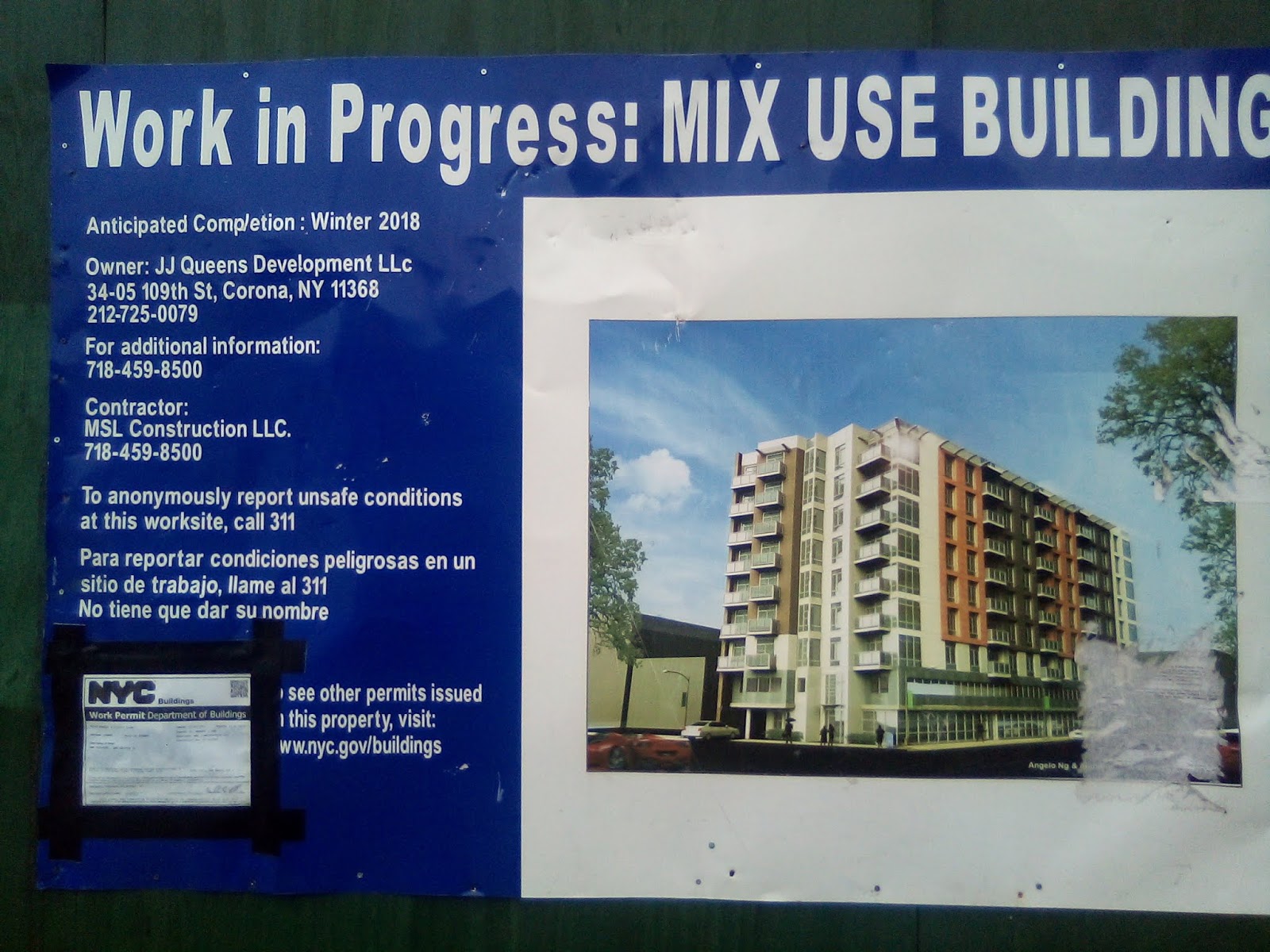
 This sign has aged quite a bit, but upon closer inspection, this building was supposed to be completed a few days from now in the year 2018


Next we cross the BQE and find this budding condo building by 70 St.

 Looks like it already is garnering interest..,

 Too bad they are going to have to wait a little longer, this was supposed to be done in Winter 2018.


But the one down the block after 70 St. is more undead than both of them.


 This zombie building is behind schedule for 4 years now.

 This zombie condo building gives off quite an aura of mystery. For who knows when construction actually started for this development and when it actually stopped. And of course why it stopped, for there is no D.O.B. certificate on it like the others and a stop work order was clearly and vainly ripped off the building placard


These photos were taken around late August/early September. I went back around Thanksgiving to see if any progress was made...


Tuesday, December 17, 2019

de Blasio is setting up a new deal for the city to buy cluster buildings from another slumlord

 NY Daily News


Ashley Taliercio and her two children have been in their Harlem apartment for three months, but it feels like years.


Each day they’re forced to walk a gauntlet of squalor: caved-in ceilings, used condoms, cigarette butts lining the stairways and constant cold inside their claustrophobic studio.


All of it has begun to numb the 30-year-old mother.


“There’s roaches, there’s fighting. There’s people doing drugs in the hallway,” she told the Daily News, her son crying in her arms, her daughter sitting stone-faced on the bed they share. “It’s not safe. But it is what it is.”


Taliercio lives at 148 W. 124 St., one of 14 buildings in Upper Manhattan and the Bronx the city is planning to buy from Mark Irgang, a landlord who already earns money from the city by housing homeless people in emergency “cluster-site” housing.


The land deal, which the city has treated as a closely guarded secret since announcing it in November, is the second part of its plan to phase out cluster housing by buying it and converting it into permanent affordable apartments.


The practice of housing people in cluster, or scatter-site, apartments has come under fire because the units cost the city a fortune to rent, and are often in a terrible state of disrepair.


Buying the Irgang’s 14 apartment buildings outright will also cost the city, however. Property records show the buildings are worth at least $41 million.


And it won’t just cost in terms of taxpayer money. Buying property from shady landlords does not happen without at least some political fallout. The purchase price in phase one of Mayor de Blasio’s cluster site conversion plan was a major headache for him both before and after the deal’s completion.


He came under fire earlier this year when The News revealed the city would be buying 17 buildings from notorious landlords, Jay and Stuart Podolsky. That was phase one of the plan. The brothers ultimately ended up making $173 million on the deal — despite one city appraisal that valued the properties at just $49 million. The city comptroller launched a probe into the appraisal process, which is ongoing.


Further complicating matters in phase two is that the controversial Acacia Network manages some of the Irgang properties.

Sunday, December 8, 2019

Multi-family homes will be destroyed for mega tower.


LIC Post

Three more century-old homes in Long Island City are slated for demolition.

The multi-family homes are all located on the same block – one at 23-10 45th Ave. and two at 45-03 and 45-07 23rd Street.

The demolitions will clear the way for the construction of a 45-story building near the southeast corner of 23rd Street and 45th Avenue in the heart of Court Square.
Development Site

Permits for the demolitions were filed Nov. 8. A total of seven multi-family homes on the block are in the process of being torn down to make way for the new high-rise.
The addresses of the buildings to be bulldozed extend from 23-10 to 23-16 45th Ave., and 45-03 to 45-09 23rd St.

The new project, however, will not cover the corner two-story building currently at 45-01 23rd St. The developer noted in city filings that attempts to purchase the property and its development rights from the owner were unsuccessful

Saturday, November 23, 2019

One less hospital, one more alleged affordable housing development

https://www.yimbynews.com/wp-content/uploads/sites/2/2015/03/immaculate2.jpgThe Real Deal


The Chetrit Group has landed $200 million in construction refinancing for its planned multifamily redevelopment at Jamaica’s Mary Immaculate Hospital site, according to sources familiar with the deal.

The funding comes from Square Mile Capital in a deal that was brokered by Henry Bodek of Galaxy Capital Group. The project will be a four-building, 324-unit complex at 150-13 89th Avenue in Queens.

Bodek declined to comment on the deal. Square Mile Capital and Chetrit did not respond to requests for comment.