Showing posts with label Robert Moses. Show all posts

Wednesday, February 7, 2024

Pete Buttigeig to New York City drivers: Drop dead

https://www.amny.com/wp-content/uploads/2022/08/BQE-Todd-Maisel-1200x797-1.jpeg 

AMNY


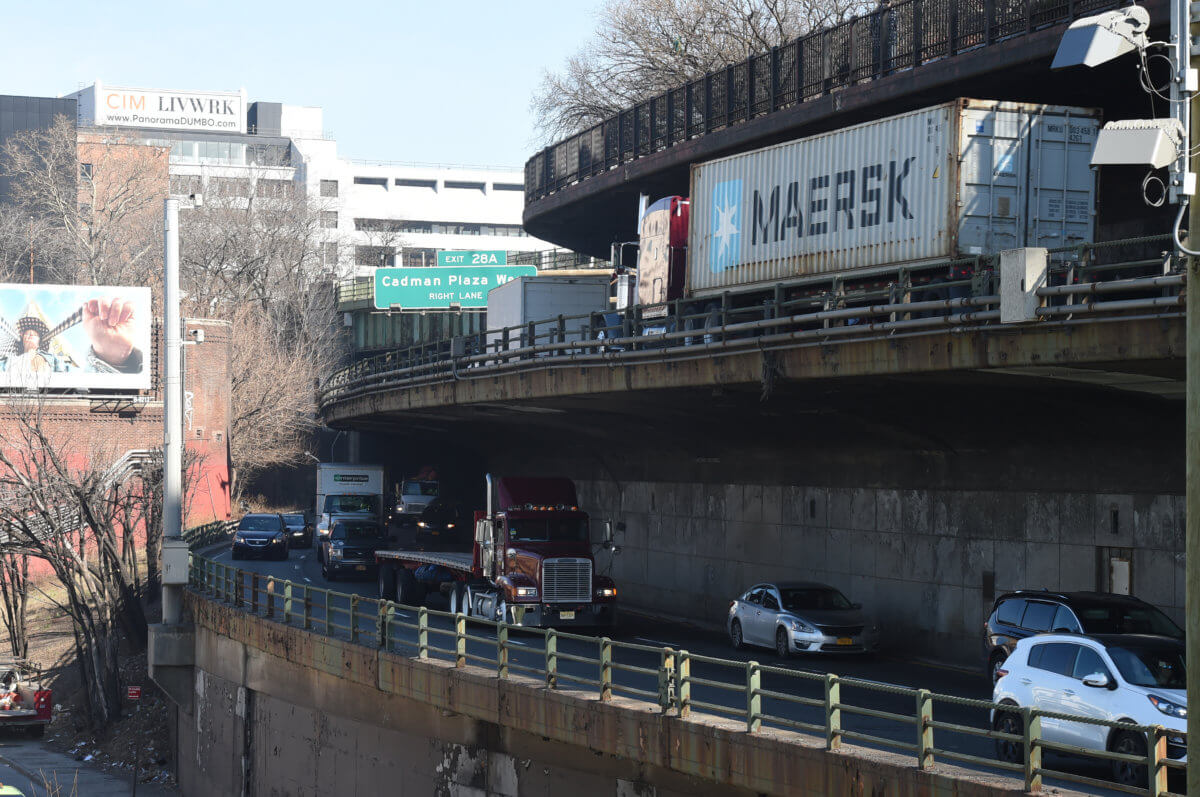
The Biden administration has rejected the city’s applications for $800 million in infrastructure grants to redesign and reconstruct the crumbling triple cantilever section of the Brooklyn-Queens Expressway, amNewYork Metro has learned.

The Federal Highway Administration (FHWA) rebuffed the city Department of Transportation’s (DOT) applications for grants under the Biden administration’s Infra and Mega programs last month, potentially imperiling the Adams administration’s hopes to redesign and rebuild the widely-maligned triple cantilever section of highway in Brooklyn Heights over the next few years.

The 1940s-era highway constructed by “master builder” Robert Moses has been deteriorating for decades, and in 2020, an “expert panel” convened by former Mayor Bill de Blasio warned the cantilever could be unsafe for travel as early as 2026.

After numerous false starts, in 2022 the Adams administration unveiled a series of “reimagining” proposals for the 1.5-mile “BQE Central” section between Atlantic Avenue and Sands Street, which includes the 0.4-mile cantilever and is the only part of the highway directly owned by the city.

The plans — which would cost around $5.5 billion, and would rely significantly on federal money authorized by the 2021 Bipartisan Infrastructure Law — called for either a partial or total reconstruction of the cantilever and to cover it up with greenspace, reconnecting Brooklyn Heights to the East River waterfront.


Monday, February 22, 2021

24 hours till City Council committee hearing on Planning Together and 9 reasons why to kill it


The Village Sun

 In 1961, Jane Jacobs, author of “The Death and Life of Great American Cities,” called city planning “a pseudo-science” that had “arisen on a foundation of nonsense.”

Jacobs argued for an end to gigantic plans that relied on “catastrophic money” and “centralized processes” and “standardized solutions.” All that, she argued, just created “dead places” —  like today’s Hudson Yards.

More recently, Sam Stein, in his book “Capital City: Gentrification and the Real Estate State,” chastised planners for serving the interest of Big Real Estate rather than the public good.

It is true that for all their talk of serving the public good, planners do appear to dislike citizens. For one, they are trained to think of citizens as generic NIMBYs standing in the way of their ideas. Moreover, as a profession, they tend to overly admire Robert Moses, the man who imposed his will on New York City in a way that was top-down, cruel and racist — not to mention plain destructive.

Moses’ defenders always respond, “At least he got something done,” and argue for more central planning power, skirting the issue of whether better plans might have been made in another way.

These issues have returned anew with the announcement of a proposed planning law that City Council Speaker Corey Johnson is promoting. The law is a very bad one. Citizens should definitely object to it, and stop this law before the city puts a new Robert Moses into power.

The purpose of the law is, to quote from it: “to prioritize population growth, where applicable, in areas that have high access to opportunity and low risk for displacement.”

“High opportunity,” “amenity rich” and “well-resourced” are code words among planners for overdeveloped neighborhoods in the historic core of the city —  Manhattan south of 125th St., Downtown Brooklyn, Brownstone Brooklyn around Prospect Park and the East River. (See Vicki Been’s report “Where We Live.”)

These are high-density, overdeveloped, often historic places with lots of subways, good schools, good parks, good grocery stores and short commutes to Midtown and the Financial District.

Oddly, these areas are also places where Big Real Estate profits are highest and where most of the new development since 2010 has already been built. Why then is the planning law so laser-focussed on driving growth to the already denser parts of the city, before the planning is even conducted? Why does a new all-powerful Director get to assign housing targets based on this high-opportunity theory? The law has planning exactly backwards.

We are supposed to use planning to figure out and debate where to put people (a.k.a. “density”) and infrastructure, not to do end runs around communities and drive new density to predetermined areas of the city!

Here are nine things wrong with the proposed “comprehensive planning” law:

1.) It fails to address the elephant in the room: the revolving door between Big Real Estate and government, thus undermining the legitimacy of the process. Big Real Estate has already captured many of the land-use regulatory agencies of the city; it thus imposes its vision upon us through its people who run the Department of City Planning, the Economic Development Corporation and the Board of Standards and Appeals. See, for example, my op-ed “Fox Guarding the Henhouse at City Planning.”

2.) The proposed law presupposes that the only way to deal with high housing prices is to obsessively build hyper-dense (and tall) near transit, which is what we have already been doing, based on a discredited trickle-down housing-supply theory. It’s a planning approach arising from a bad theory.

3.) It presupposes that the only way to deal with displacement risk is to build like crazy when, in fact, displacement risk needs to be managed in the first instance through legislation. Universal rent stabilization and the Good Cause Eviction Act would largely solve most of the displacement problem. Incremental building of more public-social housing units at the low end of the market would deal with the rest.

4.) It imposes Soviet-style housing targets on “low risk for displacement” neighborhoods, without having had binding public policy discussion about the upper limits or lower bounds of density. What kind of city do we want and how should we spread the benefits and burdens of density? The law presupposes that density can be infinite.

5.) The legislation presumes the scientific legitimacy of a dubious “index of displacement risk” that gets coded into law. This is just not credible. Such indices are built on a host of assumptions and not valid. Displacement risk is a political phenomenon as much as a market one.

6.) Also, the planning law ignores key questions for public debate. For example, when are we too dense to have a livable city? When are we not dense enough? How should density be distributed? Should it be distributed more evenly, like peanut butter on a slice of bread, or all piled up in the historic core? And who should decide these questions, the Director or the citizens of the city? All this is simply ignored, even though these questions are the very heart of planning!

7.) At no point can neighborhoods, residents, taxpayers and citizens vote on any plans at any time. There is no voting, no referenda, no democracy. In other words, the proposed law is profoundly anti-democratic.

8.) Under the proposed law, the housing targets for each neighborhood rely on a bad theory that Big Real Estate loves: New population growth should be targeted to existing “high-opportunity” areas. That’s an invitation for selective overdevelopment, leaving the historic parts of our city vulnerable to more demolition while ignoring the investment needs of currently “low opportunity” neighborhoods.

There is also this troubling fact: Residents of low-amenity neighborhoods have clearly said they don’t want to move. (See the city report “Where We Live.”) They want their existing neighborhoods to have amenities every bit as good as the neighborhoods in the core. They just don’t want to be gentrified out — or, rather, displaced.

9.) The law strengthens an already king-like mayor and recreates a too-powerful Robert Moses figure in the form of “The Director.” Citizens would not be able to reject this person.

 Procedurally, here’s how the planning system would work: The mayor would appoint a Robert Moses-like figure called “The Director.” The Director would produce research reports on a lot of topics, all required by the new law — which is O.K. Trouble arises when the Director is told by law to create housing targets (Soviet-style) for how much new housing each neighborhood (in high-opportunity/low-displacement areas) must produce.

The Director would create three scenarios for each neighborhood to accommodate their assigned housing targets. The City Council would pick one of the scenarios. If they said, “None of the above,” the Director would then pick a scenario for them. The scenarios would get bundled into a “comprehensive” 10-year plan for the entire city, approved by the City Council to become law.

Developers would have to convince the Director that a new development was consistent with the plan. If it was, they could avoid public review, citizen outcry or deference to the local councilmember for the particular project. A few public hearings are built into the process, but they are just advisory white noise, like they are today. Citizens and taxpayers never get to vote on the plan.

While this procedure sounds plausible for things like roads, schools, transit, parks, trash disposal, libraries, sewage treatment and tunnels, this plan is not really about those things. It’s really about requiring each neighborhood to fill those assigned housing targets.

The law creates new committees to work with the Director, with trivial, advisory roles. For example, the mayor, borough presidents and the City Council would appoint a 13-member “long-term planning steering committee” made up of demographically diverse “experts.” Their role would be to give advice to the Director — who could ignore it. The steering committee would also appoint five borough committees, which would provide borough-specific feedback at various points in the planning process. Their advice would also just be white noise. Community boards would do nothing different than what they do now.

  You can sign up to testify in person or submit written testimony here.


Monday, June 3, 2013

Building a mall not the walk in the park the Wilpons think it is

We've been hearing that some "ironclad" agreement between Robert Moses and the Mets allows for the Wilpons and Related to do pretty much whatever the hell they want with the public parkland next to CitiField, but the Urban Justice Center sent a letter to their lawyers that explains why that isn't the case.

From Willets Point United:

Urban Justice Center letter to Sterling-Related


This is just starting to get interesting, folks!

By the way, Flushing Meadows recently lost 358 acres...

Saturday, April 27, 2013

Putting the "barrier beach" back into Rockaway


From Capital New York:

Walter Meyer, a surfer, sometime-Rockaway resident, and urban designer, has an idea on how to protect the Rockaways from some of the devastating impacts of the next Hurricane Sandy, and he says the city is listening.

Before Hurricane Sandy lifted the boardwalk from its moorings and sent it surging blocks inland, tearing at everything in its way, swimmers and sunbathers had to cross the broad, Robert Moses-designed four-lane Shore Front Parkway, complete with a median, to reach the boardwalk to get to the beach.

Moses intended Shore Front Parkway to link Brooklyn to the Hamptons, but his plans never quite panned out. Today, the parkway is lightly used, and some of its lanes have been converted to parking.

Meyer wants to halve the width of that parkway and turn it into a regular two-way, two-lane road, so that the city can build a dune forest on its southern half.

That dune system would host a forest of pitch pine, that, like the coconut palm tree of warmer climates, develops roots that lock together, holding the beach in place and creating a formidable bulwark against future floods. A typical dune forest would take two to three summers to become operational.

“But once it gets locked in, it’s amazing how strong and resilient it is,” said Meyer.

Closer to the edge of the water he's recommending the city create another, lower wall of dunes, these planted with a collection of fast-growing sand grasses that are naturally resistant to high wind and heavy salt water. The grasses, if planted soon, could be well-established by next summer.

“The primary dune is protecting the secondary from wind, and the secondary dune is protecting the primary dune from disappearing into the sea,” said Meyer.

In between the two sets of dunes, Meyer thinks the city should build a “beachwalk,” using a sort of glue pioneered in the aftermath of the first Gulf War to harden the sand into a crust and thereby prevent tanks from getting stuck.

The beachwalk would be wide enough to accommodate ambulances and bikes and pedestrians.

Tuesday, December 4, 2012

Developing Flushing Meadows would be an ecological nightmare


From the Daily News:

Because Bloomberg understands climate change so well, it is baffling that his administration has signed on to development plans for Flushing Meadows that are alarming — the construction of new stadiums, roads, parking lots and a massive mall in the park.

These construction projects will substantially increase the percentage of impervious surface cover (materials that do not absorb water) in the park as green spaces are converted to structures (stadiums and malls) and concrete roads, parking lots and walkways. Any gains against pollution runoff and flooding in the Meadow and Willow Lake watershed will be damaged by these developments, and storm runoff into Flushing Bay will likely increase.

Such development will also further damage Flushing Meadows’ historical role as a marshy buffer against storm surge and coastal flooding, placing residents and businesses located near Flushing Meadows in a more vulnerable position during extreme weather events. Do the developers of the soccer stadium have plans to address the potential damage from flooding to surrounding neighborhoods wrought by their work?

Flushing Meadows-Corona Park is no stranger to bold plans that usher in major changes. However, these new developments resemble the worst excesses of Robert Moses rather than his success in originally creating the park. True boldness requires further protective wetland restoration in the park.

Sunday, December 2, 2012

Is this in our future?


From the Daily News:

Picture an 80-foot rock barrier rising from the Atlantic Ocean, stretching for 5 miles from Breezy Point, Queens, to Sandy Hook, N.J. — and topped with a new highway.

Or a 1,700-foot wall spanning the Arthur Kill, featuring a pedestrian walkway, a bike path, hydroelectric power and a system of locks for passing ships.

Or maybe a towering structure in the shadow of the Verrazano Bridge, with the Statue of Liberty as a backdrop, complete with twin 640-foot gates.

In post-Sandy New York, plans to harness New York Harbor and its surrounding waterways with such multibillion-dollar projects almost instantly turned more tangible than theoretical.

In the search for answers, it’s now like Robert Moses is battling King Poseidon in the globally-warmed waters around the nation’s largest city.

Proponents suggest the barriers — already successful in Russia’s St. Petersburg and across the flood-prone Netherlands — could prevent a disaster repeat.

Count City Council President Christine Quinn among that group. She’s proposed a $16 billion storm surge barrier as part of a possible plan to safeguard the city.

Count Mayor Bloomberg among the skeptics. After Sandy, he noted that “you can’t build a wall up to the sky.”

But you can build one to lessen the impact the next time a hurricane hits town, engineers and experts say — and the city has already endured two in as many years.

Sunday, August 5, 2012

The return of Robert Moses

From City Limits:

Restaurants, stores, and a 200-room hotel would go up on the Willets Point side of 126th Street, just east of Citi Field, though the city does not entirely own the property. The proposed shopping mall west of the stadium may face a larger hurdle: The parking lot is part of Flushing Meadows Corona Park. State law requires the alienation of parkland before it can be used for non-park purposes.

To meet that requirement, Bloomberg has reached back to a law passed 51 years ago, summoning an uncertain ally in the ghost of Robert Moses. But questions surround this curious piece of legislation, setting up the latest in a string of disputes over city-sponsored developments on public parkland.

"Yes, this area is parkland," says Benjamin Branham, a spokesman for the city's Economic Development Corporation, "but development is permitted under the 1961 law that authorized the construction of Shea Stadium—known as Administrative Code 18-118—which also allowed for additional uses to be built on the parking lot. It's important to be clear the authorization comes from this law as opposed to a contract or other agreement of some kind."

Yet, as recently as 2001, New York's highest court ruled parkland can't be taken, even for temporary use, without an explicit act of alienation passed by the state Legislature and approved by the Governor: "[O]ur courts have time and again reaffirmed the principle that parkland is impressed with a public trust, requiring legislative approval before it can be alienated or used for an extended period for non-park purposes."

Moses presided over the 1961 groundbreaking for Shea Stadium. He had originally offered to build the municipal arena in Flushing Meadows for the Brooklyn Dodgers and resurrected the plan when the city pushed for a new National League franchise.

The state Legislature approved his building of Shea Stadium in the park, but its 1961 legislation was primarily aimed at granting the city authority to issue bonds to finance construction. It loosely laid out the permitted uses for the stadium and grounds, listing "recreation, entertainment, amusement, education, enlightenment, cultural development or betterment, and improvement of trade and commerce." The law even allowed the city to use the site for "any business or commercial purpose," so long as this activity "aids in the financing of the construction and operation of [the] stadium, grounds, parking areas and facilities" and "does not interfere with the accomplishment of the purposes referred to" above.

"The bill reads like a Robert Moses special," says Geoffrey Croft of the watchdog group NYC Park Advocates. The broad powers it conferred were a hallmark of the Power Broker, who was so well-practiced in the black art of political legislating that Al Smith once called him "the best bill-drafter I know." The Parks Commissioner could enter into agreements to use part or all of the stadium grounds, but any agreements lasting for more than a year had to be approved by the Board of Estimate, which included the mayor, the comptroller, the City Council president, and all of the borough presidents.

In 1989, the U.S. Supreme Court found the Board of Estimate unconstitutional, because it violated the “one man, one vote” rule—for example, the borough president of Brooklyn (the city’s most populous county) had no more power than the borough president of Staten Island (the least populous county). With the elimination of the Board of Estimate, the city's Law Department says, the power of site approval under the 1961 Shea Stadium law now rests solely with the mayor. A shopping mall may not offer the "enlightenment" referenced in the text, but a Bloomberg administration spokesperson describes the new project as a "retail/entertainment complex" benefiting “trade and commerce.”


Don't you love how the city has no money for needed services for existing neighborhoods, yet has tons of cash to throw around in an attempt to justify park alienation in order to realize a Bloomberg legacy project? Why doesn't the billionaire pony up his own cash and buy out the Willets Point property owners? Then he can build whatever the hell he wants.

Leave the damn park alone.

Friday, August 13, 2010

What happened to Flushing's famous Cedar tree?

Cedar of Lebanon. Flushing, NY, 1916

Cedar of Lebanon 1924

Robert Moses did heed the call, and made a change to the City Map to show that site in Flushing was intended to be park land. But, alas, that could not save the tree.

From the NY Times:

Another of Flushing's famous trees, a 200-year-old cedar of Lebanon that survived developers but not nature. Killed by a lightning bolt in 1934, the tree was hewed 12 years later into "fireplace seats" and "memorial logs," according to a 1946 article in The Long Island Star Journal.

In 1947, the land was sold to developers and housing development was built where the park was supposed to have been.

1951

Wednesday, August 11, 2010

Flushing Commons & Sky View Parc lack financing

From the Neighborhood Retail Alliance:

In last week's WSJ, the paper covered the city council vote on Flushing Commons and got the following interesting quote from an ebullient Mike Myer: "In Flushing, the council approved rezoning for Flushing Commons. The $850 million project includes 600 residential units, 185,000 square feet of offices, 235,000 square feet of retail space, 1,600 underground parking spots and a 1.5-acre public green space. In 2005, co-developers Rockefeller Group Development Corp. and TDC Development Corp. won the bid to build on the city-owned site, and have worked since on rezoning and a plan to compensate businesses that will be affected by construction. "It was a Herculean effort," said TDC President Michael Meyer before the vote. "We've gone through two real-estate cycles…Starting tomorrow, we'll go out and look for financing."

So, let's get this straight. The developer was awarded this bid and got city council approval without any guarantee that the project is financible in this current economic climate-and what happens in case of a default? Has EDC built into the disposition any fail/safe provisions that will allow the city to reclaim the property should TDC be unable to fulfill its obligations in a timely manner? But perhaps, the city planning to convey the property to the developer without any strings attached?

Now Mr. Myer, as clever and slippery a character as we have seen-full of false bonhomie- was asked repeatedly during the ULURP process about his organization's fiscal capabilities. And, according to those at the various hearings on the land use application, the ever shifty realtor did what he does best-he shucked and ducked. But that was land use-and now we are going to have to determine the procedures for disposing of the muni lot property-and questions of financial viability should be front and center.

In addition, there is the further potential that the developer will have its funding stream collapse in the middle of construction-after the parking structure is demolished-leaving only a Robert Moses style hole in the ground. Is the city protected in case of this eventuality? Even more so, are the Union Street and other Flushing merchants going to be indemnified-not by the city-but by the developer should this kind of parking disaster occur?

And what ever happened to the 17 stipulations that CB #7-and the Queens BP promulgated? Well, one thing we know for sure is that they have been disappeared in the course of the land use review. How do these entities feel about being totally ignored-after being used as "supporters" of Flushing Commons?" And, since they will be central to the borough board process, will they be looking to amend the disposition agreement to incorporate some of the stips that were agreed to?


And over at Sky View Parc...

From the NY Post:

The developer of the mam moth, $1 billion-plus Sky View Parc condo-retail complex in downtown Flushing is scrambling to borrow nearly $150 million so it can complete the first phase of the project -- drastically overbudget and behind schedule.

Sky View Parc was conceived as something new in Queens: a luxurious, 1,000-unit residential enclave designed to exploit Flushing's status as a thriving center of Asian and Asian-American life. Residents would enjoy a private elevated park and pool, and shoppers would flock to 795,000 square feet of big-box type stores.

But according to a summary for participants in a senior lenders' meeting on June 16, "total cost overruns" on Sky View Parc, which started work in 2007, were $160,802,000 as of last December -- compared to the original budget for the project's first phase, which a source estimated at $600 million.

Now, the project's general partner, Onex Real Estate Partners, is seeking to restructure a $519.3 million construction loan to extend the term by three years and to borrow an additional $144.6 million.

So far, several lenders have not yet agreed to a restructuring plan by Eurohypo Bank AG and Wells Fargo. While the original loan might have been exhausted, work continues, thanks to equity Onex pumped in -- but long-term restructuring is deemed critical.

Tuesday, July 20, 2010

Flushing Meadows garden named for David Oats

From the Queens Tribune:

A red-tailed hawk swooped low across the open space between the Queens Theatre in the Park and the Queens Museum. Bees buzzed, collecting pollen from the freshly planted flowers and shrubs that make up the newest addition to Flushing Meadows Corona Park – David’s Garden.

Created to honor David Oats, the long-time editor of the Queens Tribune and a steadfast advocate for his beloved Flushing Meadows Corona Park, the garden was dedicated Wednesday afternoon by local officials with Oats’ widow, friends and park advocates on hand.

Oats, who helmed the Tribune over parts of three decades, grew up near the park, and as a 12-year-old snuck in during construction of the 1964-65 World’s Fair. He was brought to City power broker Robert Moses to get a stern talking to, but instead the two struck up a friendship centered on the park, and for the rest of his life, Oats was dedicated to honoring Moses by ensuring the proper upkeep of their beloved patch of green land.

Oats spent four decades advocating for the protection and improvement of the borough’s parks. He was founder and president of the Flushing Meadows Corona Park World’s Fair Association, with Moses as its first chair.

Thursday, June 24, 2010

Astoria pool to get an overhaul

From the Daily News:

A historic city pool that legendary planner Robert Moses considered a feather in his cap is in line for a multimillion-dollar restoration.

City Councilman Peter Vallone Jr. (D-Astoria) and the Parks Department recently began drafting a master plan to refurbish much of the Astoria Park Pool and Play Center, and explore year-round uses for the vaunted space.

"It's a very exciting opportunity and it's a wonderful facility, and we're very thrilled," said John Krawchuk, director of historic preservation for the Parks Department.

Officials are collecting community feedback on how to restore the center, which includes an Olympic-sized swimming pool and a diving pool that has not been used since 1980.

"Whatever happens at the diving pool location will be a huge improvement over the dilapidated eyesore that stands now," Vallone said.

The department and Vallone hosted a listening session at the Greater Astoria Historical Society on June 9 to gather suggestions from the public.

"One idea was to create some sort of outdoor amphitheater where we can provide entertainment at one of the most beautiful backdrops possible," Vallone said.

Other ideas included opening an ice-skating and hockey rink for the winter months, and building a bowling alley.

Restoring and reopening the diving pool is another possibility.

Monday, May 10, 2010

Queens Blvd is no Eastern Parkway

From City Weaving:

I am familiar with big roads. Coming from the land of sprawl and automobiles, I’m no stranger to vast expanses of asphalt and fast-moving vehicles, but it didn’t take long for me to realize that Queens Boulevard is a different animal than what I’m used to. When I came to New York City from Texas, I happened to move about two blocks away from the so-called “boulevard of death,” and it has been a presence in my life on a daily basis, but I can still remember the first time I had to go to Brooklyn and took Eastern Parkway instead of the BQE. The light bulb went off in my head.

“Oh!” I said. “This is what it should have been.”

Now, I understand (and I’m sure Robert Moses would tell me) that there are technical, functional, and historical differences between these two roads, especially regarding the manner in which they both came into being, but I think it’s truly a shame that Queens Boulevard couldn’t have been envisioned as a parkway from the get-go. Parkways are, after all, just glorified and vegetated boulevards.

The point of all this, really, is that Queens Blvd has always had the size and importance accorded to a main East/West corridor (and has amazingly always had the twelve or more lanes of traffic it boasts) but never the kind of consideration for other forms of traffic–pedestrian, bicycle, equestrian–that Eastern Parkway does. Queens Boulevard came into being when parkways were already an established form of road-building (Eastern Parkway having been the first), but it was clearly viewed as a more stripped-down piece of infrastructure.

Sunday, February 28, 2010

Malba's traffic problem

From the Times Ledger:

When Robert Moses built the Cross Island Parkway in the 1930s, cars taking what is now called the Third Avenue exit were able to enter the quiet neighborhood by 7th Avenue, a 70-foot-wide road Moses built to handle the anticipated traffic in the area.

That changed as the years passed. First, 7th Avenue was blocked from exiting traffic and in 1997 a divider was extended to keep highway traffic off Sixth Avenue.

As such, many residents say 3rd, 4th and 5th avenues have turned into speedways, with parents afraid to let their children play in their yards along the tree-lined streets.

So the Malba Gardens Civic, a group with dozens of members in the immediate area, sent out a poll asking area residents what should be done to address the situation, after which they proposed the city convert 4th and 5th avenues between Whitestone Expressway and 147th Street to one-way.

Maura McCarthy, the city Department of Transportation’s Queens borough commissioner, attended the meeting to respond to the civic’s proposal. She said since an October 2009 meeting when she first heard the concerns, the DOT has done several studies.

The department found that 107 cars passed down 5th Avenue between 2 p.m. and 3 p.m. at an average of 27.9 miles per hour, with 31 percent of drivers speeding. But 3rd Avenue was more affected by traffic problems, the study showed, as 152 vehicles drove on the street between 4 p.m. and 5 p.m. on the day of the study, while only 13 drove on 4th Avenue in the same period. Between 2004 and 2008, six car crashes occurred on 3rd, zero on 4th and two on 5th.

McCarthy said the city would not automatically make changes to the streets based on those statistics and that proposals to install stop signs or traffic lights are untenable as the volumes do not reach required thresholds.


DOT: Good at wasting time with studies. Bad at improving traffic.

Gene - nice bag. Prada or Gucci?

Wednesday, December 2, 2009

Video: Robert Moses - Master Builder


This answers some of the questions that you may have about why certain things are the way they are in this city and beyond. Great video. Bravo.

Saturday, November 28, 2009

Robert Moses and the Astoria Pool

From the Daily News:

Master builder Robert Moses was in high gear in 1936, effortlessly spending truckloads of federal money as fast as he could, not only finishing up the enormous Triborough Bridge project but also installing splendid new public swimming pools all over town for the pleasure of the good people of New York - nearly a dozen of them, one a week all summer long. Most splendid of them all was the Astoria Pool, on the Queens side of the big bridge, right down in its very shadow. Characteristically Mosesean, the pool was said to be the nation's largest - 330 feet long, 165 feet wide, its 1.8 million gallons of water handily accommodating more than 3,000 bathers - and it was stunningly futuristic, boasting of all things underwater lighting, unheard of at the time. Well, it happened to cost nearly $4 million, in 1936 dollars, but then President Franklin Roosevelt's Works Progress Administration had bucks to burn. Opening day was Saturday the Fourth of July, just a week ahead of the overhead Triborough, and if it was the Master Builder's lot not to be universally loved all his long life, on this particular occasion at least he won the hearts of many thousands of New Yorkers, since, amid the scorchingest summer in years, he ordered the Astoria and the other new pools not to close till midnight.

Wednesday, August 19, 2009

Bronx golf boondoggle gets worse

From CBS 2:

Rudy Giuliani's dream of building a highfalutin Jack Nicklaus-designed golf course on the site of a toxic waste dump in the Bronx has become Michael Bloomberg's nightmare, but the city is still going through with it even though it's $100 million over budget and is expected to be at least 12 years late.

"It is a complete waste of money. It's a boondoggle and it's something that never should have gone forward," said Geoffrey Croft of the NYC Park Advocates.

There are a lot of questions. Like what happens if the golfers hit their balls into the cemetery next door? Who wants to play on a toxic waste dump? And how much will it cost? The original plans called for charging $120 for a single round of golf. The Black Course at Bethpage, where the U.S. Open was held this summer, charges $60 on weekends. Weekdays are cheaper.

So who can afford to pay $120 for a round of golf?

"The mayor and the real estate developers -- certainly not the people who live around here," Croft said.

An avid golfer, the mayor said the city still plans to build the course, though it is, as he said, "embarrassingly" delayed and has a new problem.

"What we don't have is a developer who's willing to build the clubhouse and that's the problem at the moment," Bloomberg said.

And here's the rub: if contractors don't meet their targeted completion date, which is four years from now, it will be another mayor's problem.

The original development plans were drawn up by Robert Moses in 1949. He promised a sandy beach, lots and lots of public parkland and a tiny golf course.

Oh, how things have changed.


Someone is assuming Bloomberg will still be mayor 4 years from now. Heh.

Tuesday, August 18, 2009

The second coming of Robert Moses?

From the NY Post:

Call him the new Moses -- Robert Moses, that is.

Mayor Bloomberg says that since 9/11 he has tried to transform the city on a scale not seen since the days of the legendary and controversial master builder of highways, bridges and parks that changed the metropolitan landscape.

"I think if you look we've done more in the last seven years than -- I don't know if it's fair to say more than Moses did -- but I hope history will show the things we did made a lot more sense," Bloomberg tells The New Yorker.

"You know, Moses did some things that turned out not to be great: cutting us off from the waterfront, putting roads all along the water," he adds.

"Thanks to his money, Bloomberg has managed, perhaps more than any other Democratic politician ever before, to govern strictly with what he considers to be the greater good in mind," the magazine writes.

But the money has also served to curb New York's usually lively political discussion, it says.

A Democratic political consultant tells the magazine, "He's probably been a fine mayor, but he seems a lot better because all the usual agitators -- groups that exist to drive a mayor crazy -- have in one way or another been bought off.

"It's amazing the climate you can have when nobody is criticizing you," the consultant adds.


At least Robert Moses created actual parks and didn't pretend that streets and schoolyards were an acceptable alternative to parks. Anyway...

From the New Yorker article:

Neither the stadium nor the Olympics came to fruition, and, instead of great architecture, retrofitting is at the top of the agenda. Cataclysmic events like September 11th and the current global financial crisis have a way of occasioning revisionist thinking, and in the early months of this year, after the shock of the prospective third term had subsided, a more skeptical narrative of the Bloomberg mayoralty began to surface, in which he appeared less like Batman and more like a beneficiary of larger social and economic forces. One Manhattan businessman, after warning that he would say only “extremely positive” things for attribution, suggested that just about anyone could have been mayor from 2002 to 2008 and overseen sustainable development and growth. As the former Times columnist Joyce Purnick writes in a new book, “Mike Bloomberg: The Mogul and the Mayor,” to be published next month, “Ed Koch had cracked the eggs, Giuliani had made the omelet, and then Bloomberg appeared, and served it.”

The re-assessors rattle off similar lists of unfulfilled projects to imply that the verdict on grand-scale transformation is far from certain. The World Trade Center remains unbuilt, the conversion of the old Post Office on Eighth Avenue into a new Penn Station—Moynihan Station—is stalled, and the real-estate giant the Related Companies has had to postpone financing for the Hudson Yards project on the West Side, where the stadium was to have gone. If Atlantic Yards, a proposed remaking of downtown Brooklyn centered on the relocation of the New Jersey Nets basketball team, ever proceeds, it will be greatly diminished, and without the participation of Frank Gehry, whose involvement was originally used as a selling point. The rezonings, which amount to an impressive one-sixth of the city’s total land area, await the next boom cycle, but their primary imprint on the skyline, thus far, can be seen in luxury condominium towers and garish McMansion co-ops in Brooklyn and Queens that now seem emblematic of an unrealistic age when Wall Street money accounted for thirty-five per cent of the city’s earnings.

Who would have guessed, back in 2002, when the businessman Mayor seemed to regard recycling as a discretionary luxury, that his physical legacy might come to be defined as much by the planting of a million trees and by lawn chairs in the middle of Times Square as by gleaming (and empty) new office towers?


New York Magazine takes a closer look at Bloomie's bitchiness.