Showing posts with label Planning Together. Show all posts

Wednesday, March 24, 2021

Paul Graziano calls out Deputy Mayor Vicki Been during protest against Planning Together


The Village Sun

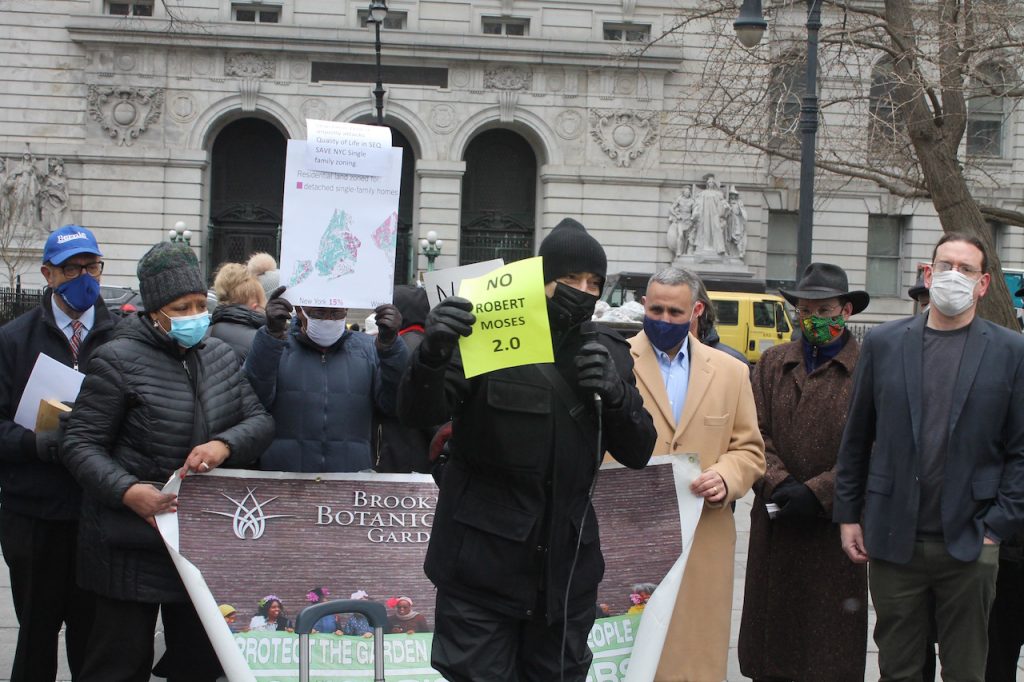
  Activists slammed Corey Johnson’s long-range planning bill as a “Trojan horse” for developers at a rally outside City Hall on Tuesday.

The temperature was freezing but passions were heated as speaker after speaker blasted the bill, Intro 2186, the City Council speaker and Mayor de Blasio at the press conference, organized by the Citywide People’s Land Use Alliance.

They derided the 10-year comprehensive planning initiative as “top-down” and “one-size-fits all.” They charged that it would cut the community out of the process and legally empower an unaccountable “director” to ram through district planning schemes — if necessary, over the objections of community boards and local councilmembers.

Most chilling to them was the fact that Intro 2186 would force mandatory upzonings every decade for every single community board in the city — in short, codifying an unstoppable development juggernaut.

Dozens of organizations supported the rally, from East River Park Action, Bowery Alliance of Neighbors, the Soho Alliance and the Seaport Coalition to Preserve BAM’s Historic District, Voice of Gowanus, Inwood Preservation and Stop Sunnyside Yards.

Alicia Boyd of the Movement to Protect the People, which is fighting a development project that threatens the Brooklyn Botanic Garden, said the citywide plan is being spun as something that will help low-income black and brown people, when, in reality, it will mainly lead to an explosion of luxury development.

“This bill is being presented as an equalizer,” she railed. “Mandatory Inclusionary Housing is a failure. It’s a Trojan horse! This is not an anti-racist plan. This is not an anti-displacement plan. This is a displacement plan. We are tired of the scams [about] affordable housing.”

Paul Graziano, a Queens native and planning consultant, has played a role in helping contextually rezone much of Queens to keep overdevelopment in check.

“It’s been three months since Corey Johnson dropped this bombshell,” he told the rally. “This bill is not a comprehensive planning bill. It’s a comprehensive overdevelopment bill. It’s a comprehensive real estate bill. I have gone through this bill with a fine-tooth comb.”

In short, Graziano said, rezonings make the “speculative value” of property go up.

The Mandatory Inclusionary Housing included in the rezonings is a “scam,” he said.

“M.I.H. has not worked,” he said, “because there is no deep affordability. And it’s set up as a real estate program.”

 Graziano blasted Vicki Been, de Blasio’s deputy mayor of housing and economic development, calling her the engineer of the current upzonings. He said a report Been headed at New York University’s Furman Center for Real Estate and Urban Policy has been used “to justify upzonings for the last eight years.”

“Eighty percent of her data is wrong,” Graziano said. “You’ve got this administration running this phony agenda and you’ve got “Planning Together” looking to lock it in for 10 years. This horrendous bill…will lock it in.

“Planning Together” is a report, released in December, on which Intro 2186 was based.


Tuesday, March 2, 2021

How to Talk Out Both Sides of Your Mouth, by Adrienne Adams

If you made it to the end of the video posted yesterday, you witnessed Adrienne Adams do a song and dance over how great Planning Together is and how much more input community boards will supposedly get in the land use process should the bill be passed into law. The video above is bookmarked to where she adamantly asserts this. Then at the end of the hearing, after community board representatives and constituents trashed the bill, her demeanor did a 180.

"Somebody said you didn't hear from your elected officials. We wanted the narrative to go around. So that was very intentional."
That is simply the biggest bunch of malarkey EVER. Elected officials don't withhold information from their constituents in order to further the conversation, they do it to squelch opposition. You were given marching orders to keep mum.

"We wanted to make sure that this legislation was scrutinized from A to Z."
You wanted to slip this bill past the goalie so you didn't bother to notify the public or community boards that it was taking place and they had to find out from a leaked email to council members.

"If we don't have the voice of the people behind this as you all noticed, if you look at who is sponsoring this legislation and I believe it's only one person from Queens on this bill, there's a reason for that as well."
Well, finally a bit of truth!

Adrienne Adams wants to be the next Speaker of the City Council, so she is trying to be a good foot soldier for county and for REBNY. But her constituents are not stupid, so she has to try to play both sides. And guess what? With Ruben Wills back in the picture, she now has to raise money for re-election, nevermind worry about the speaker's race. Calling Marisa Lago "duplicitous" while talking out both sides of your mouth? Hey pot, the kettle's calling.

Monday, March 1, 2021

CoJo in a tizzy over perceived bill "misinterpretation"

By this point during the Planning Together hearing, Corey Johnson had grown very frustrated at how cool, calm and collected Marisa Lago was under fire. You can tell because he jumps in the middle of her answering Adrienne Adams' question and goes on a diatribe. Not once, but twice!

If this bill was so great, it wouldn't be misinterpreted.

It's a bit paternalistic for carpetbagging white men like Corey (Massachusetts) and Brad Lander (Missouri) to be informing everyone else that they know exactly what's in their best interest and it involves a bill they simply must pass in their waning days in the Council while they are campaigning for higher office.

Check out Adams' attitude toward the end as well. Tomorrow, we'll delve further into her unenviable predicament. It involves a tweeding dilemma.

Saturday, February 27, 2021

Reynoso doth protest too much

Council Member Antonio Reynoso laced into City Planning Chair Marisa Lago for not supporting the Planning Together legislation but conveniently dismisses his past decisions with regard to land use.

Case in point: He seems to want to expand affordable housing stock, yet famously settled for 8 meager units of affordable housing for an 88-unit project in Ridgewood and then said nothing when the developer pulled a fast one on the affordability.

Furthermore, the land use process starts and ends with the City Council. The council member is lobbied before rezonings ever see the light of day, then they have the final say on whether or not a plan passes into law. So asking the chair of city planning why this horrible process hasn't changed is blue chip deflecting.

This man's chameleon-like behavior and disrespectful demeanor make him unfit to be Brooklyn borough president, which is what his grandstanding is about.

Wednesday, February 24, 2021

Alpha-male Brad Lander loses his shit during Planning Together hearing

Brad Lander's toxic masculinity was on full display at the Planning Together City Council hearing yesterday as he ranted and raved and laced into City Planning Director Marisa Lago for tesifying against the bill and giving answers to questions that he didn't like.

You will notice that he uses imagery of "the frog in the boiling pot" 8 times and mentions the "toxic land use process" 5 times. This is very well rehearsed phony outrage.

"All that charter revision did was a 30-day email in advance of a planning process..."
As compared to the City Council not notifying anyone prior to the hearing you are participating in?

"There's no way that communities are going to show up with their hands raised and say 'We'd like to do our fair share, let's engage in planning.'"
That's exactly what was done during the Bloomberg years using the current rezoning process - until Bill de Blasio imposed his will and cut the community out of the picture.

"If you're just going to sit here and criticize this proposal..."
Well yeah, it's YOUR legislation that the hearing is about, so everyone is going to testify about its merits.

"I don't get to ask anymore questions, but you can still go ahead and continue."
Then as she is answering, he interrupts and asks more questions.

So we have an overbearing white guy who wants to be Comptroller berating a very polite and professional and distinguished senior Hispanic female. Bad optics, Brad. And here we thought people from the Midwest were respectful. How about instead of running for Comptroller, you go back to St. Louis and mess with their land use?

Lander is so heated and stupid he doesn't even (or refuses to) see the irony while he repeatedly talks about toxic land use process when the zoning he's so desperate to get for his real estate overlords is the superfund site in Gowanus.-JQ LLC

Tuesday, February 23, 2021

Just a thought following City Council's "Planning Together" shitshow...

De Blasio opposed to ridiculously expensive Planning Together

From the Daily News: The de Blasio administration is opposing a City Council proposal to simplify the process for future development, saying legislation from Council Speaker Corey Johnson would be way too expensive. The bill...would cost the city about half a billion dollars per decade, the administration estimates — and that at a time of shrinking tax revenues due to the coronavirus outbreak. In the administration’s reading of the bill, every community district in the city would have to undergo assessments of three different development scenarios every 10 years. With an average “environmental impact assessment” costing $2.5 million to carry out, and the city having 59 community districts, that comes to about $450 million per decade, according to the administration. It also estimates the cost of staffing the undertaking would add another $50 million, not counting costs to the Office of Management and Budget. De Blasio officials including Planning Commissioner Marissa Lago are expected to testify against Johnson’s bill on Wednesday.

Monday, February 22, 2021

24 hours till City Council committee hearing on Planning Together and 9 reasons why to kill it


The Village Sun

 In 1961, Jane Jacobs, author of “The Death and Life of Great American Cities,” called city planning “a pseudo-science” that had “arisen on a foundation of nonsense.”

Jacobs argued for an end to gigantic plans that relied on “catastrophic money” and “centralized processes” and “standardized solutions.” All that, she argued, just created “dead places” —  like today’s Hudson Yards.

More recently, Sam Stein, in his book “Capital City: Gentrification and the Real Estate State,” chastised planners for serving the interest of Big Real Estate rather than the public good.

It is true that for all their talk of serving the public good, planners do appear to dislike citizens. For one, they are trained to think of citizens as generic NIMBYs standing in the way of their ideas. Moreover, as a profession, they tend to overly admire Robert Moses, the man who imposed his will on New York City in a way that was top-down, cruel and racist — not to mention plain destructive.

Moses’ defenders always respond, “At least he got something done,” and argue for more central planning power, skirting the issue of whether better plans might have been made in another way.

These issues have returned anew with the announcement of a proposed planning law that City Council Speaker Corey Johnson is promoting. The law is a very bad one. Citizens should definitely object to it, and stop this law before the city puts a new Robert Moses into power.

The purpose of the law is, to quote from it: “to prioritize population growth, where applicable, in areas that have high access to opportunity and low risk for displacement.”

“High opportunity,” “amenity rich” and “well-resourced” are code words among planners for overdeveloped neighborhoods in the historic core of the city —  Manhattan south of 125th St., Downtown Brooklyn, Brownstone Brooklyn around Prospect Park and the East River. (See Vicki Been’s report “Where We Live.”)

These are high-density, overdeveloped, often historic places with lots of subways, good schools, good parks, good grocery stores and short commutes to Midtown and the Financial District.

Oddly, these areas are also places where Big Real Estate profits are highest and where most of the new development since 2010 has already been built. Why then is the planning law so laser-focussed on driving growth to the already denser parts of the city, before the planning is even conducted? Why does a new all-powerful Director get to assign housing targets based on this high-opportunity theory? The law has planning exactly backwards.

We are supposed to use planning to figure out and debate where to put people (a.k.a. “density”) and infrastructure, not to do end runs around communities and drive new density to predetermined areas of the city!

Here are nine things wrong with the proposed “comprehensive planning” law:

1.) It fails to address the elephant in the room: the revolving door between Big Real Estate and government, thus undermining the legitimacy of the process. Big Real Estate has already captured many of the land-use regulatory agencies of the city; it thus imposes its vision upon us through its people who run the Department of City Planning, the Economic Development Corporation and the Board of Standards and Appeals. See, for example, my op-ed “Fox Guarding the Henhouse at City Planning.”

2.) The proposed law presupposes that the only way to deal with high housing prices is to obsessively build hyper-dense (and tall) near transit, which is what we have already been doing, based on a discredited trickle-down housing-supply theory. It’s a planning approach arising from a bad theory.

3.) It presupposes that the only way to deal with displacement risk is to build like crazy when, in fact, displacement risk needs to be managed in the first instance through legislation. Universal rent stabilization and the Good Cause Eviction Act would largely solve most of the displacement problem. Incremental building of more public-social housing units at the low end of the market would deal with the rest.

4.) It imposes Soviet-style housing targets on “low risk for displacement” neighborhoods, without having had binding public policy discussion about the upper limits or lower bounds of density. What kind of city do we want and how should we spread the benefits and burdens of density? The law presupposes that density can be infinite.

5.) The legislation presumes the scientific legitimacy of a dubious “index of displacement risk” that gets coded into law. This is just not credible. Such indices are built on a host of assumptions and not valid. Displacement risk is a political phenomenon as much as a market one.

6.) Also, the planning law ignores key questions for public debate. For example, when are we too dense to have a livable city? When are we not dense enough? How should density be distributed? Should it be distributed more evenly, like peanut butter on a slice of bread, or all piled up in the historic core? And who should decide these questions, the Director or the citizens of the city? All this is simply ignored, even though these questions are the very heart of planning!

7.) At no point can neighborhoods, residents, taxpayers and citizens vote on any plans at any time. There is no voting, no referenda, no democracy. In other words, the proposed law is profoundly anti-democratic.

8.) Under the proposed law, the housing targets for each neighborhood rely on a bad theory that Big Real Estate loves: New population growth should be targeted to existing “high-opportunity” areas. That’s an invitation for selective overdevelopment, leaving the historic parts of our city vulnerable to more demolition while ignoring the investment needs of currently “low opportunity” neighborhoods.

There is also this troubling fact: Residents of low-amenity neighborhoods have clearly said they don’t want to move. (See the city report “Where We Live.”) They want their existing neighborhoods to have amenities every bit as good as the neighborhoods in the core. They just don’t want to be gentrified out — or, rather, displaced.

9.) The law strengthens an already king-like mayor and recreates a too-powerful Robert Moses figure in the form of “The Director.” Citizens would not be able to reject this person.

 Procedurally, here’s how the planning system would work: The mayor would appoint a Robert Moses-like figure called “The Director.” The Director would produce research reports on a lot of topics, all required by the new law — which is O.K. Trouble arises when the Director is told by law to create housing targets (Soviet-style) for how much new housing each neighborhood (in high-opportunity/low-displacement areas) must produce.

The Director would create three scenarios for each neighborhood to accommodate their assigned housing targets. The City Council would pick one of the scenarios. If they said, “None of the above,” the Director would then pick a scenario for them. The scenarios would get bundled into a “comprehensive” 10-year plan for the entire city, approved by the City Council to become law.

Developers would have to convince the Director that a new development was consistent with the plan. If it was, they could avoid public review, citizen outcry or deference to the local councilmember for the particular project. A few public hearings are built into the process, but they are just advisory white noise, like they are today. Citizens and taxpayers never get to vote on the plan.

While this procedure sounds plausible for things like roads, schools, transit, parks, trash disposal, libraries, sewage treatment and tunnels, this plan is not really about those things. It’s really about requiring each neighborhood to fill those assigned housing targets.

The law creates new committees to work with the Director, with trivial, advisory roles. For example, the mayor, borough presidents and the City Council would appoint a 13-member “long-term planning steering committee” made up of demographically diverse “experts.” Their role would be to give advice to the Director — who could ignore it. The steering committee would also appoint five borough committees, which would provide borough-specific feedback at various points in the planning process. Their advice would also just be white noise. Community boards would do nothing different than what they do now.

  You can sign up to testify in person or submit written testimony here.


Friday, February 19, 2021

Corey Johnson is fooling absolutely no one

Add CB7 to the list of community boards rejecting "Planning Together"... (love the racism angle)

CB7 response to Planning Together by queenscrapper on Scribd

So, let me remind you that the hearing is Tuesday, February 23rd at 10am. You can sign up to testify in person or submit written testimony here. Choose the following from the dropdown menu:

Sunday, February 14, 2021

College professor debunks Cojo's bad development plan


City Limits

 ‘Upon close examination, the speaker’s proposal falls short and leaves the door wide open for the continuation of City Planning’s top-down, developer-driven rezonings by offering them a new shroud of legitimacy: a comprehensive plan engineered by city officials that fast-tracks rezonings.’

 I was pleasantly surprised by the bold new call for comprehensive planning emanating from the New York City Council. “Planning Together: A New Comprehensive Planning Framework for New York City” was issued by City Council Speaker Corey Johnson in December 2020. It is a long overdue and bold proposal that deserves close attention from community activists and critics of the Department of City Planning’s zoning policies and their role in the displacement of low-income communities of color.

However, upon close examination, the speaker’s proposal falls short and leaves the door wide open for the continuation of City Planning’s top-down, developer-driven rezonings by offering them a new shroud of legitimacy: a comprehensive plan engineered by city officials that fast-tracks rezonings. Both the plan and the planning process would continue to be controlled from the top, where lobbies with outsized influence rule. Community involvement would continue to center around weak, underfunded and often unrepresentative community boards. There are no guard rails to protect against the city’s shallow community participation games, disconnected from decision-making. Community boards remain understaffed, underfunded and underrepresented, and members continue to be appointees of the powerbrokers sitting in the offices of the borough presidents. 

Planning should be an on-going process at the neighborhood, city and regional levels. The goal should be transformative planning—dedicated to socio-economic equality and environmental justice while also being comprehensive. It should guarantee the participation and enfranchisement of historically excluded populations, not merely as endorsers but as central participants. As communities of color and immigrant communities—the majority of our population—continue to face wide environmental, public health and economic disparities, transformative planning must seek to change the balance of political power from real estate to real democracy, from Wall Street to Main Street, and from a City Hall overcharged with lobbyists to people power. For comprehensive planning to be truly democratic and equitable it must be an ongoing process led by a diverse assembly of those who live and work in the city, and not a technocratic elite under mayoral control. 

I have often pointed out how New York City is the only major city in the country that has never had a comprehensive long-range planning strategy. Instead it has relied on zoning, a piecemeal and patchwork system for regulating the use of land that too often serves the interests of developers. As the threats of climate change, sea level rise, and pollution intensify, and the city confronts huge challenges to reduce energy use and waste, it is now more urgent than ever that government at all levels break with business as usual and engage all New Yorkers in the search for deep transformations in the ways we live, work and play. Comprehensive planning could be the means for undoing and replacing antiquated and unsustainable environmental policies.

A decade ago City Limits recognized the significance of comprehensive planning in its special issue, Five Boroughs, One City, No Plan. However, subsequent efforts to put comprehensive planning on the agenda have been blocked by City Hall. In the most recent Charter Revision hearings, the chair of the City Planning Commission openly ridiculed planning. The City Planning Department has long nurtured the myth that its nearly inscrutable and overly complicated Zoning Resolution is a reasonable alternative to planning. In reality, zoning encourages the city’s decision makers to look only at individual proposed projects in limited areas. 

The strongest calls for comprehensive planning come from community activists, not planning professionals. Starting in 1977, following community demands for a greater say in planning decisions, the city’s Uniform Land Use Review Procedure (ULURP) gave 59 community boards an advisory role by allowing them to review zoning changes. Communities developed their own plans and in 1989, civil rights, environmental justice and housing advocates won changes to the city’s Charter allowing for the approval of community plans. Fulfilling its self-fulfilling prophecy that planning is just a fruitless exercise, the city’s political leadership has created one-shot “plans”—really flashy reports—that mostly end up on the proverbial shelf.

While the new City Council proposal calls for an “ongoing participatory planning process” to help plan for our infrastructure, “participation” by itself is no guarantee of democracy. We’ve had enough of DCP’s “participation games” and tightly engineered ULURP public hearings. The council proposal foresees the development of “scenarios” for every neighborhood in the city, but allows community votes to remain only “advisory,” a term meaning they will not count. 

The most unfortunate part of the City Council proposal is its utter failure to break with DCP’s fixation on growth in real estate development as the driver of planning. Even when it calls for “equitable growth,” the implication is that equity will occur only when there is growth. To understand what is wrong with this philosophy we only need to look at the results from two decades of both voluntary and mandatory inclusionary zoning, when the number of people without homes skyrocketed, public housing deteriorated, and “affordable housing” became unaffordable.