Showing posts with label NY Senate. Show all posts

Friday, February 17, 2023

State legislators fantasy MTA fix


Queens Post 

New York City lawmakers and public transport advocates held a rally in Albany on Tuesday, Feb. 14, calling on the state to pass a finance bill worth nearly $11 billion that they say would fully fund the MTA through 2026 and make it more efficient.

The legislation, known as Fix the MTA, would also keep current subway fares at $2.75 and prevent a proposed 25 cents hike to $3.

It would also make bus rides throughout the city free by 2027 and aims to make services more frequent and reliable — by ensuring subways and most buses arrive at least every six minutes, every day of the week.

The largest portion of the package, around $4.6 billion, would essentially bail out the agency by plugging its forecasted budget deficit for the next four years, while nearly $2 billion would go towards increasing bus services across the system by 20 percent.

Around $1.4 billion would be allocated to the agency to account for a 27% dip in ridership numbers compared to 2019 levels.

Fun fact: nothing is mentioned about congestion pricing. And it's mostly hedging on

State Senators Michael Gianaris, Jessica Ramos, John Liu and Kristen Gonzalez were among the Queens lawmakers who attended the rally, while Assembly members Zohran Mamdani, Alicia Hyndman Juan Ardila, and Jessica González-Rojas were also present. Assembly member Robert Carroll from Brooklyn and Assembly member Tony Simone from Manhattan also attended.

They were joined by transportation advocate groups such as Riders Alliance, the Permanent Citizens Advisory Committee to the MTA and Transportation Alternatives.

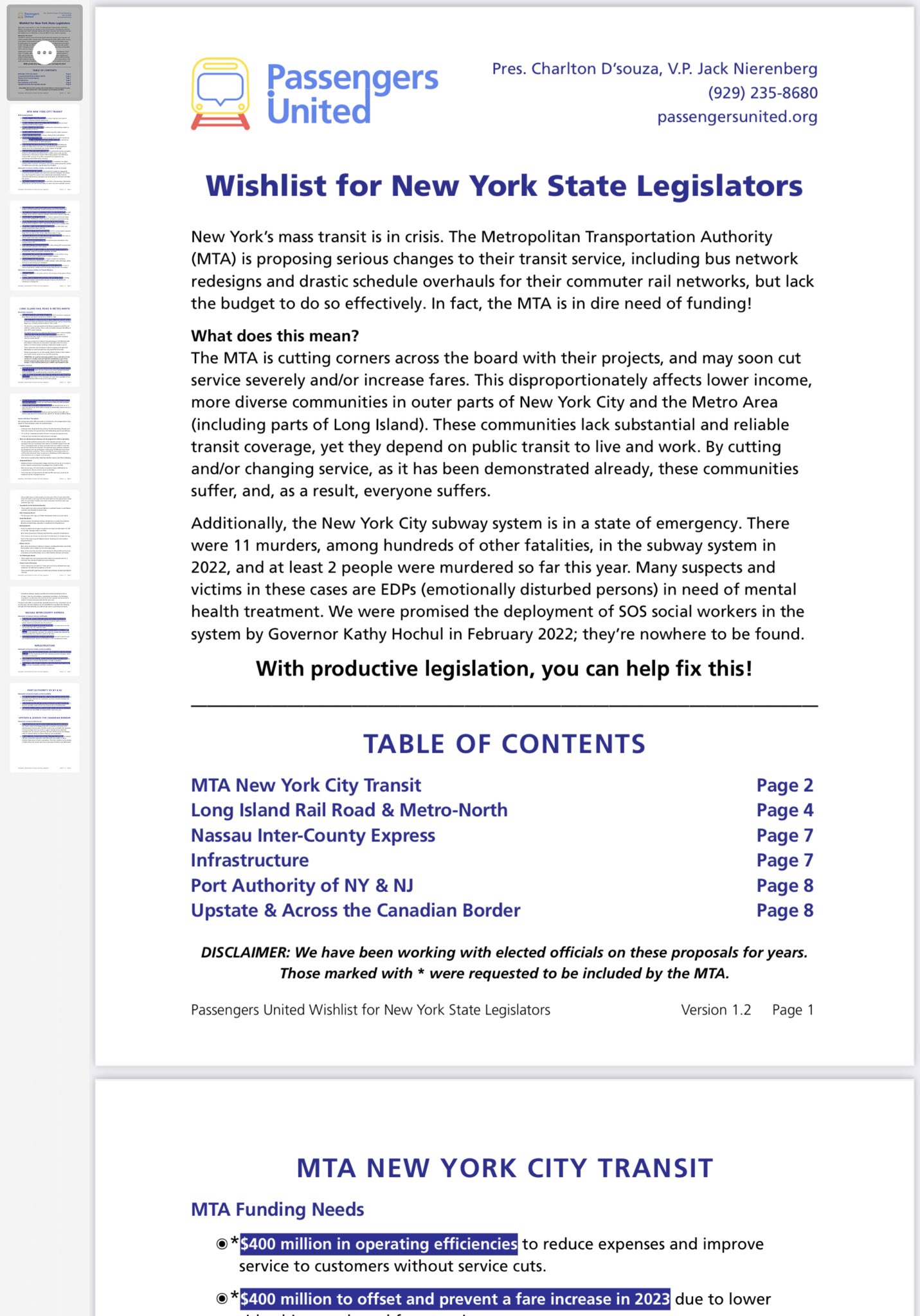
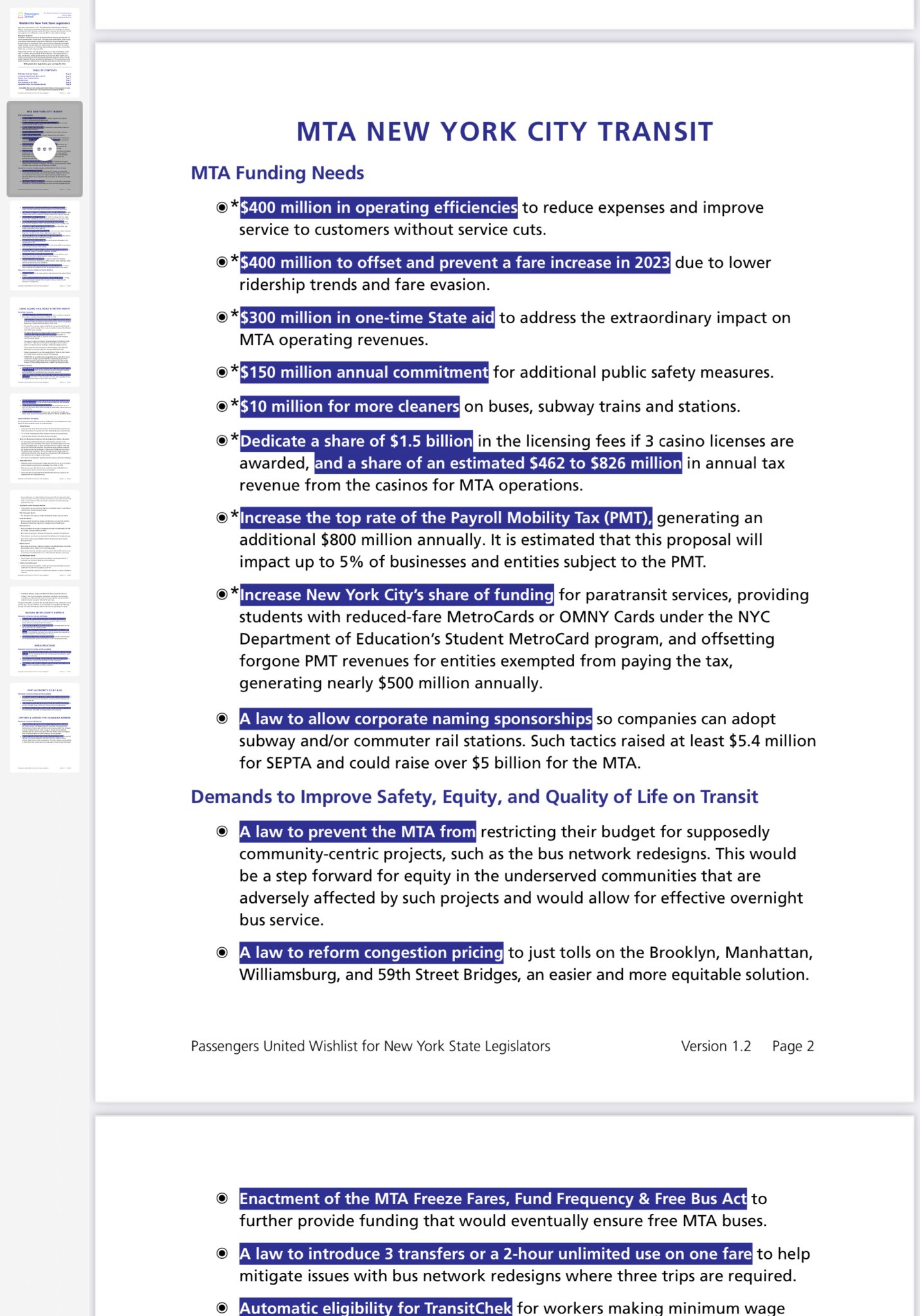
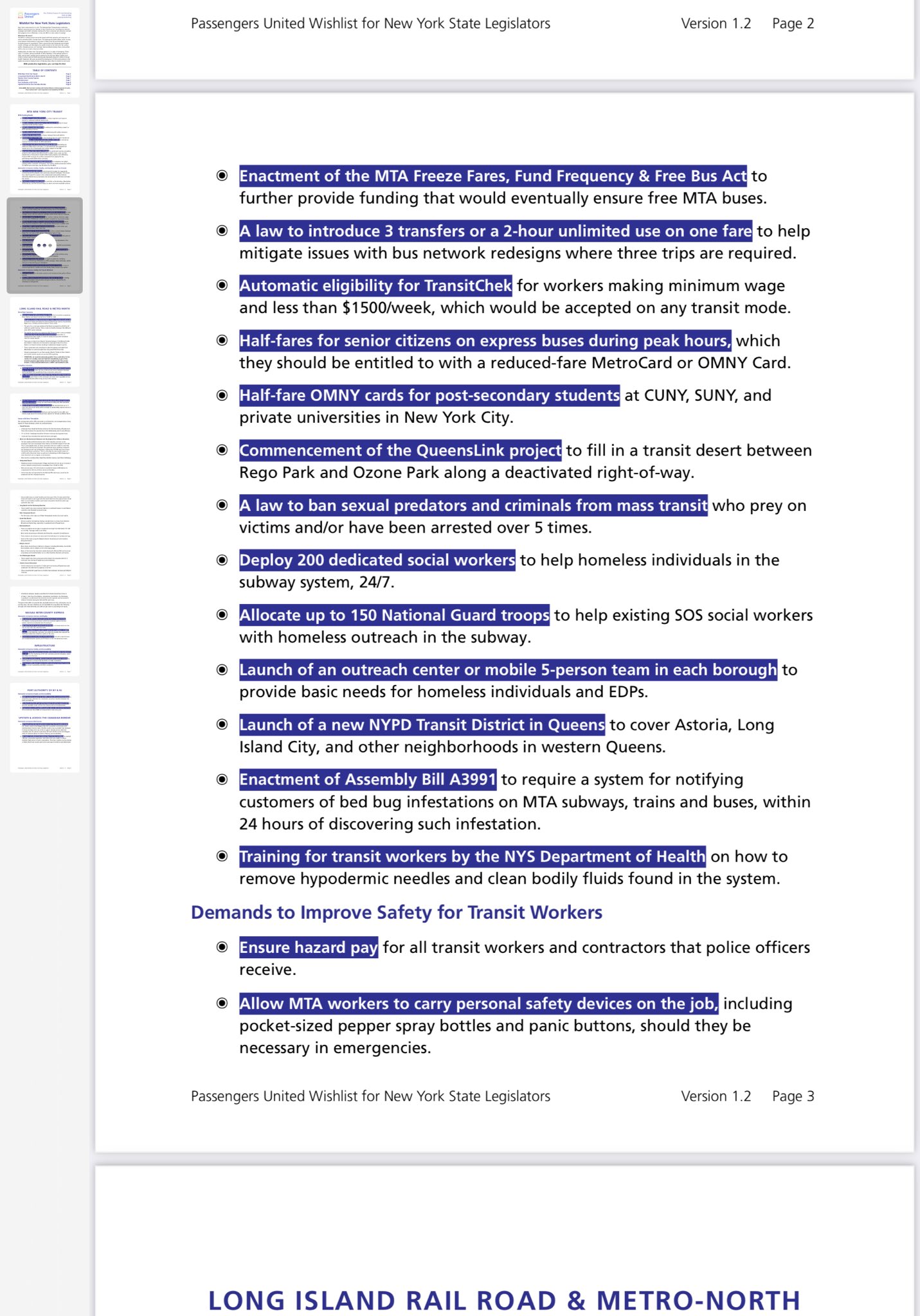
 Jesus Christ these cults are just never going to go away, as a public duty I present the counterpoint plan from Passengers United who actually ride the buses and the trains everyday with their proposal to "fix the MTA" which also includes public safety measures for transit workers, something the Albany fauxgressives and the moneyed transportation actorvates never bother to acknowledge.

 ImageImageImage


Sunday, August 28, 2022

New York Senate shadowban

https://reclaimthenet.org/wp-content/uploads/2022/08/reclaim-2022-08-19-at-16.32.37.png

Reclaim The Net 

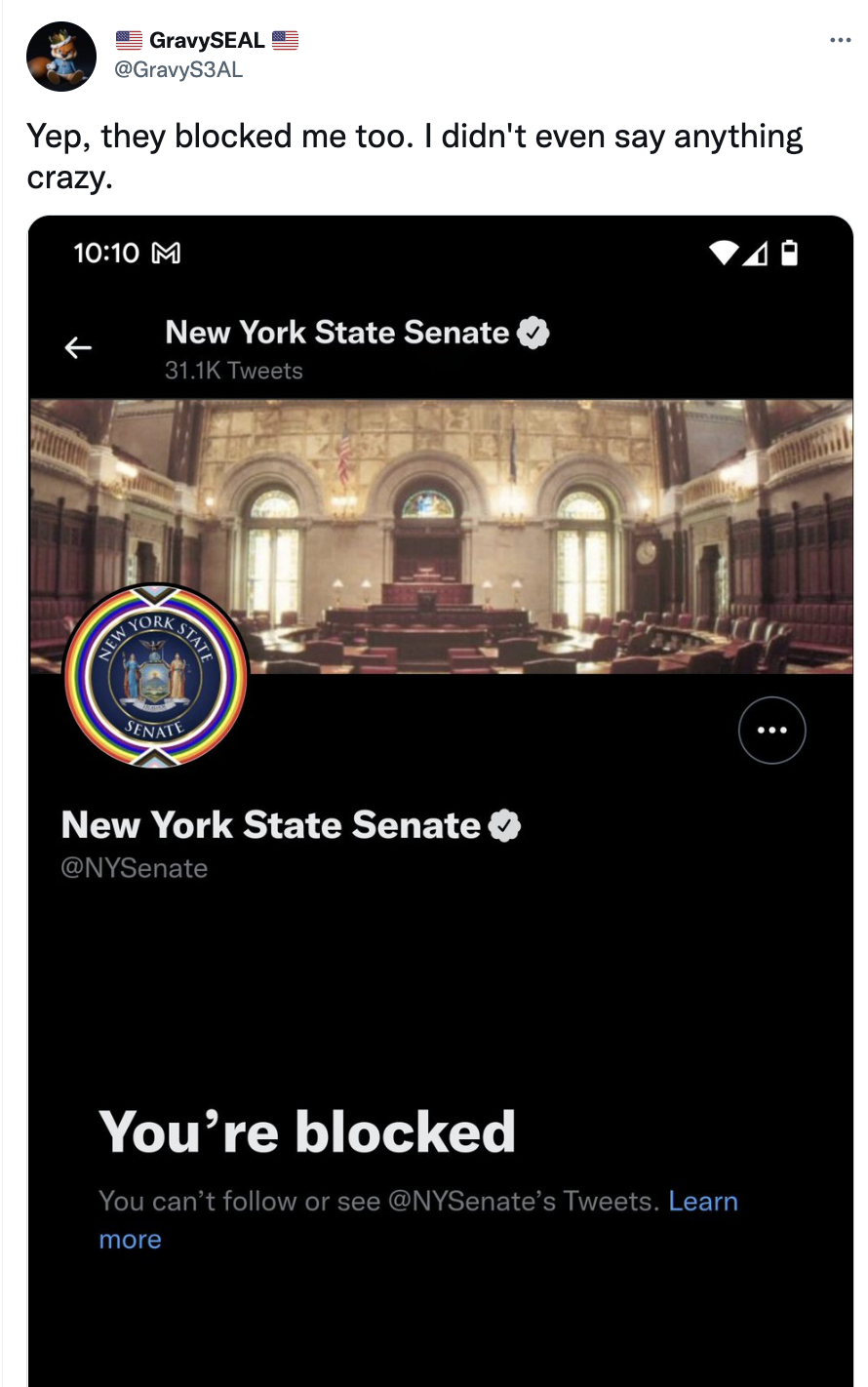
 New Yorkers who criticize the state’s Senate on Twitter have been blocked from commenting and seeing tweets, according to FIRE who is representing a New Yorker who was blocked for criticizing the state’s new gun control legislation.

In June, the US Supreme Court struck down a New York State legislation that required people to have a license to carry a concealed firearm outside of their homes. The state’s legislature responded by expediting a new gun control legislation limiting who is allowed to carry firearms among other controls.

New Yorkers upset with the reform took to Twitter to express their frustration. According to FIRE, the state’s Senate Twitter account hid about 90 tweets and blocked multiple users.

Twitter allows accounts to hide replies and block people, which prevents them from commenting and seeing future tweets. The New York State Senate’s account takes advantage of these features to hide criticism of legislators and legislation.

Because the Senate is a government entity, it is going against the First Amendment by blocking users. Several courts have agreed that when a government entity invites public comment on social media, regulating comments and engagement violates the First Amendment. The most notable case was when a court ruled that then-President Donald Trump violated the First Amendment by blocking critics on Twitter.

Wednesday, August 24, 2022

Young upper class socialist wins Senate primary


 Image

Queens Eagle

New York City closed the book on its 2022 primary season when polls closed in State Senate and Congressional races on the ballot Tuesday evening.

There were only four contested races in Queens – two in the State Senate and two Congressional races. 

Early and unofficial results show that Queens’ most hotly contested race – the race to choose a Democratic nominee for its newest State Senate Seat – has followed in the trend that was set by Rep. Alexandria Ocasio-Cortez in 2018 when she upset Queens County Democratic Party Leader Joe Crowley.

In the State Senate District 59 race between Democratic Socialists of America-backed Kristen Gonzalez, former City Councilmember Elizabeth Crowley and Mike Corbett, a former staffer to City Councilmember Costa Constantinides, Gonzalez was on top by around 6,000 votes – holding around 59 percent of the vote – with 91 percent of scanners reported. 

Crowley, who had the backing of the Queens County Democratic Party and whose fundraising numbers far exceeded those of any other candidates in the race, held around 32 percent of the vote. 

There remain around 2,220 absentee ballots from Queens voters in the district left to be counted, according to the Board of Elections, but they won’t do much to help Crowley.  

Crowley conceded to Gonzalez shortly after 10 p.m., marking her fourth consecutive losing election. 

“We put everything into this campaign that we could and sadly tonight have come up short,” Crowley said in a statement. “I can’t thank my supporters, volunteers, and my team enough for their tireless efforts. I congratulated Kristen on her win and wish her all the best.”

Should Gonzalez win in November, a group of voters in Astoria will be represented by DSA-backed officials in every legislature except the U.S. Senate. The rise to power for the DSA in the area that has taken less than five years. Astoria voters helped propel Ocasio-Cortez to office in 2018, elected Assemblymember Zohran Mamdani in 2020 and City Councilmember Tiffany Cabán in 2021. 

“We have this opportunity to set an example for the rest of the city, the rest of the state and the rest of the country,” Gonzalez told the Eagle Tuesday afternoon before the results began to come in. “It’s not only about creating Democratic Socialists at every level of government, but those Democratic Socialists are accountable to the larger community, and for the first time working class people will have a voice at every single level.”

Tuesday, June 7, 2022

Fauxgressives are eating their own

https://queenspost.com/wp-content/uploads/2022/06/kristennomiki.jpg

Brooklyn Post 

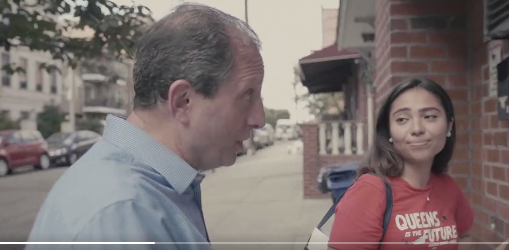
A podcaster and well-known Democratic Socialist from Astoria has thrown the progressive wing of the Democratic party into disarray by announcing she plans to run for the District 59 seat in the state Senate.

Nomiki Konst announced Tuesday on “The Majority Report” talk show—a daily political podcast–that she plans to run for the newly formed District 59 seat that covers Astoria, Long Island City, Williamsburg, Greenpoint and parts of Manhattan.

“I want to announce that I’m running for state senate in District 59—a brand new district that encompasses the community I live in.”

The new district was created mid-May, when a special master drew up the electoral maps for the state senate, after a supreme court judge tossed out the maps drafted by state Democrats on the basis that they were unconstitutional.

Konst joins other candidates such as Elizabeth Crowley and Kristen Gonzalez in the race. However, her announcement has upset many progressives who believe she will cut into the vote for Gonzalez.

Gonzalez, a progressive who lives in Long Island City, has already garnered the support of Rep. Alexandra Ocasio-Cortez, the NYC-DSA, the Working Families Party, Make the Road, New York Communities for Change, Assemblymember Zohran Mamdani, Councilmember Tiffany Cabán and many other left leaning officials and organizations.

Gonzalez announced she was running months ago, when most thought Long Island City was going to be part of Senate District 17—a district that was eliminated by the special master last month. That district would have included Long Island City, Woodside, Ridgewood, Maspeth, Glendale and Greenpoint—although not Astoria.

Konst said she decided to run after the boundaries of District 59 were drawn– which include Astoria.


Monday, May 16, 2022

The Department of Transportation Alternatives figurehead screws up speed camera negotiations

 https://www.nydailynews.com/resizer/2mIc133rMkDjEpvbXYv7LnLXQ14=/1440x0/filters:format(jpg):quality(70)/cloudfront-us-east-1.images.arcpublishing.com/tronc/HANVEZFORNBMZEW55DIHIHXMQU.JPG

 NY Daily News 

An off-the-rails trip to Albany last week by city Transportation Commissioner Ydanis Rodriguez put at risk the city’s push to run red light and speed cameras around the clock, according to DOT sources and lawmakers with knowledge of his meetings upstate.

Before the May 3 trip to the state capital, Rodriguez and DOT staffers had prepared to brief lawmakers on legislation to permit the city’s speed and red light cameras to issue tickets beyond the 6 a.m. to 10 p.m. window currently authorized by state law.

But Rodriguez went off script, DOT sources said, by pressing for even more speed and red light cameras across the city — a proposal that was previously floated by Transportation Department staffers and shot down by lawmakers.

“They prepped for extending the current cameras, not brand new ones,” said a source, who described Rodriguez’s trip to Albany as a “total f--- up.”

DOT staffers had already asked lawmakers for “home rule” for the city’s traffic camera program, which would allow the city to put as many eyes in the sky as they want without state approval.

Mayor Adams and Rodriguez have for months called for the provision, but legislators have made clear they don’t buy into the idea. It’s no secret that home rule for cameras was off the table weeks before Rodriguez’s visit, said a City Council official who asked not to be named.

But, to the surprise of lawmakers and his staffers, Rodriguez during his trip pushed for home rule for the camera program anyway, sources said.

Ydanis didn't go off script, he's doing what Danny Harris and his Transportation Scientology cult is telling him to say and do.

Saturday, April 23, 2022

Steal your face

State Sen. James Skoufis

 NY Post

This could put a real dent in the fake ID market.

The New York State Senate is moving forward with proposed legislation that would allow bars and restaurants to use facial recognition or fingerprint scanners to verify someone’s age before they buy alcohol, tobacco or electronic cigarettes.

“This is the new frontier of age verification,” said state Sen. James Skoufis, who is sponsoring the biometrics bill. “It does advance the interests of convenience.”

Skoufis envisions that bars and restaurants could scan fingerprints, faces or retinas of customers who want to be spared the trouble of showing an ID when they return to an establishment in the future. The proposed legislation requires all data to be encrypted and prohibits businesses from selling biometric data to third parties.

“No one’s forced into engaging with this technology, but they would have the choice,” Skoufis said. “There’s no big brother involved.”

Skoufis, who chairs the Investigation and Government Operations Committee, said he expects his committee will advance the proposal to the full Senate Monday. There is currently no sponsor in the Assembly though Skoufis said several members have expressed interest.

State lawmakers are scheduled to adjourn for the year on June 2.

Washington state approved a similar proposal in 2018, which allows spectators at professional sporting events to pass security and buy concessions with their fingerprints.

The legislative language states that the State Liquor Authority and the state Department of Health would be responsible for crafting regulations controlling the recording and maintenance of biometric data, which the bill states must be “stored in a centralized, highly secured, encrypted biometric database.”

Expanding the use of biometrics means privacy risks for New Yorkers, according to Albert Fox Cahn, a visiting fellow at Yale Law School and executive director of the Surveillance Technology Oversight Project. And unlike a credit card number or driver’s license, biometrics canno ever be changed, he added.

“This is a horrifying invitation for identity theft,” he said. “If one bar or restaurant gets hacked, our identities are compromised for the rest of our lives … more biometric data, potentially expands the power of government agencies to track us because this data is just going to be one court order away from being turned into a policing tool.”


Sunday, April 10, 2022

What's in the Biggest Ugliest Big Ugly in state history

 https://www.nydailynews.com/resizer/W-aymtHqJLvegNIh35jKGlM6zZ0=/800x533/top/cloudfront-us-east-1.images.arcpublishing.com/tronc/632EHHGBRRH53MPT5ED7ZWQOUY.jpg

NY Daily News 

While New York’s $220 billion budget was more than a few days late, no one can say it was a dollar short.

Bolstered by federal COVID funds and higher-than-anticipated tax revenues, the Democratic-led Legislature finally approved a sweeping, week-late spending plan Saturday. The budget language includes funds for boosting child care and wages for health care workers, temporarily suspending part of the state’s gas tax, and overhauling bail laws.

A marathon voting session concluded early Saturday in the State Capitol following two weeks of secretive, closed-door conversations centered around Gov. Hochul’s 11th-hour public safety proposals and a half-billion-dollar handout to the Buffalo Bills for a new stadium.

The final budget, which Hochul signed Saturday afternoon, included some of the governor’s desired changes to bail and gun laws and other policy items like allowing restaurants to resume the popular pandemic practice of selling to-go cocktails.

It also accelerates tax cuts for middle-class families and includes a property tax break for homeowners and a temporary, partial suspension of the state’s gasoline tax.

The state will cut taxes on gasoline and diesel fuel by 16 cents a gallon from June 1 through the end of the year in response to soaring prices at the pump.

Homeowners can expect a little relief as the state will spend about $2.2 billion in one-time property tax rebates for low- and middle-income property owners.

New York is also set to decrease tax rates for middle families by $162 million by April 2023, instead of waiting until 2025 to fully phase in the long-planned tax cuts.

“We have a once-in-a-generation opportunity to not just bring relief to families and put more money in people’s pockets today, but also to make historic investments in New Yorkers for years ahead,” Hochul said in a statement. “With this budget, we are seizing that opportunity and ushering in a new era of a stronger, safer, more prosperous New York State.”

The budget also includes billions in pandemic recovery funds that will add $800 million to the state’s depleted COVID rental assistance program, $250 million in utility arrear assistance and $125 million in homeowner and landlord assistance.

Another $1.2 billion will help fund bonuses for frontline healthcare workers and $3.9 billion in funding to aid hospitals struggling in the wake of the pandemic. Another $7.7 billion will be spent over four years to increase the home care worker minimum wage by $3.

The final tally came in $4 billion over Hochul’s initial budget proposal and includes $7 billion to be spent over the next four years to expand childcare access across the state, a priority for lawmakers in both chambers.

 The Assembly Majority has always believed in putting families first because we know that the success of our state depends on the wellbeing of our families,” said Assembly Speaker Carl Heastie (D-Bronx). “The COVID-19 pandemic has intensified the childcare crisis and forced too many New Yorkers out of the workforce entirely.”

Hochul didn’t walk away from the negotiations empty-handed as lawmakers gave the green light to $600 million in state money for a new stadium for the Bills and legislative leaders acquiesced and allowed some changes to the state’s bail laws.


Saturday, March 19, 2022

Senate and Assembly vote for accountability infrastructure for shady state deals


 Gotham Gazette

In their separate one-house budget resolutions passed this week both houses of the State Legislature included a "database of deals," a public register of state business subsidies that would shed light on billions of dollars in government incentives to corporations.

The legislation, which has been around for years but not passed, would require the state to publish a searchable database of state subsidies for economic development projects that would document the corporate recipient, the state benefits received, and number of jobs committed to and created.

Supporters of the proposal including legislators and transparency advocates say the tool would allow the government and the public to evaluate the efficacy of roughly $5 billion in annual business and economic development incentives and could make it possible to track the total flow of state money to businesses across the state.

Passage in State Senate and Assembly budget resolutions does little more than show significant legislative support for the proposal. In order to become law, it would have to survive final state budget negotiations, which are now unfolding among Governor Kathy Hochul and legislative leaders ahead of the April 1 start of the next state fiscal year. Alternatively, the bill could be passed at any time by the two houses of the Legislature.

Hochul has not taken a public position on a database of deals nor did she put it in her $216 billion executive budget or State of the State policy agenda, both released in January.

Calls for a database of state economic development deals and subsidies have grown over the years amid related corruption scandals, high-profile failures, evidence of pay-to-play politics, and general questions about the necessity and effectiveness of such tax breaks and other incentives favored by former Governor Andrew Cuomo.

"The public wants to know how their dollars are being spent and we think this database of deals legislation will go a long way to ensure that we can capture exactly what is happening, especially in economic development projects," said State Senator Leroy Comrie, a Queens Democrat who has sponsored the bill.

The legislation will "help the public see which businesses are getting state subsidies, how much they are receiving, and whether those subsidies are creating jobs, as intended," said Assembly sponsor Monica Wallace, in an email statement urging lawmakers to back its inclusion in the final enacted budget.

Economic development subsidies can take many forms, from government grants and loans to tax benefits to utility assistance. They can be administered through a range of state agencies where reporting on them is decentralized and often incomplete. One of the largest, the New York State Film Tax Credit Program, gives $420 million a year in tax breaks to businesses that produce films in New York.

Opaque and unaccountable subsidies have helped prop up billionaires and political insiders. Tech mogul Elon Musk received upwards of $950 million in state incentives to open a spectacularly overvalued solar panel factory in upstate New York that created few jobs before being absorbed by Musk's company Tesla. Another economic development project, the billion-dollar nanotech initiative spearheaded by Cuomo as part of “the Buffalo Billion,” incubated one of the biggest bid-rigging scandals in recent state history and ended with close Cuomo allies going to jail.

Like her predecessor, Hochul has continued to tout state incentives for major economic development projects, like the "Finger Lakes Forward" initiative that includes a $500 million state investment promised to “incentivize private business to invest well over $2.5 billion” to revitalize the region and create “up to 8,200 new jobs.”

As part of that effort, on Wednesday Hochul announced that a French yogurt and desserts company, La Fermière, “will establish its U.S. production operations in New York State” and committed to constructing a large new production facility in Batavia. The company, the governor’s office said in a press release, “expects to create up to 135 new jobs in the region.” The press release did not say what types of incentives the company was getting from the state.

Monday, February 14, 2022

Mayor Adams fires 1,430 non-compliant workers, doesn't do shit about bail reform

https://nypost.com/wp-content/uploads/sites/2/2022/02/city-works-protest-559.jpg?quality=90&strip=all

 NY Post

Mayor Eric Adams fired more than 1,400 government workers who refused to get vaccinated, the city revealed on Monday — including 36 NYPD personnel, 25 Fire Department workers and 914 Department of Education staffers.

The number had dropped considerably by last Friday’s vaccine mandate deadline as more employees submitted proof of getting at least one shot, City Hall officials said.

At one point last week, officials estimated that 4,000 were on the chopping block.

The number then dropped to around 3,400 — and then to 1,430 firings, officials said.

In one category, there were 2,400 veteran employees on leave without pay who had not opted to extend their health insurance and had not provided proof of vaccination. In the end, 1,428 of those city workers failed to get shots and were fired.

Nearly 1,000 — or 40 percent — provided evidence of getting at least one shot at the 11th hour and returned to work, officials said.

NY Post 

Mayor Adams appeared to throw in the towel on trying to convince Assembly Democrats to roll back the state’s bail-reform law following a closed-door meeting in Albany on Monday.

In remarks to reporters, Adams said he “shared” his plan to fight crime in the Big Apple before adding, “If I am not getting the things I laid out … I still have an obligation to keep the city safe.”

“That’s why we’re putting in place our anti-gun unit. That’s why we’re going to go after the causes and feeders of crime,” said Adams (above left with Senate Majority Leader Andrea Stewart-Cousins and Assembly Speaker Carl Heastie).

Before the meeting, Assemblywoman Latrice Walker (D-Brooklyn) — who last week clashed with Adams over his desire to let judges lock up defendants they deem dangerous — said that “we are gonna hold the line” on criminal justice reforms enacted in 2019. 

Municipal workers hold the line and have their livelihoods taken from them, lawmaker holds the line and Adams loses his spine. Looks like the mayor is swagger selective.


Saturday, May 8, 2021

NY Senate bill is a firestarter


 QNS

Two key figures in the western Queens NYCHA community have joined a coalition of leading business organizations and consumer product safety advocates who are warning that a proposed ban on flame retardants in New York state could increase fire-induced deaths, injury and property damage and further ravage an already struggling economy.

The ban would prohibit the sale of a broad range of products for use in residential settings that contain some of the most commonly used fire retardants, products that provide an important layer of protection by helping to stop or delay the onset and spread of fires, providing additional life-saving time to escape a fire, according to the American Chemistry Council.

“The threat of fires is something we live with every day as public housing residents,” Astoria Houses Tenant Association President Claudia Coger said. “It is deeply troubling that lawmakers would consider taking action that could make it easier for fires to spread and even more difficult for residents to escape in a life-or-death situation.”

If enacted, the ban would impact a broad range of fire retardant substances found in everyday household items — including computers, televisions, mobile phones, video game consoles, children’s toys, electronics used for infants, exercise equipment such as stationary bikes and treadmills, couches and mattresses — which would become fuel for fires across the five boroughs. Research has demonstrated that fire death rates are higher in states with larger percentages of people who are African-American, lower-income and smokers, and have less formal education.

Fire safety is also a critical issue for senior citizens. Older adults continue to experience a disproportionate share of fire deaths. Although adults aged 65 and over are only 16 percent of the U.S. population, National Fire Protection Association (NFPA) data shows that individuals 65 and over make up 33 percent of fire deaths. According to U.S. Census Bureau projections, by 2060, the number of individuals ages 65 or older is expected to be 95 million — nearly double the amount in 2017. Of the 114 civilian home fire fatalities in New York in 2020, 43 were older adults.

Wednesday, April 7, 2021

Scandal scarred Governor Cuomo finalizes state budget with more taxes for the wealthy, rent and mortgage relief,financial aid for undocumented immigrant workers and also ends immunity for nursing homes

A New York State budget bill in the Senate Chamber. 

THE CITY

State lawmakers and Gov. Andrew Cuomo reached a deal on the state’s $212 billion budget Tuesday, agreeing to tax increases on wealthy New Yorkers and to create a fund for undocumented workers shut out of financial assistance during the pandemic.

Buoyed by a $12.6 billion infusion from the stimulus package Congress passed in March, the budget is New York’s largest financial plan to date. New York’s second pandemic budget arrived nearly a week past the April 1 start of the state’s fiscal year, after an embattled Cuomo and Democratic lawmakers disagreed on a multitude of issues.

Among the most contentious: billions in aid for workers excluded from unemployment benefits and federal pandemic stimulus payments, billions more for financially distressed renters and homeowners, and another $1 billion-plus to jumpstart Cuomo’s Penn Station overhaul.

Bills detailing the intricacies of the proposals were introduced Tuesday evening.

“Thanks to the state’s strong fiscal management and relentless pursuit to secure the federal support that the pandemic demanded, we not only balanced our budget, we are also making historic investments to reimagine, rebuild and renew New York in the aftermath of the worst health and economic crisis in a century,” Cuomo said in a joint statement with Assembly Speaker Carl Heastie and Senate Majority Leader Andrea Stewart-Cousins.

The massive spending plan will also raise taxes on the state’s million-dollar-plus earners — spurring concerns from fiscal watchdogs who say it risks driving high-earning taxpayers to leave New York. And the deal will legalize online sports betting, adding a projected $99 million in revenue this fiscal year and up to $500 million annually in years to come, lawmakers estimate.

Spending highlights outlined by Cuomo, Stewart-Cousins and Heastie include:

  • $2.1 billion for the so-called Excluded Workers Fund
  • $2.4 billion in assistance to renters
  • $600 million in aid to homeowners
  • $1.3 billion for the Empire Station project at Penn Station
  • $29.5 billion in schools spending — a $3 billion increase

    Governor Cuomo repealed a controversial law that shielded nursing homes and other essential businesses from coronavirus related lawsuits Tuesday night. The measure rolled back the “Emergency or Disaster Treatment Protection Act,” which granted health care facilities and workers liability immunity from negligence suits, and comes as Cuomo’s administration is under federal investigation for covering up some 9,000 COVID-19 related nursing home deaths last year. The scandal — exclusively revealed by The Post — weakened Cuomo politically and led to calls for him to resign as sexual harassment accusations against him swirled in the wake of the report. “As we near the passage of this year’s momentous budget, I am relieved to see corporate immunity, which was slipped into last year’s budget, fully repealed,” Bronx State Senator Alessandra Biaggi, one of the bill’s sponsor said in a statement Tuesday night. “This blanket immunity prevented thousands of families who lost loved ones to COVID-19 from seeking legal recourse, and potentially incentivized nursing home executives to cut corners — endangering staff and residents.”