Showing posts with label Housing and Urban Development. Show all posts

Tuesday, March 17, 2020

HUD apartment building's LLC landlord is putting elderly tenants at risk of contracting coronavirus


https://www.amny.com/wp-content/uploads/2020/03/Screen-Shot-2020-03-17-at-10.23.11-AM-740x317.png

AM New York

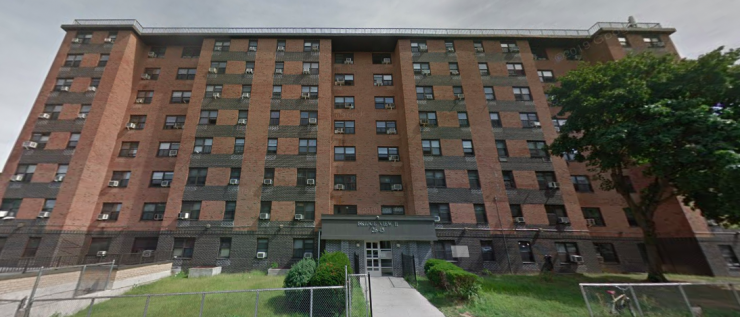
Some residents of Astoria’s Bridgeview II Co Apartments were left without hot water and heat for more than 55 hours over the weekend, one tenant’s son told QNS.

Although the hot water went back on for a few hours on Monday, March 16, it is off again as of Tuesday morning, according to Dannelly Rodriguez, a student at CUNY Law and a community activist who’s mother lives in the building. He said the heat never went back on.

“On Saturday at like 8:30 a.m., there was no hot water or heat, and the day before there was brown water,” Rodriguez said. “This is especially problematic because a lot of the tenants are elders who are most susceptible to COVID-19, so I felt like something needed to be done immediately.”

Rodriguez’s mother, who he says has serious health conditions and receives Section 8, is one of those tenants. When he went to visit her on the eighth floor, he realized the issue and that a number of other people in the building also didn’t have hot water and heat. He then started encouraging neighbors to file complaints with management and call 311.

Bridgeview II Apartments, located at 26-45 9th Street, is a low income, HUD apartment building with 110 units. It is currently managed by Axion Management LLC, according to the Department of Housing Preservation and Development (HPD) website.

Rodriguez, a former tenant of the building, said this is not an “isolated incident.” He recalls filing a lawsuit a few years prior in order to have the building fix his mother’s leaking roof.

“They have had these kinds of incidents in the past, including boiler, heat, mold issues, broken appliances and windows issues,” Rodriguez said. “The building has a host of violations. The culture of this building is that they’re actively negligent and fail to make repairs for the people who live there. Having this boiler issue now is a manifestation of everything that’s happened throughout the years.”

An HPD spokesperson told QNS that inspectors assessed the building on Monday, and found the hot water and heat were “adequate.” They said heat was at 68 degrees (the high yesterday was 45 degrees) and the hot water was 120 degrees, OSHA’s recommended temperature for domestic hot water.

Rodriguez said the hot water was working after complaints were filed, but the heat still wasn’t working as of Monday — for several apartment units, not just his mother’s apartment.

HPD said they will work directly with tenants who need hot water and heat.

Over the weekend, Rodriguez took to Twitter to document what was going on — knowing that he’d get more responses that way.

Wednesday, July 25, 2018

Rats abound at Jamaica site

From the Queens Chronicle:

What once was a private park and playground at the corner of 109th Avenue and 171st Street in Jamaica has long been an overgrown eyesore for nearby residents.

Now it has been designated as a rat-infested danger by the city, which has laid poison in traps around the property and down holes on the lot itself.

“People in the apartment building across the street tell me they don’t want to go outside at night. That’s when they come out,” said Pam Hazel, a neighborhood activist, in one of two telephone interviews with the Chronicle in the last week.

The first treatment was put down on July 7, according to both Hazel and signs posted on the chain link fence around the property by the Department of Mental Heath and Hygiene.

During a visit by the Chronicle in 2013 the property, while already fenced off, had remnants of playground equipment and dilapidated but still recognizable park benches.

A visit last Friday showed the trees to have been cleared out, but that grass, brush and smaller trees have taken over all but the concrete-and-paving stone paths inside.

A handful of residents last Saturday staged a rally outside the property in an effort to draw the attention of the owners and elected officials from the area.


Why did a developer get control of this instead of the Parks Department?

Saturday, May 5, 2018

Development plan for Sunnyside to be crafted this summer

From Crains:

The de Blasio administration and Amtrak will begin crafting a development plan for Sunnyside Yard in Queens this summer, city and Amtrak officials will announce today.

The master planning team will be led by Vishaan Chakrabarti's architecture firm, Practice for Architecture and Urbanism, which was first reported by Crain's in March.

"This is a once-in-a-generation opportunity for civic groups, public officials and residents to create a vision for their borough," Alicia Glen, Housing and Urban Development deputy mayor, said in a statement.

The city has carved out a position within the Economic Development Corp. to oversee the process and announced a steering committee composed of roughly two dozen local and citywide stakeholders to provide input. Last year a city study found that about 80% of the 180-acre yard could be decked over and covered with 24,000 apartments, along with schools, parks and other infrastructure, at a cost of $19 billion. The master planning process is expected to take around two years and will come up with a more specific blueprint of what could be constructed.

Monday, November 20, 2017

BDB knew about the NYCHA mess for quite some time

From the Wall Street Journal:

New York City Mayor Bill de Blasio has known the city’s housing authority wasn’t complying with lead-inspection regulations since last year, his office said Sunday.

In a report issued last week, the city’s Department of Investigation said the New York City Housing Authority submitted false claims to the federal government showing it had conducted lead-paint inspections when the required work hadn’t been done for years.

The mayor was first informed of “the possibility of non-compliance” in March 2016, his office said.

Mr. de Blasio, a Democrat who was re-elected to a second term on Nov. 7, has said “operations executives” were responsible for the lapses.

The housing authority notified City Hall that the agency wasn’t in compliance with local laws in April 2016 and with U.S. Department of Housing and Urban Development rules in July, according to de Blasio spokeswoman Olivia Lapeyrolerie.

“As part of the agency’s response, NYCHA inspected every apartment with kids under 6 where there may have been lead paint in 2016 and will do so again by the end of 2017,” Ms. Lapeyrolerie said.


Meanwhile, all this is costing us taxpayers a ton of cash.

Friday, November 18, 2016

Nationwide homeless population is down - but way up in NYC

From the Daily News:

Despite a record rate of homeless in New York City, homelessness across the country has continued to decline over the past seven years, the U.S. Department of Housing and Urban Development announced Thursday.

There were 549,928 homeless people on a single night in January 2016, a 14% drop since 2010, the year the Obama administration started Opening Doors, a broad plan to combat homelessness.

The data is based on figures reported by approximately 3,000 cities and counties across the country.

But the success has not spread to New York City, where there are an estimated 73,523 homeless people, according to HUD.

That's a 37.9% increase since 2007, records show.

Also Thursday, a new poll showed nearly all New Yorkers think homelessness is a serious problem in the city, and respondents gave Mayor de Blasio lower grades on handling it than any other issue.

In the Quinnipiac University poll, 96% of voters said homelessness was a serious problem — 70% saying it’s “very serious,” and 26% “somewhat serious.”

Saturday, September 24, 2016

Building it Back on the city's dime

From the Wall Street Journal:

Mayor Bill de Blasio’s administration plans to use $500 million in New York City taxpayer money to fund initiatives related to superstorm Sandy that were expected to be fully paid for with federal aid, city officials said Wednesday.

The city’s plan to infuse half a billion dollars into Sandy recovery and storm-protection programs comes as the cost to U.S. taxpayers for repairing and elevating some of the houses damaged by the 2012 storm could hit about $1 million a home, according to documents reviewed by The Wall Street Journal.

Tishman Construction submitted a package of bids to the city earlier this month to elevate 53 homes in Queens damaged by the 2012 storm for $50 million, according to documents and a person familiar with the bids. Tishman is overseeing hundreds of properties in the Build It Back program, an initiative dedicated to assisting owners whose homes were damaged by Sandy.

Build It Back has, to date, been bankrolled with federal Sandy relief funds allocated to the city by Congress through the U.S. Department of Housing and Urban Development. The federal government is also funding a number of storm-protection initiatives aimed at protecting the city in the future.

But significant cost overruns in Build It Back appear to be leaving city taxpayers on the hook for some of the storm-protection initiatives. The program is about $500 million over budget.

Saturday, November 21, 2015

Homelessness down nationwide, up in NYC

From the NY Times:

The federal government’s annual homelessness count showed an increase in New Yorkers living on the streets or in shelters, even as the number of homeless people nationwide dipped slightly compared with the previous year.

The results of the count, released on Thursday by the federal Department of Housing and Urban Development, confirmed what many New Yorkers had already recognized, particularly in recent months — that homelessness was rising and that more government action was needed.

New York, with a population of over eight million, has about 14 percent of all homeless people in the United States, or 75,323 people, the count found.

Friday, October 2, 2015

Foreclosure fixed up

From the Times Ledger:

Dozens of Habitat for Humanity and Delta Airlines volunteers, a few carrying small luggage, gathered Wednesday on a rainy day to start work on restoring an abandoned home in Cambria Heights.

The derelict house, infested with termites, fell victim to foreclosure and then became a zombie home until a fire destroyed most of the property. The property was then handled by the U.S. Department of Housing and Urban Development before being acquired by the New York City Housing Authority to become affordable housing.

Future homeowners are required to volunteer in the restoring of their homes. At the Cambria Heights house at 219th St, 53-year old carpenter Richard Thompson was ready to work on his future home.

“I found out about the program when I was looking for a home, but I did not have enough money for a down payment,” said Thompson, who currently lives in Brooklyn.

The program through Habitat for Humanity offers a 30-year fixed mortgage at a 2.0 percent rate with only a 1 percent down payment for a restored home.

Thursday, July 3, 2014

Some eyesore homes belong to NYCHA

From the NY Post:

For 15 years, New York’s low-income Housing Authority has owned a home in St. Albans, Queens. No one lives there. The windows are broken and the grass is overgrown.

The 120th Avenue house was so ignored that, in 2007, a dog-fighting ring moved into it right under the city’s nose. Neighbors are forced to shovel snow, clean up and nail doors shut.

“I’ve lived next door to this monstrosity … and pulled down all the weeds and done so much like it’s mine,” fumed Kathleen Gittens-Baptiste, who has desperately tried to buy the building.

But this isn’t the only home the New York City Housing Authority has left to rot.

In the midst of a housing crisis, NYCHA owns at least 80 homes that it has left to decay, in some cases for decades, The Post has learned
.
The city obtained the homes in the late 1970s from the Department of Housing and Urban Development. After tenants moved or passed away, NYCHA kept the buildings empty.

The Housing Authority now says it plans to dispose of the houses — many of them in Jamaica — because they “represent an inefficient allocation of housing resources,” according to a draft 2015 fiscal year plan filed with HUD.

Saturday, January 4, 2014

"Park advocate" in favor of alienation joining HUD

From Crains:

New York City parks advocate Holly Leicht will join the U.S. Department of Housing and Urban Development as the director for New York and New Jersey. In that post she will be responsible for rolling out continued recovery efforts in response to Superstorm Sandy. Ms. Leicht was appointed to the post by HUD Secretary Shaun Donovan. She is currently executive director of New Yorkers for Parks, a nonprofit advocacy organization, where she will have worked for nearly three years when she leaves Jan. 10.

I can't think of a better place for this hypocrite. Buh-bye!

Saturday, November 23, 2013

Homelessness: Will deBlasio do any better?


From the Huffington Post:

New York City's homeless population rose 13 percent from 2012 to 2013, according to new federal statistics released on Thursday.

The U.S. Department of Housing and Urban Development's one-night study found 64,060 people living in city shelters. New York's uptick comes only second to Los Angeles', where homelessness increased a staggering 27 percent during the same period.

Meanwhile, homelessness at a national level dropped four percent from 633,782 to 610,042. New York was among five states -- including California, Florida, Texas, and Massachusetts-- that accounted for more than half of the country's homeless population.

Prior to the study's publication, the Coalition for the Homeless hosted a panel on Wednesday to discuss the city's unprecedented homelessness rate and outline possibly policy changes mayor-elect Bill de Blasio could enact to help bring the numbers down.

Monday, October 28, 2013

Bill wasn't on top of scammers at HUD

From the NY Post:

Bill de Blasio presided over millions of dollars in wasted taxpayer money when he oversaw the federal government’s public-housing programs in New York and New Jersey, records show.

He served as director of the New York-New Jersey region for the Department of Housing and Urban Development from 1997 to 1999. In that time, HUD’s inspector general reported that the region lost about $23 million to scams perpetrated by public-housing officials, mortgage companies and nonprofits that got grants from HUD.

Other accounts put the loss much higher. In a Dec. 14, 2000, article, The New York Times reported that several people defrauded HUD of $70 million in federally insured loans on more than 250 New York properties from 1998 to 1999.

Susan Gaffney, HUD’s inspector general, described extensive illegal activity by nonprofit groups at the time as “unique to New York.”

New York City — by far HUD’s largest grantee — received $1 billion annually from the agency during de Blasio’s tenure.

Tuesday, February 5, 2013

State plan to buy up storm-ravaged homes


From the NY Times:

Gov. Andrew M. Cuomo is proposing to spend as much as $400 million to purchase homes wrecked by Hurricane Sandy, have them demolished and then preserve the flood-prone land permanently, as undeveloped coastline.

The foundation is all that remains of 45 Kissam Avenue on Staten Island. Many homes were totaled during the storm and work crews have been demolishing what is left.

The purchase program, which still requires approval from federal officials, would be among the most ambitious ever undertaken, not only in scale but also in how Mr. Cuomo would be using the money to begin reshaping coastal land use. Residents living in flood plains with homes that were significantly damaged would be offered the pre-storm value of their houses to relocate; those in even more vulnerable areas would be offered a bonus to sell; and in a small number of highly flood-prone areas, the state would double the bonus if an entire block of homeowners agreed to leave.

The land would never be built on again. Some properties could be turned into dunes, wetlands or other natural buffers that would help protect coastal communities from ferocious storms; other parcels could be combined and turned into public parkland.’

The Federal Emergency Management Agency has financed the purchase of homes in disaster-stricken areas for two decades. Hundreds of property owners in upstate New York decided to pursue buyouts after Tropical Storms Irene and Lee, though no sales have been finalized, according to state emergency management officials.

Mr. Cuomo is proposing a far broader program for homeowners affected by Hurricane Sandy, using money from the federal Department of Housing and Urban Development, an agency Mr. Cuomo once headed.

The buyout program requires approval from the federal housing agency. The governor’s office said federal officials seemed receptive to their proposal, and that Mr. Cuomo hoped the program would be approved and that he could announce details in the next two weeks.

A spokesman for the Hurricane Sandy Rebuilding Task Force, which President Obama created in December, said Sunday that it is too soon to say whether the state will be allowed to proceed.

Tuesday, July 31, 2012

Housing project becomes eyesore


From the Daily News:

Thirteen years ago the New York City Housing Authority got a big pile of taxpayer money to fix up the deteriorating Prospect Plaza houses in Ocean Hill, Brooklyn.

It never happened.

NYCHA moved all 1,500 residents into apartments scattered around the city in 2000 with the promise that they’d all be back in new and improved versions of their familiar locales by 2005.

They hired a developer and planned to spend the $148 million, including money they’d borrow plus a $21 million grant allocated to them by the U.S. Department of Housing and Urban Development.

Today Prospect Plaza is a ghost town, a boarded-up testament to bureaucratic bungling and constantly shifting priorities that illustrates the agency’s inabilty to get the job done, even when it’s handed free money.

Of the $21 million HUD awarded NYCHA in 1999, a stunning $17 million remains unspent, and a project that NYCHA vowed would transform lives has instead become a symbol of incompetence.

Friday, November 12, 2010

Flake's group building affordable senior housing

From the Daily News:

A CONTROVERSIAL developer has been awarded almost $12million to build affordable senior housing in the Rockaways.

The Allen A.M.E. Neighborhood Preservation and Development Corp. expects to break ground on the 66-unit Allen by the Bay this fall. The five-story project, which includes an arts-and-crafts room and a library, is slated to open 12 to 14 months after construction begins, corporation officials said.

"There's just not enough affordable housing available for senior citizens," said the Rev. Floyd Flake, the group's chief executive officer. "What we provide is the ability to live with dignity in the latter years of their lives."

Flake and his development group have come under fire recently.

The former congressman was investigated in a possible ethics flap regarding Aqueduct Entertainment Group's winning bid to run a racino at the Queens race track.

But Flake was cleared - for the most part - in the inspector general's report.

His development group, an arm of the powerful Greater Allen A.M.E. Cathedral of New York, wanted to build the housing in response to the overwhelming need in the borough, he said.

More than 1,000 people are on waiting lists for two of the church's three Queens affordable-housing residences for the elderly, Flake said.

The Far Rockaway facility, at 22-14 and 22-22 Loretta Road, is being funded through a $11.5million New York State Homes and Community Renewal loan.

That money will be paid back through a $10million U.S. Department of Housing and Urban Development grant and various tax credits, said the organization's chief financial officer, Charles Foster.

Wednesday, September 8, 2010

How much of this mess is Cuomo's fault?

From the NY Times:

Mr. Cuomo was housing secretary at a critical moment for the nation, just as its subprime mortgage fever was beginning to spike. It was during his tenure that the banking industry began to embrace predatory loans, and these creations led to a housing bubble that badly damaged America’s banks and nearly toppled its financial system.

An examination of Mr. Cuomo’s tenure atop the agency shows he was quick to warn about Wall Street’s dangerous hunger for predatory subprime loans — generally more expensive mortgages sold to people with poor credit. He counseled caution when many influential players, including the Federal Reserve and Congress, resisted any suggestion that they slow the country’s stampede to home ownership.

He also called attention to a pernicious mortgage-broker incentive payment that drove up interest rates for borrowers — secretly, in many cases — and that helped put many home buyers into loans they later found they could not afford.

And, in an effort to reverse decades of discrimination against blacks and Latinos, Mr. Cuomo pushed the government-sponsored banks, Fannie Mae and Freddie Mac, to buy more home loans taken out by poor and working-class borrowers.

But when presented with chances to throttle back on the exploding subprime market, guard against predatory lending and reel in mortgage brokers and lenders, Mr. Cuomo several times faltered and backed down, interviews and records show.

He did not heed local officials and others who wanted him to make Fannie and Freddie publicly report details about the loans they bought.

And he chose not to impose penalties and other deterrents to ensure that the giant public banks did not promote dangerous lending.

He also reversed himself, under heavy lobbying pressure from mortgage brokers and bankers, on the arcane but costly mortgage-broker payments known as yield spread premiums. These were lucrative bounties that banks paid to brokers who found new clients; the unwitting borrowers paid higher-than-market interest rates as a result.

Yield spread premiums fueled the subprime frenzy, according to official post-mortems on the crisis.

Friday, August 20, 2010

Luxury condos getting FHA help

From NBC:

The federal government may soon come to the rescue of stalled luxury condominiums in Manhattan.

Manhattan luxury condominiums known for posh amenities and high price tags are beginning to apply for Federal Housing Administration backing.

Condominium developers hope to open financing opportunities for their purchasers as well as guarantee a little protection for themselves. Not only will lending institutions be more willing to lend to purchasers with FHA backing, but the FHA will pay the mortgage should a home buyer default.

The FHA loosened the condo rules because of “market conditions,” Lemar Wooley, an agency spokesman told Bloomberg.com

The U.S. Department of Housing and Urban Development relaxed its financing rules in December, allowing the FHA to insure loans on new developments where only 30 percent of the rental units are in contract instead of 50 percent.

“Something has to happen for this product to be marketable,” Jonathan Miller said. “I just find the whole thing ironic that FHA is providing financing for luxury housing.”


Yeah, really. What happened to the free market?

Friday, April 9, 2010

Section 8 program may run out of money

From the NY Times:

Because of a $45 million budget gap, the New York City Housing Authority may have to revoke rental-assistance vouchers from more than 10,000 low-income tenants, a drastic move that could cause families to lose their apartments.

The federal government gave the housing authority less money for the voucher program, known as Section 8, than the authority expected. But the authority made matters worse by continuing to issue new vouchers until December, eight months after the government warned it to stop doing so because the program was likely to run a deficit.

Michael P. Kelly, the authority’s general manager, said that terminating vouchers would be a last resort. The authority has not decided who might lose their vouchers, but if the deficit is not closed, the cuts could begin this summer.

The agency is seeking federal and state funding to avert the voucher cuts. But the state is facing a huge deficit. Sandra Henriquez, an assistant secretary of the Department of Housing and Urban Development, said that HUD would review the housing authority’s books, but she added that “they cannot and should not expect that the federal government will cover the shortfall.”

As an alternative, the housing authority is considering reducing the value of each voucher, meaning that landlords, tenants or both would have to absorb the cost.

Under Section 8, residents typically pay 30 percent of their income toward rent, and the voucher covers the balance. In New York City, about 102,000 families now have vouchers, which are administered by the authority and allow families to live in units where private landlords accept Section 8 benefits. An additional 178,000 or so families live in public housing complexes owned by the authority.

After the authority voided 2,600 outstanding vouchers in December, prompting an outcry from affected families, it urged people to apply for public housing, although the waiting list is years long.

HUD provides money for the Section 8 vouchers and tells housing authorities the maximum number they can use. In May, HUD told the New York City Housing Authority it was in danger of exceeding its allotted number.

Tuesday, December 29, 2009

More than arson involved in Bushwick fire tragedy

From the NY Times:

There was little question that someone set fire to a federally owned walk-up apartment building in Brooklyn early Monday, killing a 17-year-old girl and injuring five others.

The questions that remain are why and who.

Investigators were still trying to determine the motive Monday evening. The building was so heavily damaged that it will have to be torn down, officials said.

The Department of Housing and Urban Development said that the building, which in March was cited by the city for dozens of violations, was among 450 troubled buildings that the agency acquired around 2004. Many required extensive repairs.

But of the 450, the department was unable to refurbish 6, including the Harrison Place building, because of difficulties with tenants, department officials said.

The agency has asked the tenants, who have not paid rent since 2004, to move so the building can be fixed. The department has offered to pay for relocation expenses, but the tenants have declined to move, officials said. Several eviction efforts were rejected in Brooklyn housing court.

Since 2004, the department has received several complaints that drugs were being dealt in the building. And the department’s contractors, including a building supervisor and an architect who was trying to develop repair plans, had been rebuffed repeatedly by tenants who would not allow them to enter their units.

In March, city officials did a “roof to basement” assessment of the building, finding 75 violations, including a dozen that were considered immediately hazardous. Among the violations were several for not having working fire and carbon monoxide detectors in apartments. A spokesman for the Fire Department said Monday evening that it was not known whether there were working fire detectors in the building.