Showing posts with label Coronavirus. Show all posts

Thursday, November 12, 2020

de Blasio's Citywide Administration Services allowed contractors to swindle the city during the start of the pandemic by sending the wrong face masks

 THE CITY 

 Last spring, frontline medical workers scrambled in vain to find proper surgical masks as the coronavirus swept through hospitals across the city.

Doctors, nurses and medical technicians were forced to reuse the same mask over and over — a dangerously ineffective method to stem infection from a virus that’s now taken the lives of more than 24,000 New Yorkers.

City officials jumped into action, signing more than $1 billion in emergency no-bid contracts with seemingly anybody who claimed they could produce high-quality masks and other crucial COVID gear — including ventilators.

Among them: Genuine Parts Company, an Atlanta-based firm that specializes in auto parts. The Department of Citywide Administrative Services (DCAS), which handles most of City Hall’s purchases, had bought parts for city vehicles from Genuine in the past.

An auto parts company from Atlanta?? Why? 

Go on...

According to internal records obtained by THE CITY, DCAS paid $348,000 for what was described by Genuine as 300,000 “non-Latex surgical masks” that were marked as “received” by the city on April 7. That was at the peak of the virus’ spread in New York City, when the seven-day average for daily hospitalizations hit 1,642, compared to this week’s 52.

 But records show that when DCAS’ Bureau of Quality Assurance inspected the delivered goods, workers discovered not surgical masks but “disposable single-use non-surgical mask/dust mask/Not FDA approved.”

The items were nevertheless deemed “accepted due to public necessity.” DCAS paid full price and placed subsequent orders for more masks from the car parts dealer, records show. DCAS then “redirected” the masks — useless in emergency rooms — elsewhere for non-medical use.

The Genuine mask purchase is part of a disturbing pattern uncovered during an investigation by THE CITY of DCAS’ pandemic-spurred emergency buying spree.

During some of the most dire weeks of the crisis, THE CITY found, the agency lost track of key equipment from masks to ventilators — driving an exasperated DCAS official to declare in one early May meeting: “Stop this s—t! Stop this s—t! Fix the problem!”

 And guess who also was involved in this honest incompetence graft? The Blaz's art dealer buddy Contractor Gadget

A similar scenario unfolded with another vendor, Digital Gadgets, an electronics firm whose CEO, Charlie Tebele, along with family members, has been a frequent donor to de Blasio’s various political campaigns.

In late March, DCAS awarded $19 million in no-bid contracts to Digital for high quality N95 masks and lower quality KN95 masks. That included an $8 million contract for what the firm promised would be two million “surgical grade N95s,” according to internal DCAS documents. 

 The company also won a $91 million contract to provide DCAS with ventilators that was later cancelled because, Benson told THE CITY, the agency “decided to order a different ventilator model.”

Digital Gadgets — which previously supplied hoverboards to QVC — did deliver masks. But DCAS records reveal that the agency’s Bureau of Quality Assurance discovered the masks Digital delivered were not “surgical grade N95s” as promised and had not been approved by either the Food and Drug Administration (FDA) or the National Institute for Occupational Safety and Health.

Sunday, August 23, 2020

The new depression manifests itself in Flushing


NY Post

The line stretched a quarter-mile before the sun was barely up Saturday, snaking around corners like bread lines in the 1930s. But the hungry in Queens are today’s New Yorkers, left jobless by the coronavirus.

Until the pandemic struck the city, La Jornada food pantry used to hand out groceries to roughly 1,000 families a week. Now, the number tops 10,000. And volunteers serve lunch every day to 1,000 — many of them kids with growling stomachs. Across the five boroughs, the hungry is in the hundreds of thousands, the Food Bank of New York estimates.


“It reminds me of the picture from the Great Depression where a man in a suit and tie is giving another man in a suit and tie an apple. That’s all he had,” La Jornada’s Pedro Rodriguez told The Post. “We give all we have, but that’s not enough.”
 
Seniors, moms and kids, singles — many immigrants from China and Mexico — wait for hours. They turn out in droves wherever, and whenever, the food pantry’s truck shows up.


“We feel like we are underwater, drowning in a tsunami of people,” Rodriguez, a volunteer who acts as the food pantry’s executive director, told The Post. “This isn’t like a little rain coming down. The numbers are unbelievable.”

Cuomo's Lethal Ill-Logistics


Impunity City

Where does one begin to discuss the current global pandemic induced phenomenon and cult of personality that is the governor of New York, Andrew Cuomo? Since he locked down the state back in mid-March as coronavirus cases grew by thousands and thousands and thousands, Mario’s son had become the chosen one; elder statesman of all things COVID-19 and the default rebuttal warrior against Donald Trump’s consistent, insistently brazen and meta-comical errors of the novel disease and how to fight it. (Bleach and sun anyone?)

Like the spiky red-pockmarked handball looking pathogen, Andrew has become quite the pop culture icon himself with his daily afternoon government issue polo shirt press briefings on the outbreak. It’s become as much national institution as the Price is Right used to be at 12 p.m. every day as snippets of his videos and images have gone viral; thoroughly giving his constituents and viewers across the country and the globe essential information about the contagion’s spread and the status of his state.

His briefings have managed to even produce a spin off show via Fredo’s Chris Cuomo’s prime time “news” hour program on CNN. It’s quite a big ratings grabber despite the huge ass conflict this comes with as his kid brother “interviews” him about his brah governing the response and recovery while gushing about him in dreams and blatantly egging him to run for President.

 About that. Because of all this attention, social media had dubbed and trended Andrew as #PresidentCuomo and corporate news grabbed onto to that to fill their webpages and hyperlinks with blanket speculation and suggestions about the COVID19 superstar to run for the white house too. Not to mention dozens of articles proclaiming how the suddenly hunky Cuomo is the boyfriend of America, but that’s just icky and gross so I’ll end it there.

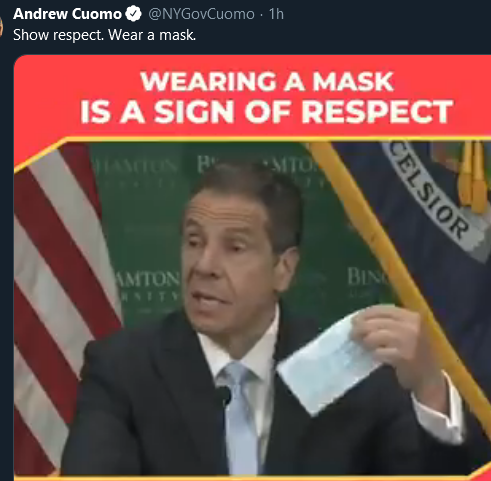
Since this is supposed to be a devastatingly serious column,(note the header photo) but all that shit had to be prefaced to illustrate and elaborate how the goddamn Governor Cuomo does not deserve all these adulation and accolades or should still have a job right now regarding the consequences of his inaction and very suspect actions to stem the spread of the novel virus in his state besides lamely ostracizing people to wear masks.

As the days counted down to the cruelest April of our lifetime and humankind, Cuomo continued his daily briefings as a salve to his constituents and a reassurance to the nation following them as an alternative to Trump’s alternative facts.

Immediately at the start of the month the plague really came in. Yet here was the resilient and virile leader on the dais every afternoon in front of the camera, an exhibition of transparency reading out the morbid death tolls while quite oddly talking about flattening the curves as casualties started to mount. Yet the veneration levied to him by social and news media continued to shower on him…

…until he weaponized that veneration and adulation to shield himself

Monday, August 3, 2020

Skipped tracers


It was only a few weeks into the rollout of New York City’s much-heralded contact-tracing program, a vital initiative in the effort to contain the coronavirus and to reopen the local economy. But in private messaging channels, the newly hired contact tracers were already expressing growing misgivings about their work.

One said the city was “putting out propaganda” about the program’s effectiveness.

Another wrote, “I don’t think this is the type of job we should just ‘wing it,’ and that’s the sense I’ve been getting sometimes.”

A third tracer said, “The lack of communication and organization is crazy.”

The authorities around the world — especially in East Asia and Western Europe — have rapidly enacted contact-tracing programs, which are used to identify and then isolate groups of people who may be infected with the coronavirus.

Mayor Bill de Blasio has declared that the city’s new Test and Trace Corps, which has hired about 3,000 contact tracers, case monitors and others, will make a difference in curbing the virus now that the outbreak that devastated New York in the spring has waned.

But contact-tracing programs have presented an array of challenges to government officials everywhere, including difficulties hiring many workers, privacy issues and faulty technology, like apps. And New York City’s seems to have been especially plagued by problems.

The de Blasio administration acknowledged that the program, which began on June 1, had gotten off to a troubled start, but said that improvements had been made.

“All signs indicate that the program has been effective in helping the city avoid the resurgence we’re seeing in other states,” Avery Cohen, a spokeswoman for the mayor, said.

Still, some contact tracers described the program’s first six weeks as poorly run and disorganized, leaving them frustrated and fearful that their work would not have much of an impact.

They spoke of a confusing training regimen and priorities, and of newly hired supervisors who were unable to provide guidance. They said computer problems had sometimes caused patient records to disappear. And they said their performances were being tracked by call-center-style “adherence scores” that monitor the length of coffee breaks but did not account for how well tracers were building trust with clients.

Some also bristled at what they described as crackdowns on workers talking to one another.

The New York Times developed a portrait of the program through interviews with several current and former workers, as well as through an examination of internal documents. Further information was obtained from screenshots of Slack messaging channels used by tracers, which featured numerous conversations about workplace conditions.

“It reminds me of an Amazon warehouse or something, where we are judged more on call volume or case volume than the quality of conversations,” one newly hired contact tracer, a public health graduate student, said in an interview.

“To me, it seems like they hired all of us just to say we have 3,000 contact tracers so we can start opening up again, and they don’t really care about the program metrics or whether it’s a successful program,” she said.

Most of the current workers interviewed for this article spoke only on the condition of anonymity, saying that they feared losing their jobs if they spoke out publicly.

Tuesday, June 9, 2020

Governor Cuomo: What deaths from coronavirus? I don't know


Gothamist

New York is one of several large states in America that is still not counting probable deaths, even though federal public health officials have been recommending states do so since April.

A review by the Washington Post found that New York was among 24 states, including California, Florida and North Carolina, that have not complied with the guidance issued by the Centers for Disease Control and Prevention.

 The lack of probable deaths is "one reason government officials and public health experts say the virus’s true toll is above the U.S. tally as of Sunday of about 1.9 million coronavirus cases and 109,000 deaths — benchmarks that shape policymaking and public opinion on the pandemic," the Post story says.

According to the CDC, a probable death or case is defined as a person who meets certain clinical or laboratory criteria for the virus but does not have confirmed testing for COVID-19.

At news conferences, Governor Andrew Cuomo has been repeatedly asked why the state is not following CDC guidance in counting probable deaths. When it comes to nursing home fatalities, both New York and New Jersey have included probable deaths at nursing homes, but have not included them in their states’ overall death totals.


 “Probable is different than confirmed,” Cuomo said on May 22nd. “Probable is ‘probable, but I have to check, I don’t know, I have to do further testing.’ We’ve had many cases that were probable coronavirus and turned out not to be coronavirus and that’s why they call them probable.”


Thursday, May 28, 2020

Mayor de Blasio thinks your city can handle a couple more months of economic limbo


Daily Mail

New York City Mayor Bill de Blasio has been blasted as a 'liar' for claiming that struggling small businesses are 'hanging on' and are prepared to stay closed for 'months' yet as he continues to cling on to the city's lockdown despite mounting calls to reopen. 

New York City saw just 63 hospitalizations for suspected COVID-19 cases on Monday, less than a tenth of the number on March 20 when the city went into lockdown, but still de Blasio and Cuomo refuse to say when the city will reopen again. 
In an interview with WNYC radio on Friday, de Blasio claimed: 'I’ve talked to lots and lots of business leaders, especially the smallest businesses. 

'They’re very worried about their futures understandably, but they also are hanging on and they know it can be a matter of months until they’ll be back in action.'  

The remark has been met with outrage by small business owners who say they are barely still surviving. 

Some called his remark 'outrageous' and particularly offensive from someone who owns two homes in Park Slope, an expensive neighborhood in Brooklyn. 

Hundreds of businesses have joined together to form a coalition to reopen the city. 

Some have taken it into their own hands to reopen because they simply cannot afford to stay closed any longer, and they have received summonses from the NYPD. 

Many are now asking why mega retailers like Costco and Walmart have been allowed to stay open throughout the pandemic while smaller stores that are able to enforce social distancing practices more seamlessly have been forced shut.

Bruce Backman, spokesman for Reopen New York, the coalition, told DailyMail.com on Tuesday: 'I think it's a power grab... you have to wonder, how much lobbying are the big box stores doing to keep themselves the only ones in business? 

'When have we ever forced people to go to three stores to buy everything? It's like the Soviet Union.' 


Wednesday, May 27, 2020

Fire through dry grass; Governor Cuomo's directive sent 4,500 coronavirus patients to nursing homes and gave immunity to them stemming from the industriy's donations to his last re-election campaign

 AP

 More than 4,500 recovering coronavirus patients were sent to New York’s already vulnerable nursing homes under a controversial state directive that was ultimately scrapped amid criticisms it was accelerating the nation’s deadliest outbreaks, according to a count by The Associated Press.

AP compiled its own tally to find out how many COVID-19 patients were discharged from hospitals to nursing homes under the March 25 directive after New York’s Health Department declined to release its internal survey conducted two weeks ago. It says it is still verifying data that was incomplete.

Whatever the full number, nursing home administrators, residents’ advocates and relatives say it has added up to a big and indefensible problem for facilities that even Gov. Andrew Cuomo — the main proponent of the policy — called “the optimum feeding ground for this virus.” 

“It was the single dumbest decision anyone could make if they wanted to kill people,” Daniel Arbeeny said of the directive, which prompted him to pull his 88-year-old father out of a Brooklyn nursing home where more than 50 people have died. His father later died of COVID-19 at home.

“This isn’t rocket science,” Arbeeny said. “We knew the most vulnerable -- the elderly and compromised -- are in nursing homes and rehab centers.”

Told of the AP’s tally, the Health Department said late Thursday it “can’t comment on data we haven’t had a chance to review, particularly while we’re still validating our own comprehensive survey of nursing homes admission and re-admission data in the middle of responding to this global pandemic.”

Cuomo, a Democrat, on May 10 reversed the directive, which had been intended to help free up hospital beds for the sickest patients as cases surged. But he continued to defend it this week, saying he didn’t believe it contributed to the more than 5,800 nursing and adult care facility deaths in New York — more than in any other state — and that homes should have spoken up if it was a problem.

“Any nursing home could just say, ‘I can’t handle a COVID person in my facility,’” he said, although the March 25 order didn’t specify how homes could refuse, saying that ”no resident shall be denied re-admission or admission to the (nursing home) solely based” on confirmed or suspected COVID-19.

Over a month later, on April 29, the Health Department clarified that homes should not take any new residents if they were unable to meet their needs, including a checklist of standards for coronavirus care and prevention. 

Remember, Andrew Cuomo named this directive after his mother.

A directive influenced by a profit-driven health and hospice care industrial consortium that gave Cuomo millions to his last re-election campaign:

TMI

As Governor Andrew Cuomo faced a spirited challenge in his bid to win New York’s 2018 Democratic primary, his political apparatus got a last-minute boost: a powerful health care industry group suddenly poured more than $1 million into a Democratic committee backing his campaign. 

Less than two years after that flood of cash from the Greater New York Hospital Association (GNYHA), Cuomo signed legislation last month quietly shielding hospital and nursing-home executives from the threat of lawsuits stemming from the coronavirus outbreak. The provision, inserted into an annual budget bill by Cuomo’s aides, created one of the nation’s most explicit immunity protections for health care industry officials, according to legal experts. 

Critics say Cuomo removed a key deterrent against nursing home and hospital corporations cutting corners in ways that jeopardize lives. As those critics now try to repeal the provision during this final week of Albany’s legislative session, they assert that data prove such immunity is correlating to higher nursing-home death rates during the pandemic — both in New York and in other states enacting similar immunity policies.

New York has become one of the globe’s major pandemic hot spots — and the epicenter of the state’s outbreak has been nursing homes, where more than five thousand New Yorkers have died, according to Associated Press data. 

Those deaths have occurred as Cuomo’s critics say he has taken a hands-off approach to regulating the health care industry interests that helped bankroll his election campaign. In March, Cuomo’s administration issued an order that allowed nursing homes to readmit sick patients without testing them for COVID-19. Amid allegations of undercounted casualties, the governor also pushed back against pressure to have state regulators more stringently record and report death rates in nursing homes. 

And then came Cuomo’s annual budget — which included a little-noticed passage shielding corporate officials who run New York hospitals, nursing homes, and other health care facilities from liability for COVID-related deaths and injuries. 

GNYHA — a lobbying group for hospital systems, including some that own nursing homes — said it “drafted and aggressively advocated for” the immunity provision. The new law declares that top officials at hospital and nursing-home companies “shall have immunity from any liability, civil or criminal, for any harm or damages alleged to have been sustained as a result of an act or omission in the course of arranging for or providing health care services” to address the COVID outbreak. 

Prior to the budget language, Cuomo had already temporarily granted limited legal immunity to doctors and nurses serving on the medical front lines. But the carefully sculpted passage buried in the state’s annual spending bill expanded that by offering extensive immunity to any “health care facility administrator, executive, supervisor, board member, trustee or other person responsible for directing, supervising or managing a health care facility and its personnel or other individual in a comparable role.”

New York is now one of just two states to shield those corporate officials from both civil lawsuits and some forms of criminal prosecution by the government, according to an analysis by Syracuse University law professor Nina Kohn and the University of Houston’s Jessica L. Roberts. 

“New York is an outlier and has the most explicit and sweeping immunity language,” Kohn said.

Tuesday, May 26, 2020

Governor Cuomo diminishes the deaths of 73 people as good news

NY Daily News

Gov. Cuomo said it’s time to “supercharge” the economy as New York emerges from the coronavirus pandemic.


Hours after ringing the opening bell at the New York Stock Exchange Tuesday morning, welcoming traders back to the floor since it closed two months ago, the governor turned his attention to the state’s economic future.


“We want that economy to come roaring back and that’s not going to happen just by wishing it to be so," Cuomo said. “I don’t believe the economy just bounces back. I believe it bounces back, but it bounces back differently."

The governor will travel to Washington Wednesday to meet with President Trump to talk about infrastructure projects and other ways to jump start the economy.

Another 73 New Yorkers died Monday from COVID-19, the governor said.

“Number of lives lost, 73, that’s the lowest it’s been since this all started,” he said. “In this absurd new reality, that is good news."

New confirmed coronavirus cases dropped to just about 200, also at the lowest level since early March.

“Memorial Day is going to be a point where we don’t all run back to the beach, but we’re going to turn the page on COVID-19,” Cuomo said. “And we’re going to start focusing on reopening and how we reopen and how smart we are in reopening."

Fuck the new normal and fuck you governor.

Truly Yours, JQ LLC

New York State and New York City pandemic recovery teams consists of two Big Clubs of Cuomo's and de Blasio's donors

NY Daily News

Gov. Cuomo appointed dozens of generous donors to a board helping advise the state on re-opening and lifting New York coronavirus restrictions, The Daily News found.

Thirty-seven Cuomo donors who’ve collectively given him nearly $1 million were put on the “New York Forward Re-Opening Advisory Board” created last month, according to a News analysis of campaign filings.

Nineteen advisory board members have donated at least $10,000 to Cuomo campaigns and all but two have given $1,000 or more.

The Cuomo donors account for 28% of all advisory board’s 134 members – and 21 have shelled out $427,550 for the governor since January 2017 alone.

Cuomo said in April the board will “help guide” the state’s phased re-opening “and ensure businesses are following the necessary guidelines to preserve public health as we work towards a new normal."


The advisory board includes leaders of unions, trade associations, businesses, education institutions, nonprofits and sports teams, as well as big names in real estate, health care, finance and commerce.

Advisory board members are unpaid but their advice will help Cuomo and the state develop coronavirus policies that could ultimately benefit their industries or the businesses and organizations where they work.

“It is deeply disturbing that Governor Cuomo is exploiting the pandemic to promote his billionaire campaign donors to lead the recovery while ignoring the needs of parents, children and educators," said Jasmine Gripper, executive director of the Alliance for Quality Education. "We need a Governor who will demand New York’s billionaires pay their share so our state can recover from COVID-19 — instead of cutting schools and furthering pay-to-play politics.”

NY Daily News

Some things never change — even during a pandemic.

Mayor de Blasio appointed at least 80 donors to advisory groups that were formed to help shape New York City’s response to the coronavirus pandemic, the Daily News found.

The coronavirus advisers have collectively given Hizzoner at least $176,282 — including $44,320 last year, according to a News analysis of campaign filings. That’s not counting thousands that their relatives gave to de Blasio or any taxpayer funding that the mayor got when certain donations were matched with public financing in city races.

The donors account for nearly a quarter of some 330 people de Blasio appointed to 10 COVID-19 advisory councils and a “fair recovery task force" this month.

While the advisers are unpaid, their guidance will help the city develop coronavirus policies that could benefit the businesses and organizations where they work.

De Blasio has faced multiple investigations into his fund-raising practices, including whether his administration was favorable to donors and others with business before the city. Prosecutors eventually decided against charging de Blasio or his aides — but they still said he intervened on behalf of donors seeking favors from City Hall.

The mayor’s office said advisers have “no decision-making power,” but de Blasio himself has stressed the importance of seeking outside input to bolster the city’s response to coronavirus and other issues.

The councils include industry leaders, head honchos and prominent figures in all aspects of city life: transportation; large business; small business; construction and real estate; education; faith; labor; nonprofit and social services; health, and arts, culture and tourism. While the 10 sector advisory councils will help shepherd the city’s efforts to reopen the economy and lift coronavirus restrictions, the “fair recovery task force” is focused on a broader postpandemic recovery.

“We know that we as a city government, we can take all the best information and come up with the right game plan, but we need to always run it by the people who actually do the work,” de Blasio said last week.


Monday, May 25, 2020

Red Hook field hospital opens too late and goes to waste


https://thenypost.files.wordpress.com/2020/05/virus_outbreak_new_york.jpg?quality=90&strip=all&w=915
NY Post

 A roughly $21 million Brooklyn field hospital authorized by the de Blasio administration at the height of the coronavirus pandemic opened and closed without ever seeing one patient, according to city officials.


The Brooklyn Cruise Terminal in Red Hook was one of several sites across the five boroughs converted into a medical facility as a way to relieve the city’s overburdened hospital system as the COVID-19 crisis mounted.


Mayor Bill de Blasio announced plans on Mar. 31 — a day after the USNS Comfort hospital ship arrived in New York Harbor to aid in the coronavirus fight — for the $20.8 million Red Hook field hospital with an estimated capacity for 750 beds.
 
The field hospital was built by Texas-based construction company SLSCO.

Chalk up another pop-up medical care facility going unused and millions and millions and millions of tax dollars descended into the void.


Saturday, May 23, 2020

Department of the Aging is starving the aging

 https://encrypted-tbn0.gstatic.com/images?q=tbn%3AANd9GcR_JsA1G9ieHxT9DzDKOQyHsO2TQ8gUJD7fRRYFjjEI6vlFiHD2&usqp=CAU

Politico

 Marnee May, 75, was told by the city she’d be getting shipments of weekly meals in late March. She lives in Lower Manhattan and was getting the “grab-and-go” meals from the senior center in her building.

Toward the end of last month, as the coronavirus tore through the city, the center was shuttered. 

Weeks have since gone by and her meals haven’t arrived.

“Why weren’t we set up for this? That’s what I don’t understand,” May said during a phone interview Thursday afternoon. “What happened to the food? And where is that food? Where is it?”
 
The coronavirus pandemic that has seized New York City has created an almost impossible situation for its older residents. With that population particularly vulnerable to the disease and much of the city on lockdown, their families and friends have been officially warned against visiting. That leaves precious few options for elderly New Yorkers to get meals.
 
New York City’s massive effort to deliver food directly to the homes of the elderly, spearheaded by the Department for the Aging, has left many behind, according to interviews with seniors, advocates and government officials. Throughout the city, many of its most vulnerable residents are trapped at home, wondering when their next meal will come.
 
“I could say funeral homes weren’t prepared for this, but Jesus, the city should have been prepared to give people meals,” May told POLITICO.
 

Friday, May 8, 2020

The nursing home with the most deaths from COVID-19 is in Glen Oaks


 https://external-content.duckduckgo.com/iu/?u=https%3A%2F%2Ftse1.mm.bing.net%2Fth%3Fid%3DOIP.xB6slU9aaKR8ajQG82geQgHaFR%26pid%3DApi&f=1

Patch

When Mary Ann Sudlow showed up at Long Island Jewish Medical Center one day in late April, she was dehydrated and her kidneys were failing. She had tested positive for the new coronavirus earlier that day at the rehabilitation center next door, where she was recovering from a hip replacement.

Six weeks before she ended up in a hospital ICU, the 85-year-old was seemingly healthy and living on her own. Then it became painful to walk. She landed in the operating room for surgery to replace her hip, then, on March 30, she moved to the Parker Jewish Institute for Health Care and Rehabilitation to recover.

What Sudlow's family didn't know was that, four days prior, Parker had reported its first confirmed case of COVID-19, the disease caused by the new coronavirus. Sudlow tested positive for the virus just under a month after arriving at Parker.

She was immediately transferred to Long Island Jewish, which is next to Parker but run independently. There, ICU doctors told her family it was only a matter of time. She died three days later.

Interviews with the families of four current or recent Parker residents, including Sudlow, paint a picture of a facility under siege amid the coronavirus pandemic, with too few protective measures, not enough health care workers and little-to-no communication about what's going on inside — claims the facility disputes.

To Sudlow's son, Michael, what happened can be summed up by a text message he got one day from his brother: "The nursing home is who killed mom."

Department of Homeless Services supplies city workers with garbage bags to wear to move homeless people's belongings


 dhs-ppe-04https://thenypost.files.wordpress.com/2020/05/dhs-ppe-04.jpg?quality=90&strip=all&w=915

NY Post
 Department of Homeless Services laborers tasked with helping move the Big Apple’s least fortunate in and out of shelters are wearing trash bags to protect themselves from the coronavirus — as they demand additional protection from city officials.
The members of AFSCME District 37 Local 924 shot the photos as they moved a family from a Bronx shelter and submitted them to DHS officials to support their claims they need protective bodysuits to remain safe during the coronavirus pandemic.
“At the end of the day, you need to protect yourself by any means necessary and you have to put garbage bags around you to do that, you need to do that,” said Local 924 President Kyle Simmons. “If you’re going to do the job, you’ve got to protect yourself — or do the best you can.”
Simmons says his members need protective gowns for their clothing, commonly known as Tyvek suits, to stay safe while working with the homeless and moving their belongings.
The city, he says, has refused to provide them for the laborers while giving them to other employees.

Monday, May 4, 2020

A tale of two Queens towns impacts from the coronavirus


THE CITY 

On paper, Flushing and Corona, two bordering neighborhoods in Queens, are more alike than different.
Separated by two highways and 
Flushing Meadows-Corona Park, the working-class neighborhoods have a large share of foreign-born residents. Corona is predominantly Latino, while Flushing is home to a large Asian community.

Both are high-density areas with similar socioeconomic profiles. They’re linked by the usually crowded No. 7 train.
Nearly half of workers in both neighborhoods are employed in food service, construction, cleaning and transportation — jobs that New York State has deemed essential through the pandemic.

Residents of both places typically have household income below the Queens median and a similar share of people who lack health insurance, as measured by the U.S. Census Bureau. And almost half of apartments and houses in both areas have more than one occupant per room, the Census definition of crowded.

Yet when it comes to COVID-19, the differences between the neighborhoods couldn’t be more stark.

Corona emerged as the early epicenter of the outbreak in New York City and shows no sign of slowing down. Meanwhile, the rate of test-confirmed positive cases of the virus among Flushing residents has remained among the lowest in the five boroughs.

The divergent impact of the virus in two similar neighborhoods suggests that low incomes and poor access to health care alone do not predicate the virus’s damage, public health experts say.

The divide between Corona and Flushing also highlights a striking possibility: that early measures many Flushing residents, workers and businesses took to protect themselves — during crucial weeks while city and state government held back — may have made a difference.

“I was very aware when the virus first started in China,” said a Flushing nurse, originally from China, who spoke with THE CITY on the condition of anonymity.

“I knew we’d be hit hard if America didn’t prepare,” she said.

Saturday, May 2, 2020

Breaking News: Mayor de Blasio suddenly doesn't want to convert hotels into homeless shelters

The Intercept

Mayor Bill de Blasio’s administration is opposing legislation that would allow thousands of at-risk homeless New Yorkers to live in vacant hotel rooms for the duration of the coronavirus crisis, claiming the price tag is too hefty — but according to advocates, legislators, and City Council staff, the program could be paid for using federal government funds.

The 80,000 New Yorkers who sleep in the city’s shelters, streets, and subways are among the most vulnerable to Covid-19, the disease caused by the novel coronavirus. On Wednesday, the mayor announced that the city would move 1,000 people experiencing homelessness into double-occupancy hotel rooms each week going forward, in addition to the 2,500 who had already been given hotel rooms. But homeless individuals and advocates say this isn’t nearly commensurate with the severity or urgency of the crisis.

City Council member Steve Levin has introduced legislation to offer all residents of congregate shelters and all unsheltered single adults — 12,000 people in total — the option to relocate to some of the 100,000 vacant private hotel rooms across the city. On the current course, Levin told The Intercept, it’s “inevitable” that New York’s shelters will see the devastating outbreaks experienced by shelters in other cities. Already, 94 of the city’s roughly 100 congregate shelters, where single adults live as many as 20 to a room and eat in communal areas, have seen at least one positive Covid-19 case.

De Blasio’s administration opposes the bill, testifying at a Council hearing that it would cost the city $495 million over six months. “I don’t see that as a real number,” Levin told The Intercept. The city has not answered the Council’s questions about how it arrived at the estimate but appears not to have factored in the steep drop in the market rate for hotel rooms amid the pandemic. Levin estimates the bill will cost just $108 million, excluding operational and social services costs.

Regardless of the total price, it is likely that the bill can be footed by the Federal Emergency Management Agency, or FEMA, which reimburses costs for approved state disaster response programs. FEMA is currently funding California Gov. Gavin Newsom’s “Project Roomkey,” which will eventually house tens of thousands of people in 15,000 hotel rooms.

Wow, good work there Levin. Although you should include those other costs that way you can expose de Blasio lies better.

Wonder what Maspeth and East New York think of the Mayor's harsh decision.

Monday, April 27, 2020

Queens nursing homes and adult care centers has the most fatalies from COVID-19 of the five boroughs


Queens leads in virus nursing home deaths 2
Queens Chronicle

Considering Queens is the epicenter of the COVID-19 pandemic, it may be no surprise that the borough also leads the way in coronavirus-related deaths within nursing homes.

According to data released by the Department of Health, nearly 24 percent of COVID-19 related deaths in New York State are of seniors living in nursing homes and adult care facilities as of April 22. Of the 3,477 senior citizens who died of coronavirus-related complications in New York State, 760 are from Queens, which accounts for nearly 22 percent of state senior-living facility deaths and 5 percent of all COVID-19 state deaths.

Queens leads by a margin of nearly 6 percentage points, with the Bronx following at 558 senior deaths and Brooklyn at 435.

It is widely known that nursing homes have been ground zero of the attack by the novel coronavirus,” Parker Jewish Institute for Health Care and Rehab of Glen Oaks said in a prepared statement. The facility suffered 44 reported deaths, the second-highest number in the borough following Franklin Center for Rehabilitation and Nursing in Flushing, which reported 45.

As infections and deaths rise in senior care facilities, families of the elderly have grown increasingly worried that they are being left in the dark on the condition of their loved ones. On April 18, 

Assemblymember Ron Kim (D-Flushing) announced that he and his staff “spent countless hours helping a daughter find answers about her mother who has been stuck in a facility with a COVID-19 outbreak” just three days after Gov. Cuomo signed an executive order requiring nursing homes to inform family members of residents of COVID-19 cases.

“I appreciate the governor’s staff working with me and sending inspectors onsite to monitor the status of our nursing homes,” Kim said. “But I’m still unclear if these inspections are designed to find solutions and fix the ongoing outbreak of COVID-19 at our nursing homes or if they are for optics and damage control.”

Saturday, April 25, 2020

Escape from an Elmhurst adult care center


Propublica

As the coronavirus races through nursing homes and assisted living facilities across the country, many desperate family members are finding themselves like Roland, unable to learn the truth about what is happening inside.
 

In story after story, the owners of beleaguered facilities — because of greed, incompetence or fear — have kept the reality of circumstances murky or misleading.

 Many state health departments nationwide are refusing to provide up-to-date, or in some cases any, facility-specific numbers on COVID-19 deaths or infections to the family members of residents, to journalists or even to local politicians. 

And in New York, which has just begun releasing some information, state officials are relying on nursing homes to accurately report deaths and infections.
 

As a result, family members and local officials are turning into detectives and activists, forming alliances to track down clues about what’s happening inside the homes and what, if anything, state health departments are doing about it.

The U.S. Comfort and Jacob Javits triage hospital went to waste


 https://navylive.dodlive.mil/files/2020/03/Comfort2.jpg

NY Post

New York health officials were warned in writing that a Brooklyn nursing home where 55 patients have died of coronavirus was overwhelmed — weeks before it began topping the state’s official list of resident COVID-19 deaths, damning emails show.


Cobble Hill Health Center CEO Donny Tuchman sent a desperate email to state Health Department officials on April 9, asking if there was “a way for us to send our suspected covid patients” to the hospital built inside the Javits Convention Center or the US Naval hospital ship Comfort — the under-utilized federal medical facilities on Manhattan’s West Side.


“We don’t have the ability to cohort right now based on staffing and we really want to protect our other patients,” Tuchman wrote in a chain of the emails reviewed by The Post.
 
He was denied.

I was told those facilities were only for hospitals” to send their overflow patients, Tuchman said.
At the time Tuchman sent his plea, only 134 of the 1,000 beds at the Javits Center were full and the Comfort — which had just been reconfigured to treat up to 500 COVID-19 patients — had a mere 62 on board.

Adding insult to injury, the Navy hospital ship wound up treating just 179 patients before Gov. Cuomo on Tuesday said it was no longer needed.

So I ask again, but to #PresidentCuomo and the New York State Dept. Of Health and not when but why haven't they. Although Javits was available and had plenty of beds.


https://blogger.googleusercontent.com/img/b/R29vZ2xl/AVvXsEjAm-07LG3splEbon0EPw88omcQN1lIuYlpxwUEu70gfELU-JLzx23spvQdU9Mt9aUQJNHIL3hOobIIOkjhfzub2DYyUsFKixSb0hVd5fhyNH5vrJqlyX9gnpK-fPTOwotEqbqHj7jGOrs/s640/Screenshot_2020-04-16+JQ+LLC+Impunity+City+on+Twitter+When+the+fuck+is+the+city+going+to+open+these+other+triaged+hospitals%255B...%255D.png

Update: We should all ask FEMA, the Department of Defense and the President too, looks like Javits went to waste as well.

Gothamist

The federal government is moving forward with plans to shutter the little-used field hospital inside the Javits Center, as the rate of COVID-19 hospitalizations in New York continues to decline. The USNS Comfort, also practically empty, is expected to soon depart as well, President Donald Trump announced earlier this week.

"We are encouraged by the data which suggest the curve is flattening in New York and we are working with the city and state to begin the strategic drawdown of resources," a spokesperson for the Federal Emergency Management Agency told Gothamist on Friday.

The spokesperson said there was no set date for either closure. But according to a FEMA official who spoke with ABC News, the Navy ship will leave New York as soon as April 30th. The Javits Center is slated to close on April 30th, according to the unnamed official.


The two facilities have treated 1,100 patients in total, and never came close to approaching their full capacity. As of Friday, just 32 patients were receiving care aboard the Comfort, which has space for 1,000 people, the FEMA spokesperson said. Of the 2,500 beds inside the Javits Center reserved for COVID-19 patients, only 141 were full.

Hospital workers have previously complained about the strict intake procedures at the two Department of Defense facilities, pointing to a 25-point checklist that excluded many would-be patients from being transferred from overrun hospitals, according to the Post.


Friday, April 24, 2020

Andrew Cuomo's Department of Health sends COVID-19 infected elderly people to nursing homes expecting them to die

https://external-content.duckduckgo.com/iu/?u=https%3A%2F%2Ftse1.mm.bing.net%2Fth%3Fid%3DOIP.Y1InFTbyF4YwxSebkE3-xQHaEm%26pid%3DApi&f=1
NY Post

 The first coronavirus patients admitted to a Queens nursing home under a controversial state mandate arrived along with some grim accessories — a supply of body bags, The Post has learned.

An executive at the facility — which was previously free of the deadly disease — said the bags were in the shipment of personal protective equipment received the same day the home was forced to begin treating two people discharged from hospitals with COVID-19.

“My colleague noticed that one of the boxes was extremely heavy. Curious as to what could possibly be making that particular box so much heavier than the rest, he opened it,” the exec told The Post Thursday.

“The first two coronavirus patients were accompanied by five body bags.”

Within days, three of the bags were filled with the first of 30 residents who would die there after Gov. Cuomo’s Health Department handed down its March 25 directive that bars nursing homes from refusing to admit “medically stable” coronavirus patients, the exec said.

Like clockwork, the nursing home has received five body bags a week — every week — from city officials.

“Cuomo has blood on his hands. He really does. There’s no way to sugarcoat this,” the health care executive added.

 Why in the world would you be sending coronavirus patients to a nursing home, where the most vulnerable population to this disease resides?”
\
Since March 25, the Queens nursing home has admitted 17 patients from hospitals who tested positive for coronavirus, but in a bitter irony most of them have fared well, the exec said. Those who have died passed away without a test or while awaiting the results from one.

“The rest of the people are dropping like flies — literally like flies — and most of them have been with us for years,” the exec added.

COVID-19 has killed at least 3,540 residents of New York’s nursing homes and adult care facilities as of Wednesday, according to the most recent state Health Department data