The interim borough president of Queens
recommended against approval of a development plan for the Flushing
waterfront in an advisory opinion Friday.
Sharon Lee acknowledged the potential
of the proposed Special Flushing Waterfront District to fulfill
long-held dreams of revitalizing the area—the unrealized goal of at
least five earlier planning efforts.
“Downtown Flushing, however, is not immune to the consequences of
transformative large-scale new development that inadvertently leaves
many behind,” Lee wrote in her recommendation.
“The people living closely to the SFWD will bear the brunt of the
noise, dust, traffic and other construction-related inconveniences as
the proposed project is built, with little chance to afford or secure
some of the new housing that would be built in the new modern waterfront
development.” To make the project acceptable, Lee
specified, developers must commit to paying prevailing wages, hiring
union labor and building more affordable housing, and that the school
system must find a place for new school seats in downtown Flushing.
I don't know how much of an effect an interim office holder can have on a political machine based decision but here's a thought, write in Sharon's name on the ballot for Queens BP.
Along the banks of the Flushing Creek—one of New York’s most vital and most polluted waterways—dozens
of construction cranes loom over the landscape, and half-finished glass
towers cast ominous shadows over the water. During heavy rain storms,
the waterway regularly swells, flooding pathways in Flushing
Meadows-Corona Park, the streets of Willets Point, and even portions of
the Van Wyck Expressway. And after those storms, the city’s overtaxed
sewer system often pours raw sewage into the creek and Flushing Bay,
causing a stench to waft from its brackish waters. Dead fish occasionally float upon its surface.
But this chunk of Queens real estate has been targeted for development
by a consortium of landowners and stakeholders, including a group
called the Flushing Willets Point Corona Local Development Corporation (FWPCLDC) that has long pushed for revamping the waterfront. Last December, the group quietly submitted plans
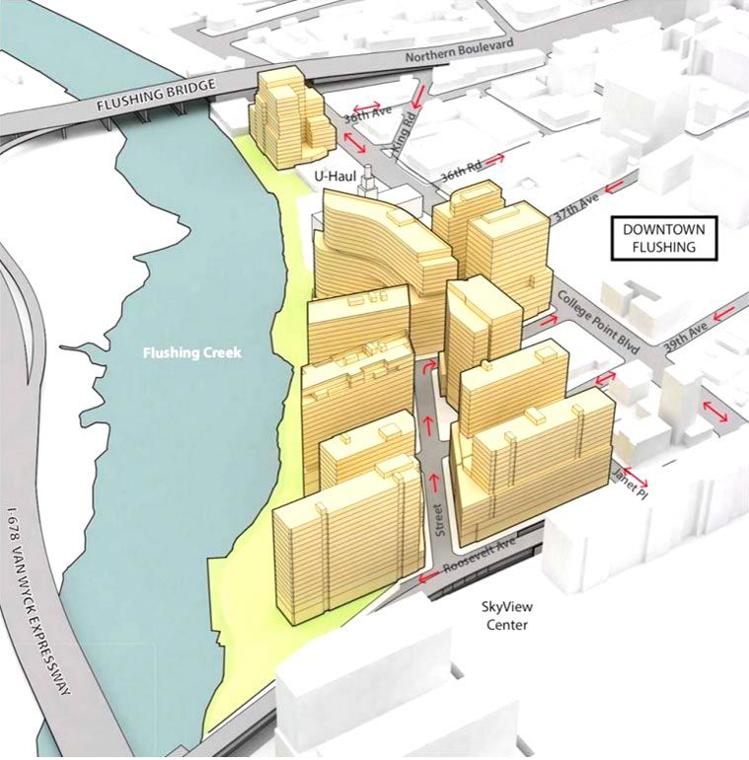
to redevelop a 29-acre stretch of industrial property along the
waterfront, which would include rezoning the northernmost section from
manufacturing to residential use.
The proposal
calls for creating a Special Flushing Waterfront District, which could
accommodate a huge mixed-use development with more than 1,700
apartments, retail, a hotel, and publicly accessible open space
(including a riverfront promenade that would connect to the recently opened
Skyview Flushing Creek Promenade). Developers also want to integrate a
publicly accessible road network with the existing street grid,
effectively expanding downtown Flushing. The portion of land that would
be rezoned could eventually be home to just under 100 below-market-rate
apartments.
While proponents say the development will benefit the
community, critics are concerned that development will have “immense
impacts” on the fragile condition of the Flushing waterfront.
“Adding
significant residential development could overwhelm the Creek’s
overburdened infrastructure that already releases over one billion
gallons of raw sewage and stormwater runoff into the Creek every year,”
the Guardians of Flushing Bay, a group of environmental activists, said
in a statement. “Though the plan aims to provide critical access to a
virtually inaccessible swath of the waterfront, it is essential that
this project, if enacted, be implemented in a way that would enhance
coastal resiliency, recreation opportunities, ecological stewardship and
equitable access to the waterfront.”
The proposal comes as downtown Flushing experiences a development boom:
Between 2009 and 2019, the neighborhood saw the second-largest number
of condos constructed in New York City after Williamsburg, Brooklyn, according
to Nancy Packes Data Services, a real estate consultancy and database
provider. Over the past five years, rents have climbed by a whopping 21 percent.
Although historically home to a largely working- and middle-class
Chinese immigrant population, many of Flushing’s new developments—such
as the massive The Grand at Skyview Parc, which has two-bedrooms selling for around $1.27 million—cater to a new wave of immigrants with deep pockets.
With Flushing booming, the waterfront remains the last
frontier for developers. But given the size of the proposal from the
FWPCLDC, as well as the fact that the Special Flushing Waterfront
District is situated in a coastal flood hazard area,
critics have argued that an environmental impact study—which is not
required for this particular project—must be conducted before the plan
moves forward.
“They’re adding three million square feet along the
waterfront,” says Tarry Hum, chair of the Queens College Department of
Urban Studies. “Can you imagine the environmental impact?
Update: Community Board 7 approves the rezoning anyway
At a tense Monday night meeting, Community Board 7 voted 30-8 to
approve a development team’s plan to rezone a large section of land by
Flushing Creek. Dozens of protesters showed up to criticize the land-use application
filed by FWRA, a consortium of real estate firms behind the project. The development group wants to rezone a section of the area so it can
construct a 13-tower project with 1,725 residential units and 879 hotel
rooms–along with retail and office space–by the waterfront. The 29-acre property is bound to the north by 36th Avenue, to the
east by College Point Boulevard and to the south by Roosevelt Avenue. FWRA seeks the creation of the Special Flushing Waterfront District
and a rezoning in order to move ahead with the proposed plan.
The standing-room only meeting was heated. Activists grew frustrated
that they were unable to speak until after FWRA presented its lengthy
and time-consuming presentation, which continued on until after 9 p.m. “Let us speak,” some in the crowd pleaded during FWRA’s presentation. CB 7 Chairman Gene Kelty walked into the crowd and tried to hush some
of the unsatisfied people who were waiting for their turn to speak. In a video
of the meeting, one frustrated woman tells Kelty, “Why are you saying
this is a public hearing? This is not a public hearing and you know it.” The footage shows the CB 7 chairman saying, “It is a public hearing,”
uttering a few more words that are drowned out by other noise, and then
appearing to lunge at the woman to steal her phone before being stopped
by police officers and others. “Let us speak! Let us speak!” the group chanted as Kelty walked away.
Special Flushing
Waterfront District protesters returned brandishing “Housing justice for
all” and “The massive waterfront giveaway” signs for the developers’
presentation at Community Board 7’s Land, Buildings and Zoning Committee
hearing Tuesday, Jan. 21.
“You have your
signs and that’s great, it’s no problem. March around with your signs,
but please kindly control the tone,” District Manager Marilyn McAndrews
said at the start of the meeting, begging the protesters not to repeat
their chants of the Jan. 13 public hearing meeting that disrupted the
nursing home the meeting took place in.
“Flushing community members are concerned with
increased congestion, pollution, construction hazards and mass
displacement resulting from new luxury development,” MinKwon Center, the
advocacy group that organized the protest, said in a statement.
The Brownsfield Opportunity Area plan, which
allows for redeveloping the 29-acre stretch of waterfront industrial
property and surrounding land in Downtown Flushing, aims to extend the
district to the waterfront, improve pedestrian flow and vehicular
movement, add affordable housing and improve the water quality of
Flushing Creek. As the meeting progressed, CB 7 members, who hold the
power to make an advisory vote, scheduled for Feb. 10, on the
implementation of the plan, found themselves voicing similar concerns to
the protesters.
“This is a vacant site. Other than U-Haul there
is no activity,” said Ross Moskowitz, the attorney representing the
project owners in response to a question about displacement, “The
increase in this project should not have an impact on the local
businesses ... these are local developers. They are long-established
owners, operators, tenants, residents. They have invested in this
community and will invest in this community.”
Italicized passages and many of the photos come from other websites. The links to these websites are provided within the posts.
Why your neighborhood is full of Queens Crap
"The difference between dishonest and honest graft: for dishonest graft one worked solely for one's own interests, while for honest graft one pursued the interests of one's party, one's state, and one's personal interests all together." - George Washington Plunkitt
The above organizations are recognized by Queens Crap as being beneficial to the city as a whole, by fighting to preserve the history and character of our neighborhoods. They are not connected to this website and the opinions presented here do not necessarily represent the positions of these organizations.
The comments left by posters to this site do not necessarily represent the views of the blogger or webmaster.


:format(webp)/cdn.vox-cdn.com/uploads/chorus_image/image/66284373/shutterstock_1377263150.0.jpg)