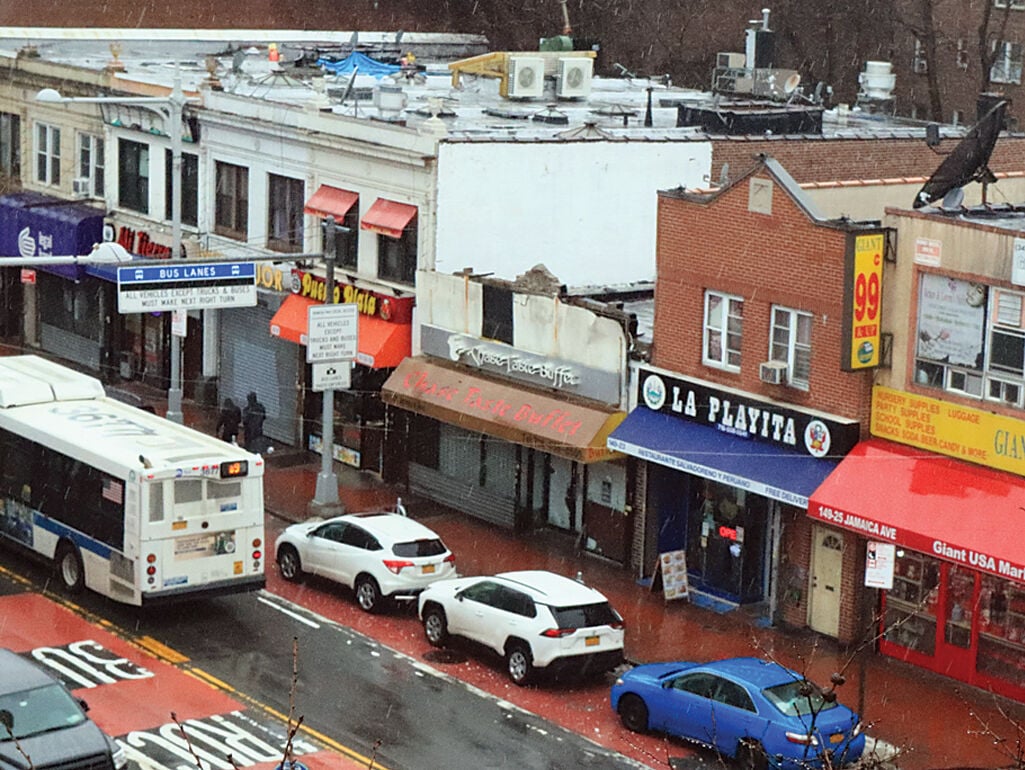
Approximately 90 businesses in Downtown Jamaica are struggling with the recent changes in the area. With new development came trucks and with the implementation of busways in Archer and Jamaica avenues, drivers have fewer parking options and receive more traffic tickets.
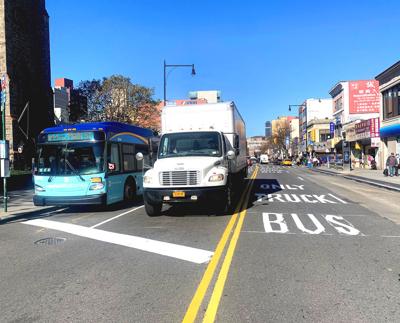
Leran Ruben, the owner of Beverly Hills Furniture at 149-01 Jamaica Ave., said that he had no problem with the development or the busways at first because the new transit lanes would have a loading spot for trucks being used in the area to prevent street traffic and could potentially increase the number of new consumers in the community.
However, he says, city workers — particularly members of the NYPD Forensics Laboratory at 150-14 Jamaica Ave. — have been abusing their placards by parking in the truck loading area, causing more traffic in Downtown Jamaica and driving away customers who were already struggling with getting around the shopping district.
“This space was put in place so that trucks could unload over here and not double-park to cause traffic,” said Ruben, a third-generation storeowner. “We even have placard vehicles in the bus lane.”
When the Queens Chronicle came to visit Beverly Hills Furniture on Feb. 4, there was a parked vehicle with a placard in front of the store at the truck-loading spot and a row of vehicles in the busway in front of King Manor Museum at 150-03 Jamaica Ave.
“Nobody is going to get ticketed,” said Ruben as a police car drove by. “Nobody cares.”
Straphangers getting off the bus also have to disembark into the street instead of at the curb, according to Ruben.
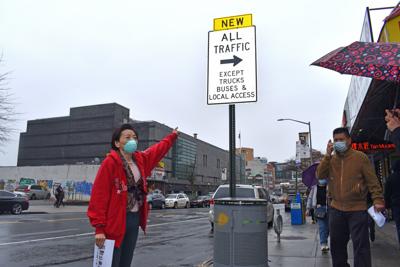
“Why should a passenger on a bus have to load and be unloaded into the street? It’s unsafe,” said Ruben while pointing to a sign that directed traffic off Jamaica Avenue unless it was a bus or truck. “Why are [city workers] getting special privileges?”
What infuriated Ruben the most was that there was an underutilized six-floor parking lot for the forensics team next to the lab on 150th Street as another placard vehicle was parked in the Q54/Q56 bus stop.
“The crime lab is where the green scaffolding is and this is their parking lot,” said Ruben as he walked to the parking lot. “From my understanding, they have reserved spots for employees. If you are doing shifts, working four days and working 40 hours, the rest of the time your spot is empty. Instead of rotating spots they just park here.”
At the parking lot, one level was empty at approximately 11 a.m. while other levels had either a few available spots or were more than 50 percent empty.
After leaving the parking lot, Ruben motioned toward the corner street across from it where anyone could park, but more placard vehicles, which were partially on the sidewalk, occupied the space.
“There is one street where you are allowed to park,” said Ruben. “It’s still all police vehicles. Is this fair? Everyone has a placard and they are here for hours. If you are a customer, how do you get here? If you come here, you are going to circle the block and be here for 20 minutes.”
Ruben believes there wouldn’t have been a need for a 24/7 busway to reduce traffic in the area if the initial problem of double-parking, which exists partially because of city workers with placards, was taken care of with ticketing in the first place.