Saturday, March 19, 2022

Senate and Assembly vote for accountability infrastructure for shady state deals


 Gotham Gazette

In their separate one-house budget resolutions passed this week both houses of the State Legislature included a "database of deals," a public register of state business subsidies that would shed light on billions of dollars in government incentives to corporations.

The legislation, which has been around for years but not passed, would require the state to publish a searchable database of state subsidies for economic development projects that would document the corporate recipient, the state benefits received, and number of jobs committed to and created.

Supporters of the proposal including legislators and transparency advocates say the tool would allow the government and the public to evaluate the efficacy of roughly $5 billion in annual business and economic development incentives and could make it possible to track the total flow of state money to businesses across the state.

Passage in State Senate and Assembly budget resolutions does little more than show significant legislative support for the proposal. In order to become law, it would have to survive final state budget negotiations, which are now unfolding among Governor Kathy Hochul and legislative leaders ahead of the April 1 start of the next state fiscal year. Alternatively, the bill could be passed at any time by the two houses of the Legislature.

Hochul has not taken a public position on a database of deals nor did she put it in her $216 billion executive budget or State of the State policy agenda, both released in January.

Calls for a database of state economic development deals and subsidies have grown over the years amid related corruption scandals, high-profile failures, evidence of pay-to-play politics, and general questions about the necessity and effectiveness of such tax breaks and other incentives favored by former Governor Andrew Cuomo.

"The public wants to know how their dollars are being spent and we think this database of deals legislation will go a long way to ensure that we can capture exactly what is happening, especially in economic development projects," said State Senator Leroy Comrie, a Queens Democrat who has sponsored the bill.

The legislation will "help the public see which businesses are getting state subsidies, how much they are receiving, and whether those subsidies are creating jobs, as intended," said Assembly sponsor Monica Wallace, in an email statement urging lawmakers to back its inclusion in the final enacted budget.

Economic development subsidies can take many forms, from government grants and loans to tax benefits to utility assistance. They can be administered through a range of state agencies where reporting on them is decentralized and often incomplete. One of the largest, the New York State Film Tax Credit Program, gives $420 million a year in tax breaks to businesses that produce films in New York.

Opaque and unaccountable subsidies have helped prop up billionaires and political insiders. Tech mogul Elon Musk received upwards of $950 million in state incentives to open a spectacularly overvalued solar panel factory in upstate New York that created few jobs before being absorbed by Musk's company Tesla. Another economic development project, the billion-dollar nanotech initiative spearheaded by Cuomo as part of “the Buffalo Billion,” incubated one of the biggest bid-rigging scandals in recent state history and ended with close Cuomo allies going to jail.

Like her predecessor, Hochul has continued to tout state incentives for major economic development projects, like the "Finger Lakes Forward" initiative that includes a $500 million state investment promised to “incentivize private business to invest well over $2.5 billion” to revitalize the region and create “up to 8,200 new jobs.”

As part of that effort, on Wednesday Hochul announced that a French yogurt and desserts company, La Fermière, “will establish its U.S. production operations in New York State” and committed to constructing a large new production facility in Batavia. The company, the governor’s office said in a press release, “expects to create up to 135 new jobs in the region.” The press release did not say what types of incentives the company was getting from the state.


Caption former City Council Crony and fauxgressive Stephen Levin

https://pbs.twimg.com/media/FOIndloWYAIYH5C?format=png&name=small

Friday, March 18, 2022

Queens is burning: Merchant building collapses after early morning fire in Flushing

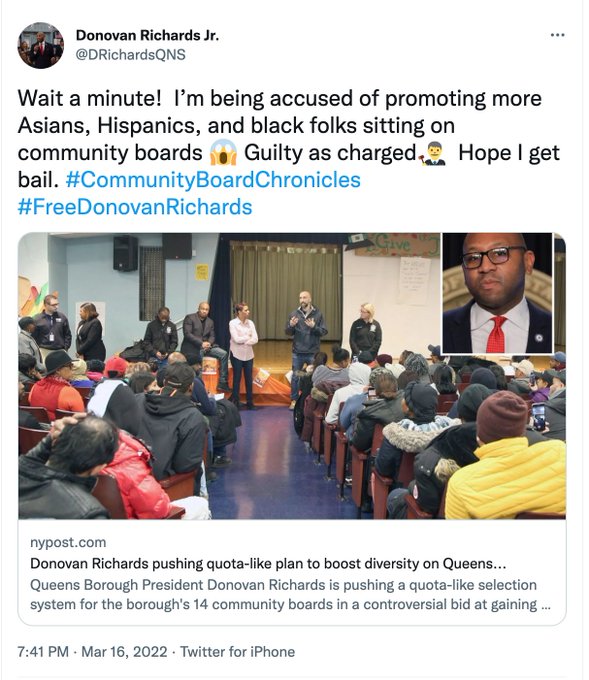
Community board profiling

https://pbs.twimg.com/media/FOAmFXPXEAApKZP?format=jpg&name=small

NY Post 

Queens Borough President Donovan Richards is pushing a quota-like selection system for the borough’s 14 community boards in a controversial bid at gaining more diversity on the panels, which weigh in on virtually all local projects, The Post has learned.

Richards appoints half the members to the advisory boards and local council members the other half. The boards often wield influence on key land use issues as well as on locating bars and restaurants in neighborhoods and sidewalk cafe permits.

A source forwarded to The Post a recent letter that Richards sent to council members recommending new appointments based on his affirmative action plan that takes into account the current composition of the boards with regards to race, age and sexual identity as well as census data.

For Community Board 9 covering Kew Gardens, Richmond Hill, Ozone Park and Woodhaven, for example, Richards said council members appointments should be “between the ages of 16-45, 56-65, of Asian, Black and Latino/x background and female/gender non-conforming.”

The CB 9 district has a large Hispanic population and a growing south Asian and central Asian population. But Latinos, who make up 40 percent of the population, accounted for only 16 percent of the 47 community board members.

Queens Councilman Robert Holden, who makes selections to CB5, blasted the quota-type system.

“We should appoint people who are most committed to their neighborhoods and who are the best candidates. You don’t look at race, ethnicity or age,” said Holden, who served on CB 5 for 30 years before being elected to office.

He expressed concern that racial and ethnic preferences, while well-intended, could lead to accusations of discrimination.

“You don’t want to be charged with racism or ageism,” Holden said.

For CB6, which takes in Forest Hills and Rego Park, Richards recommends selecting new board members who are ages 16 to 35, “of Asian ethnic background based on the latest census data” as well as women.

The neighborhoods have a growing population of Bukharan Jews from central Asian countries, particularly Uzbekistan, as well as Chinese immigrants, who combined make up about a third of the population. But only five board members of Asian descent, or 13 percent, served on the board.

The borough president also recommended younger and Asian and Latino appointees in CB5 that covers Ridgewood, Glendale, Middle Village and Maspeth.

Thursday, March 17, 2022

de Blasio let security contract balloon at hotel shelter for inmates during the pandemic

https://cdn.vox-cdn.com/thumbor/9uHIYe2BSACo7IKpA7sKizPAANA=/0x0:3000x2000/1820x1024/filters:focal(1260x760:1740x1240):format(webp)/cdn.vox-cdn.com/uploads/chorus_image/image/70618144/030222_queens_homeless_hotel_1.0.jpg

THE CITY

In the early months of the COVID pandemic, as the virus spread like wildfire through New York City, the de Blasio administration began placing inmates released from Rikers and state prisons into hotels.

The point was to keep them safe — and to curb the spread of the virus. But did City Hall implement adequate safeguards to protect the released inmates from non-COVID dangers?

One former inmate THE CITY spoke to alleges she was sexually assaulted in August 2020, while staying at a hotel involved in the program, the Wyndham Hotel in Fresh Meadows. She is suing Exodus Transitional Community, the nonprofit group hired by the city to administer hotel placements.

When asked by THE CITY, the Mayor’s Office of Criminal Justice (MOCJ), which oversaw the project, could not definitively identify the firm that provided security at the Wyndham as a subcontractor to Exodus. At times, MOCJ and Exodus pointed to two different firms as the security provider in 2020.

But when reached by THE CITY, executives at these two firms denied that their companies were subcontracted to provide security at the Wyndham. Under law, firms that provide security at city shelters, including hotel placements for inmates, must be properly licensed.

When THE CITY requested documentation that the firm providing security at the hotels had a proper state security guard license, MOCJ provided a license that belongs to one of the firms that denies having anything to do with the ex-inmate placement program.

Records show the no-bid contract signed by the mayor’s office with Exodus to place inmates in hotels grew from $835,000 to $55 million in just 16 months. Under the arrangement with MOCJ, Exodus was not required to report to the city crisis incidents that occurred there, including violent ones like sexual assault.

The Adams administration recently awarded Exodus another $40 million contract for “emergency reentry hotel services” that runs through June under a no-bid process. Adams’ team did not respond to THE CITY’s question about the nature of the ongoing emergency.

Upon her release from Rikers Island in June 2020, Latoya Walker, 32, was placed into a Wyndham Hotel in Fresh Meadows, one of six hotels managed by Exodus as part of the inmate release program.

There, Walker alleges, she was sexually assaulted in her room by an Exodus employee who’d been assigned to her as a caseworker. The man was ultimately arrested on sex abuse and other charges. Although the Queens district attorney later dropped the case due to delays in bringing it to trial, Walker has since filed a civil suit against Exodus that is pending.

Walker claims that from the moment she brought in the police, Exodus resisted cooperating, delaying turning over a surveillance camera tape that she says helps corroborate her accusation.

After a detective in the special victims squad was assigned to investigate, Walker said, “Exodus wouldn’t give her the tape. They wouldn’t give her information on (the caseworker)’s employment,” she told THE CITY. “I felt like Exodus was just sticking together. Every time I brought it up as something that was bothering me, they started giving me the brush off.”

The Department of Homeless Services managed a similar effort to place shelter residents in hotels to stifle the spread of COVID-19. But DHS required all providers to report every “critical incident,” such as assaults, at the hotels where the homeless were placed. The inmate hotel program had no such requirement.

Exodus’ founder, Medina, refused to answer any of THE CITY’s questions, including whether he reported Walker’s allegations to MOCJ. The mayor’s office also declined to say whether they were aware of the incident, other than to say the hotel ex-inmate program had no incident reporting requirements.